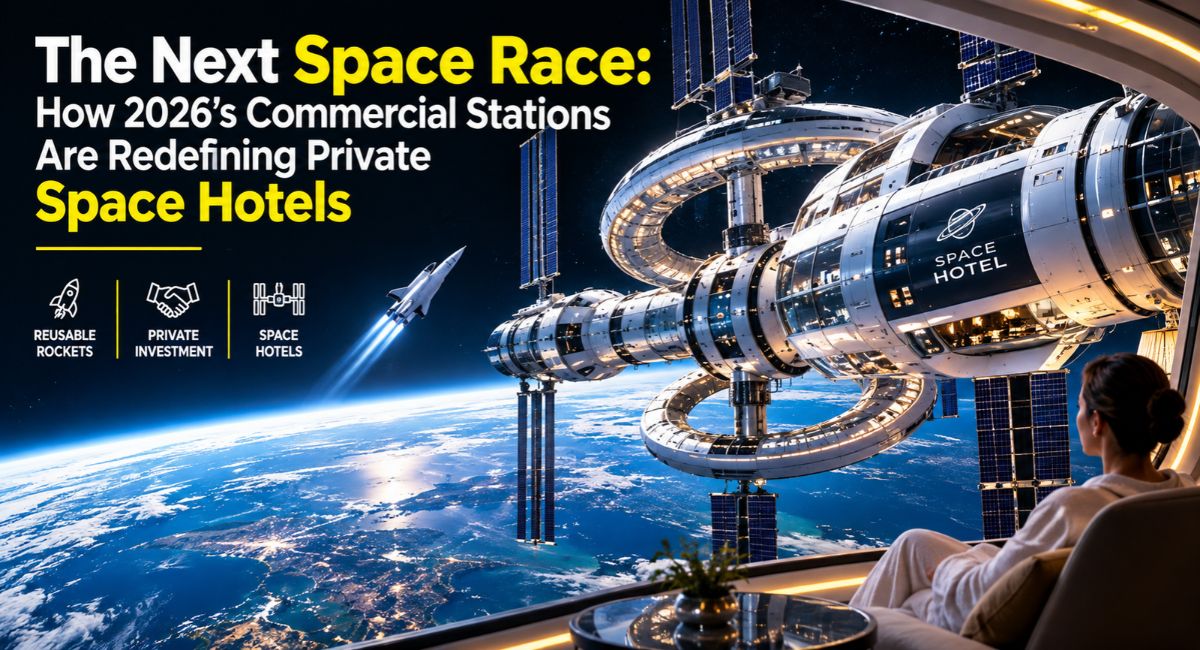
For decades, human space travel was a club reserved strictly for government-trained astronauts from agency powerhouses like NASA, Roscosmos, and ESA. Outer space was a frontier defined by scientific research, intense physical training, and immense national budgets.
However, we have officially entered a brand-new chapter. A quiet revolution in Aerospace engineering driven by reusable rockets, private investment, and public-private partnerships has kicked off the next great space race.
Today, low-Earth orbit (LEO) is no longer solely a government laboratory. It is becoming an economic zone complete with private space stations, commercial microgravity manufacturing laboratories, and the world’s very first high-altitude destinations: private space hotels.
If you have ever wondered what it takes to turn an astronaut’s operational habitat into an orbital luxury stay, or how private enterprises plan to replace the aging International Space Station (ISS), this article breaks down everything you need to know in plain, simple terms.
What Is a Commercial Space Station?
To understand how private space hotels work, you first need to understand what a space station is.
A space station is essentially a giant, pressurized satellite designed to orbit Earth for years at a time while hosting human crews. Inside, life-support systems continuously generate breathable air, scrub out carbon dioxide, control temperature, and recycle water.
Government vs. Private Space Stations
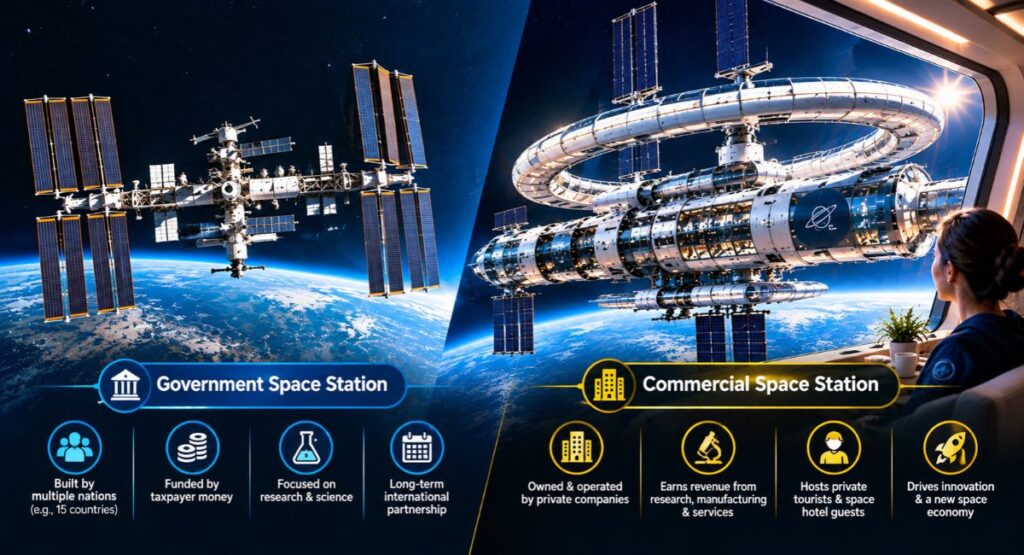
Historically, building a space station required billions of dollars from taxpayer funds. The International Space Station (ISS), for example, was built and maintained through a collaborative effort involving fifteen nations.
A commercial space station, by contrast, is built, owned, and operated by private corporations. Rather than relying exclusively on federal research grants, these stations earn revenue by renting laboratory space, offering industrial manufacturing services in zero gravity, and hosting private tourists seeking the experience of a lifetime.
Why Is 2026 a Turning Point for Space Tourism?
The year 2026 marks a pivotal moment in aerospace history. For over twenty years, the International Space Station has been the primary home for humans in low-Earth orbit. However, the ISS is aging and scheduled for retirement near the end of the decade.
Rather than building a direct replacement government station, NASA initiated programs designed to hand over the low-Earth orbit torch to commercial companies.
The Key Drivers Behind the 2026 Acceleration
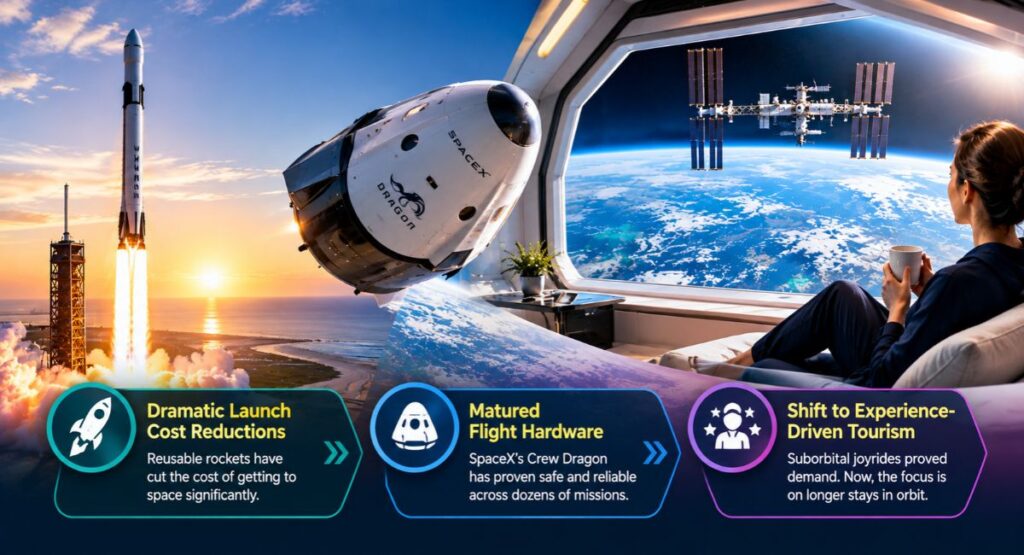
- Dramatic Launch Cost Reductions: Thanks to rapid innovations in fully reusable rocket boosters, the cost of sending payloads and humans into orbit has dropped significantly.
- Matured Flight Hardware: Private capsules such as SpaceX’s Crew Dragon have proven their safety and reliability across dozens of missions.
- Shift to Experience-Driven Tourism: Suborbital joyrides (short 10-minute trips to the edge of space) demonstrated immense demand for civilian space travel. The next logical step is staying in orbit for days or weeks.
The Major Players Building Tomorrow’s Orbital Hotels
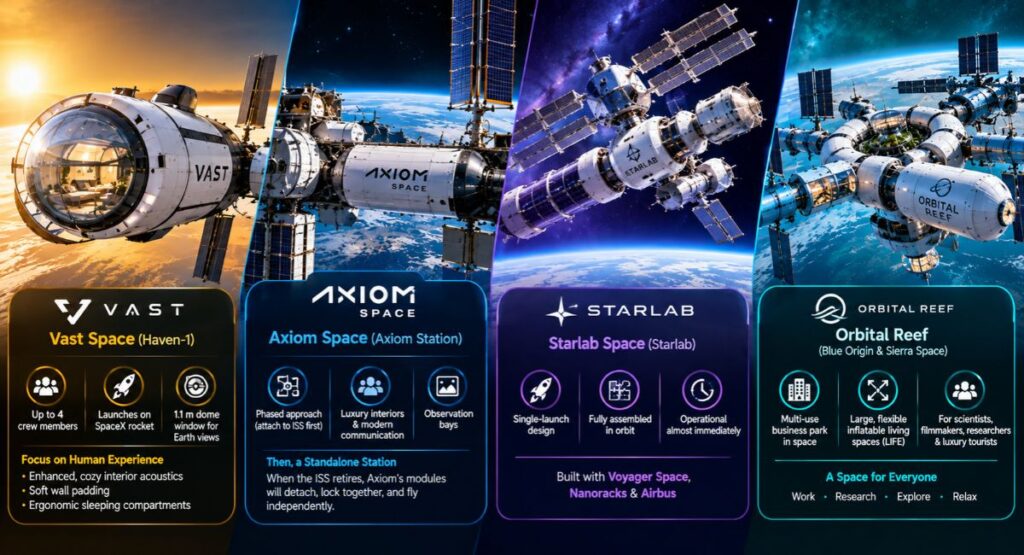
Several aerospace pioneers are racing to deploy private platforms in orbit. While each company approaches engineering with a unique strategy, all share the vision of opening outer space to broader audiences.
1. Vast Space (Haven-1)
Vast has positioned itself as one of the fastest-moving private space habitat developers. Their flagship module, Haven-1, is designed as an all-in-one single-module space station. Launching aboard a SpaceX rocket, Haven-1 aims to accommodate up to four crew members at a time.
Unlike industrial scientific modules, Haven-1 prioritizes human experience:
- Enhanced, cozy interior acoustics and soft wall padding.
- Custom, ergonomic sleeping compartments designed for weightlessness.
- A massive 1.1-meter dome window providing breathtaking, panoramic views of Earth.
2. Axiom Space (Axiom Station)
Axiom Space took a unique, phased approach to station construction. Instead of launching an isolated platform immediately, Axiom is building commercial modules that will initially attach to the existing International Space Station.
These modules feature world-renowned designer interiors, state-of-the-art communication equipment, and luxury observation bays. When the ISS retires, Axiom’s modules will detach, lock together, and fly independently as a standalone commercial station.
3. Starlab Space (Starlab)
A joint venture bringing together Voyager Space, Nanoracks, and European aerospace leader Airbus, Starlab focuses heavily on a single-launch design. By leveraging ultra-wide payload rockets, Starlab is engineered to deploy fully assembled, allowing it to become operational almost immediately upon reaching orbit.
4. Orbital Reef
Backed by Blue Origin and Sierra Space, Orbital Reef is envisioned as a multi-use business park in space. Designed with large, flexible inflatable living spaces (developed via Sierra Space’s LIFE habitat modules), Orbital Reef plans to host scientists, filming crews, tech research teams, and luxury tourists all under one roof.
What Is It Really Like to Stay in a Space Hotel?
If you book a stay at an orbital destination, do not expect a standard luxury resort with room service and infinity pools. Living in weightlessness requires completely re-imagining everyday comfort.
1. The Overview Effect
Perhaps the single greatest draw for private space travel is the Overview Effect. This cognitive shift, often reported by astronauts, occurs when they see Earth suspended in the black void of space. Because commercial stations orbit the planet every 90 minutes, guests can witness up to 16 sunrises and sunsets each day.
2. Zero-Gravity Accommodations
Without gravity pulling you down, traditional furniture like beds or chairs is ineffective. Space hotel rooms feature vertical sleeping pods fitted with soft-lined sleeping bags tethered to the walls to keep guests from floating around while resting. Custom lighting systems mimic Earth’s 24-hour day-night cycle to help maintain natural circadian rhythms.
3. High-Tech Amenities and Connectivity
Modern space hotels feature high-speed satellite internet, letting guests livestream zero-gravity flips, host high-definition video calls with family on Earth, or post photos directly to social media in real time.
Key Challenges Facing Commercial Space Stations
While the vision of orbital hotels is exciting, building and operating habitats in microgravity comes with complex technical and financial challenges.
High Ticket Costs
At present, orbital spaceflight remains extremely expensive. Booking a seat on a commercial mission can cost tens of millions of dollars. Until rocket transport becomes even more economical, private orbital stays will remain focused on high-net-worth individuals, sovereign research programs, and corporate sponsors.
Safety and Environmental Control
Space is a harsh environment. Orbital habitats must offer robust protection against solar radiation, cosmic rays, and orbital debris. Maintaining 100% reliable life-support systems, air scrubbers, thermal control loops, and water recycling systems requires continuous monitoring and complex fail-safes.
Rigorous Passenger Training
Unlike traditional vacations where you simply buy a ticket and board a plane, space hotel guests must undergo mandatory safety training. Passengers must learn emergency procedures, how to move safely in weightlessness, and how to operate space suit systems.
The Economic Future: Beyond Tourism
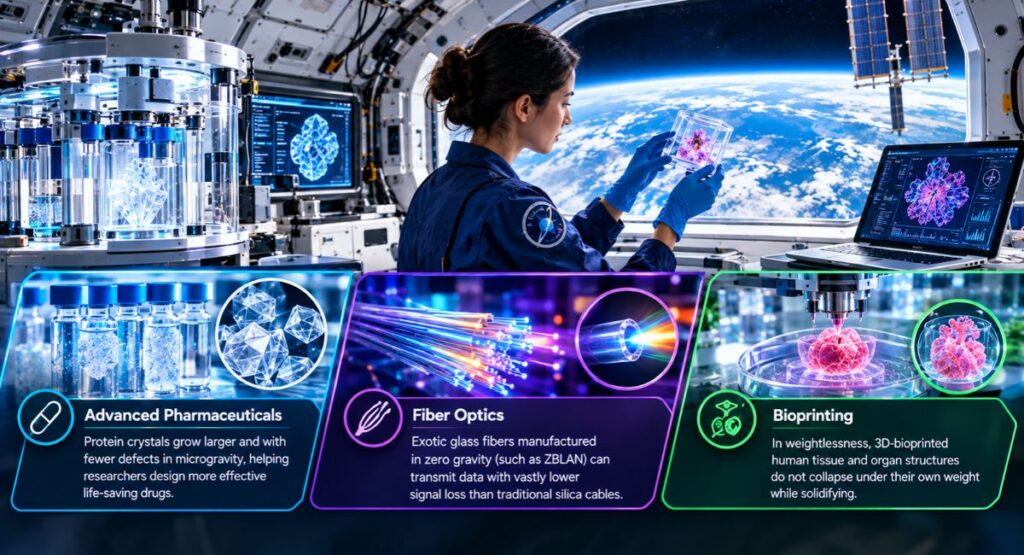
Space tourism receives the most headlines, but commercial stations are designed for far more than luxury vacations. They represent a brand-new frontier for industrial manufacturing and technology development.
Microgravity Manufacturing
Certain materials can be manufactured far better in zero gravity than on Earth:
- Advanced Pharmaceuticals: Protein crystals grow larger and with fewer defects in microgravity, helping researchers design more effective life-saving drugs.
- Fiber Optics: Exotic glass fibers manufactured in zero gravity (such as ZBLAN) can transmit data with vastly lower signal loss than traditional silica cables.
- Bioprinting: In weightlessness, 3D-bioprinted human tissue and organ structures do not collapse under their own weight while solidifying.
Conclusion
The transition from government-led space exploration to private, commercial space stations marks one of the most exciting shifts in modern history. Commercial stations are proving that low-Earth orbit is no longer just a distant scientific frontier; it is a thriving ecosystem for innovation, research, and human adventure.
As private companies streamline habitat production, expand passenger accommodations, and lower transport costs, the dream of spending a night among the stars is closer than ever.