Over the past decade, the global defense landscape has shifted dramatically. If you picture a military drone from twenty years ago, you likely imagine a large, remote-controlled aircraft piloted by a human sitting thousands of miles away in a secure room. Early unmanned aircraft served mainly as scouts, gliding silently across high-risk borders to feed real-time video directly to military commanders. Today, that picture is entirely obsolete.
We are living through a quiet, rapid revolution in military technology where artificial intelligence (AI) has transformed static flying cameras into autonomous actors. More importantly, the focus has shifted away from single, expensive aircraft toward drone swarm networks groups of dozens, hundreds, or even thousands of small drones that communicate, think, and hunt collectively like a flock of birds.
For beginners looking to understand this monumental technological shift, this article breaks down how we got here, why yesterday’s AI integration paved the way, and what the future of robotic warfare looks like for global security.
The Evolution of Military Drones: A Brief Historical Overview
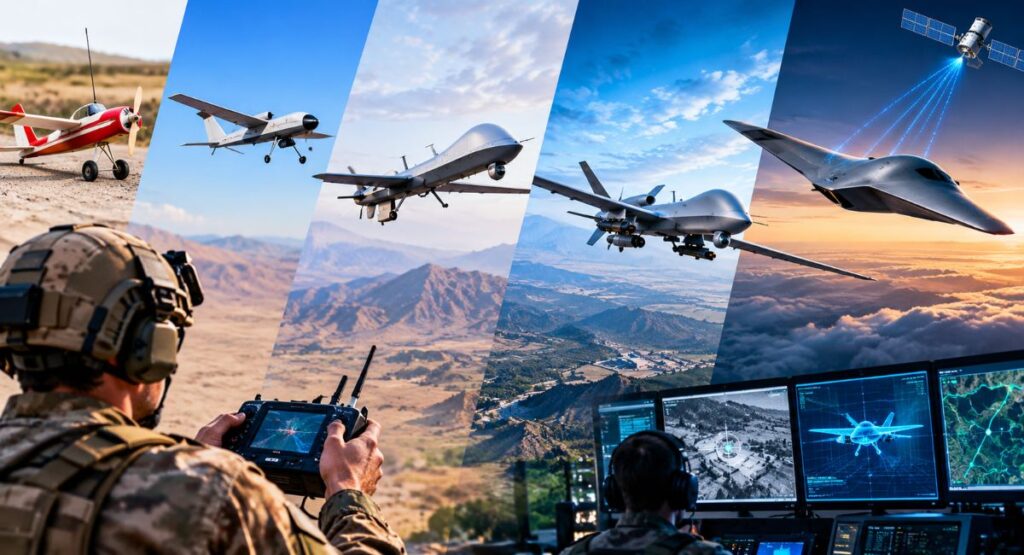
To understand where robotic warfare is heading, we must first look at how unmanned systems evolved from simple gadgets into complex defense systems.
From Remote-Controlled Toys to Strategic Assets
In their infancy, militaries viewed drones with skepticism. They crashed easily, required constant satellite links for manual piloting, and carried limited payloads. However, as battery technology improved, microchips shrank, and aerodynamics advanced, militaries around the world recognized their utility. They could go where humans could not, staying aloft for hours without risking a pilot’s life.
The Turning Point: Introduction of Basic Automation
The first major leap came when engineers stopped treating drones merely as remote-controlled airplanes and started treating them as smart computers with wings. Early automation let drones maintain a steady flight path, automatically return to base if they lost signal, and stabilize in high winds. This reduced the workload on human operators, but the drones themselves were still passive tools. They could not make tactical decisions; every movement depended on human input.
Analyzing Yesterday’s AI Integration Success
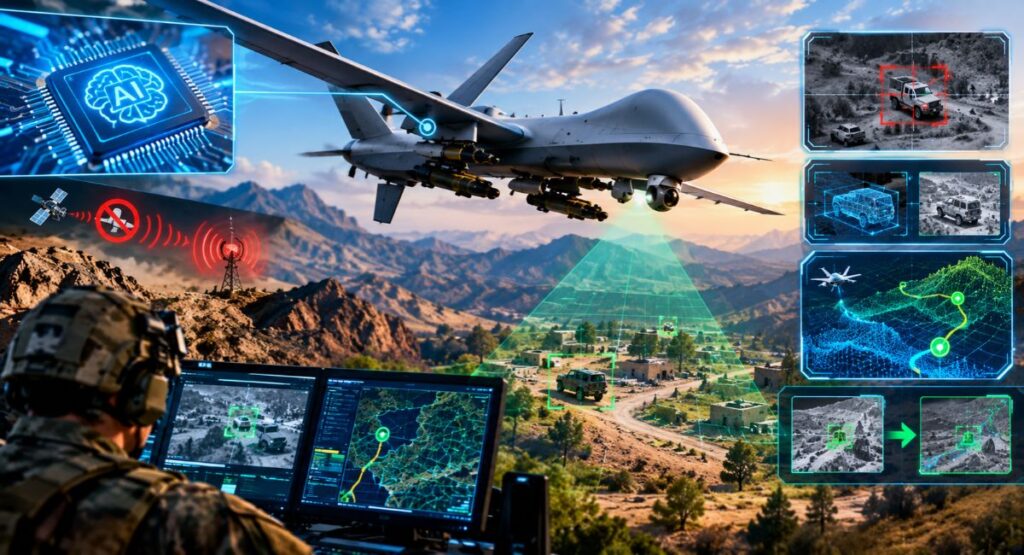
The true turning point occurred when artificial intelligence moved from theoretical computer science labs directly into military hardware. Integrating AI solved some of the biggest vulnerabilities that early drones faced: reliance on constant human contact, slow reaction times, and GPS vulnerability.
Edge Computing and Onboard Processing Breakthroughs
In past decades, a drone had to stream raw video back to a remote command center, where human analysts would interpret the data and send back instructions. This required massive bandwidth and created a dangerous delay (latency).
The success of recent AI integration lies in edge computing. By placing small, powerful microchips directly onto the drones, developers enabled machines to process visual and sensor data locally in real-time. A drone no longer needs to ask permission or stream gigabytes of video to figure out what it is looking at; its onboard computer analyzes the environment instantly.
Computer Vision and Autonomous Target Recognition
Using advanced computer vision, modern military drones can scan complex terrain, identify specific vehicles or objects, and track movements without human intervention. This capability changed the game in contested environments where electronic jamming often blocks communication lines. Even if a drone is completely cut off from its base, its AI lets it execute its programming, detect changes in the landscape, and complete its mission.
Resilience in GPS-Denied and Jammed Environments
Traditional navigation relies heavily on Global Positioning System (GPS) satellites. However, in modern conflicts, electronic warfare frequently targets GPS signals, blinding traditional guided weapons. Yesterday’s AI integration introduced alternative navigation methods, such as visual-inertial odometry, which lets drones navigate by looking at the ground and matching visual landmarks, much like a human pilot using a physical map.
Transitioning from Single Drones to Coordinated Swarm Networks
While a single smart drone is powerful, a collection of them acting together is exponentially more dangerous and efficient. This realization sparked the shift toward swarm networks.
What is Swarm Intelligence?
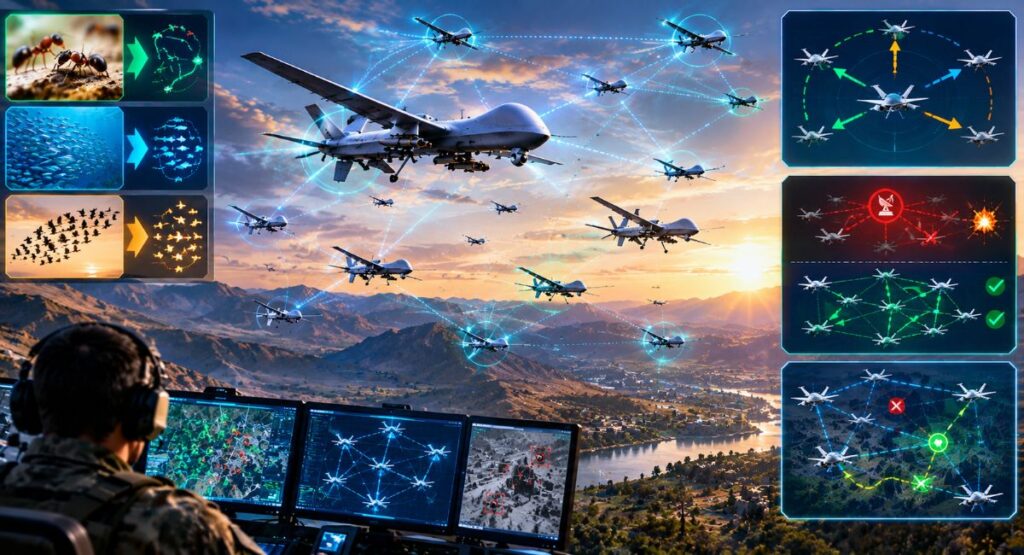
Swarm intelligence is a concept borrowed directly from nature. Think of how ants find food, how schools of fish evade sharks, or how a flock of starlings moves in perfect synchronization without a designated leader.
Scientists and defense engineers translated these biological principles into mathematical algorithms. Instead of programming every single drone from a central computer, developers give each drone a few simple rules:
- Separation: Do not bump into neighboring drones.
- Alignment: Match the speed and direction of nearby drones.
- Cohesion: Stay close to the center of the group.
When hundreds of drones follow these simple rules while pursuing a shared objective, complex, unpredictable, and highly resilient behaviors emerge naturally.
Decentralized Control vs. Centralized Command
Older military networks relied on a centralized model: a mother ship or a ground station gave orders to every individual unit. If the command center was destroyed, the drones were rendered useless.
Modern swarm networks use decentralized control. There is no single point of failure. If an enemy shoots down or jams thirty drones in a swarm of two hundred, the remaining units instantly reorganize, recalculate their trajectories, and continue the mission without missing a beat.
Self-Healing Mesh Networks: Staying Connected Under Fire
Communication within a swarm relies on peer-to-peer data sharing, often called a mesh network. Each drone acts as a relay node, passing information to the drone next to it. If a communication link breaks down in one part of the network, the data automatically routes through alternative pathways. This self-healing property makes drone swarms remarkably difficult to disrupt using traditional electronic countermeasures.
The Mechanics of Modern Robotic Warfare
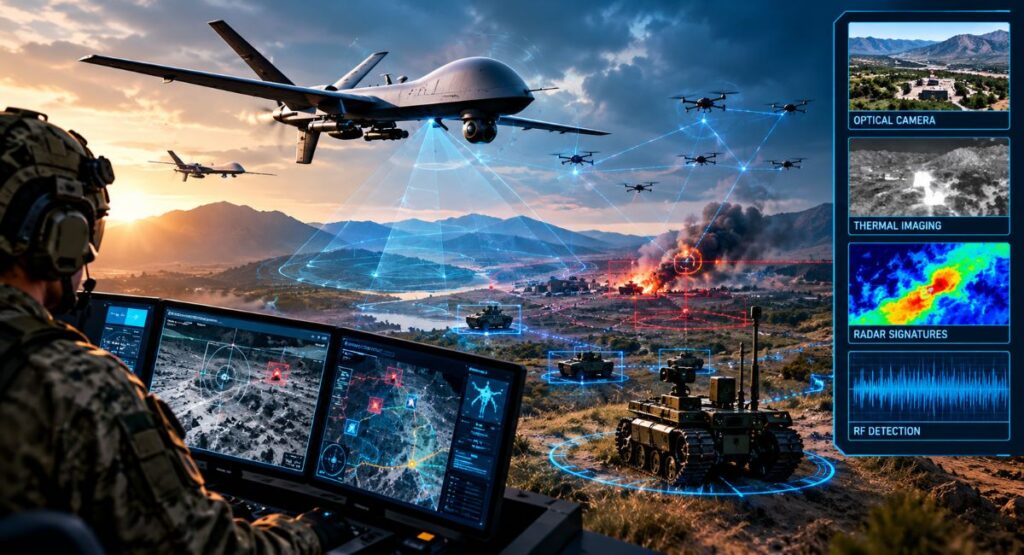
To truly grasp how these systems operate, we need to examine the underlying mechanics that enable machines to coordinate at superhuman speeds.
Multi-Sensor Fusion and Real-Time Awareness
Modern robotic warfare is driven by multi-sensor fusion. A military drone no longer relies on just one camera. It combines data from optical cameras, infrared sensors, thermal imaging, radar signatures, and radio frequency detectors simultaneously. The AI processes this blended data stream to create a comprehensive, 360-degree picture of the battlefield that far exceeds human perceptual capabilities.
Hybrid Autonomy: Balancing Human Judgment and Machine Speed
One of the most intense debates surrounding robotic warfare is the question of machine autonomy. To prevent catastrophic errors, modern defense doctrines increasingly lean toward hybrid autonomy.
Under this model:
- Machine Speed: The AI handles high-speed, repetitive tasks such as obstacle avoidance, route optimization, maintaining swarm formation, and initial target identification.
- Human Judgment: High-stakes decisions such as confirming a target or authorizing a strike often remain under human supervision, ensuring that ethical boundaries and rules of engagement are respected.
Challenges, Ethical Questions, and Global Implications
The rapid advancement of AI-driven drone swarms brings profound ethical questions and geopolitical challenges that the world is struggling to address.
The Accountability Vacuum: Who Is Responsible?
If an autonomous drone swarm makes a tactical error due to a glitch in its machine learning algorithm, who is held accountable? Is it the commander who deployed the swarm, the software engineer who wrote the code, or the defense contractor who manufactured the microchip? Traditional military law relies heavily on individual human intent and responsibility, which becomes deeply blurred when decisions are executed at machine speed by decentralized algorithms.
Escalation Risks and Accidental Conflict
Because drone swarms can operate with lightning-fast autonomy, they risk accelerating the speed of battle beyond human control. A localized skirmish could escalate into a full-scale conflict within minutes if automated defense systems react to perceived threats faster than diplomats or commanders can de-escalate the situation.
Proliferation and Accessibility Concerns
Unlike traditional heavy military hardware such as fighter jets, aircraft carriers, or tanks, small drones and commercial-grade AI software are relatively inexpensive and widely accessible. This creates a dangerous risk of proliferation, where non-state actors, rogue militias, or smaller nations can acquire or build potent swarm capabilities without needing massive industrial manufacturing bases.
The Future Horizon: What Lies Ahead for Robotic Warfare?
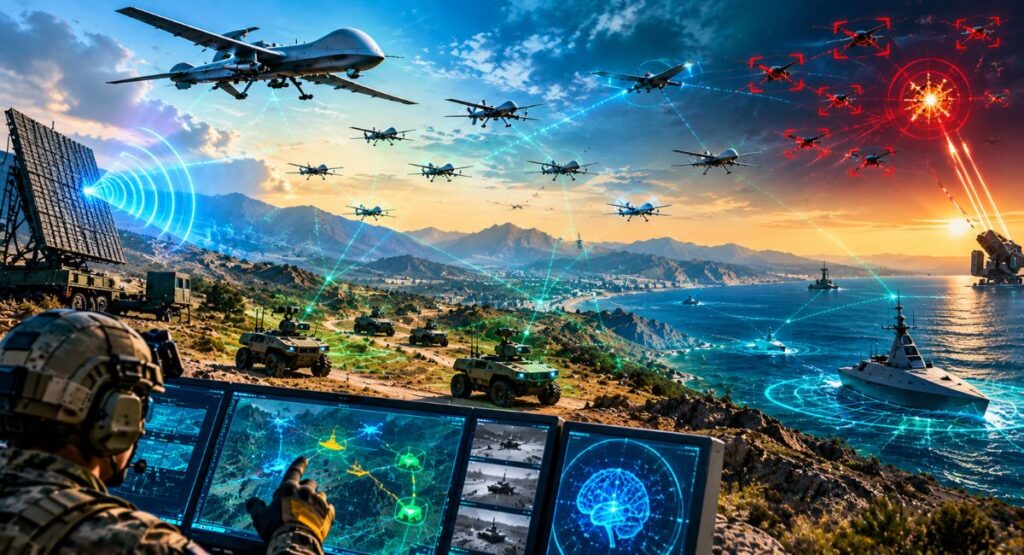
As we look toward the remainder of the decade and beyond, the trajectory of robotic warfare points toward even deeper integration across multiple domains.
Integration with Unmanned Ground and Maritime Systems
The future is not restricted to the skies. Current research focuses on cross-domain swarms where aerial drone networks communicate seamlessly with unmanned ground vehicles (UGVs) and autonomous naval vessels. An aerial swarm could scout a region, instantly share target coordinates with automated ground rovers, and coordinate a multi-pronged tactical response without human intervention.
Ultra-Fast Neural Networks and Microwave Defense
To counter incoming drone swarms, defense researchers are developing advanced AI systems capable of processing microwave and radio frequency signals at nanosecond speeds. These systems aim to detect, classify, and neutralize massive groups of hostile drones simultaneously before they can reach their objectives.
Conclusion
The evolution from single, remote-controlled drones to intelligent, self-coordinating swarm networks marks one of the most profound shifts in military history. By successfully integrating edge computing, computer vision, and bio-inspired swarm intelligence, defense technology has entered an era defined by speed, resilience, and autonomy.
While these technologies offer unmatched tactical advantages and help protect human personnel from direct harm, they also force humanity to confront complex ethical dilemmas. Balancing technological innovation with strict accountability will be the defining challenge for global security leaders in the years to come.