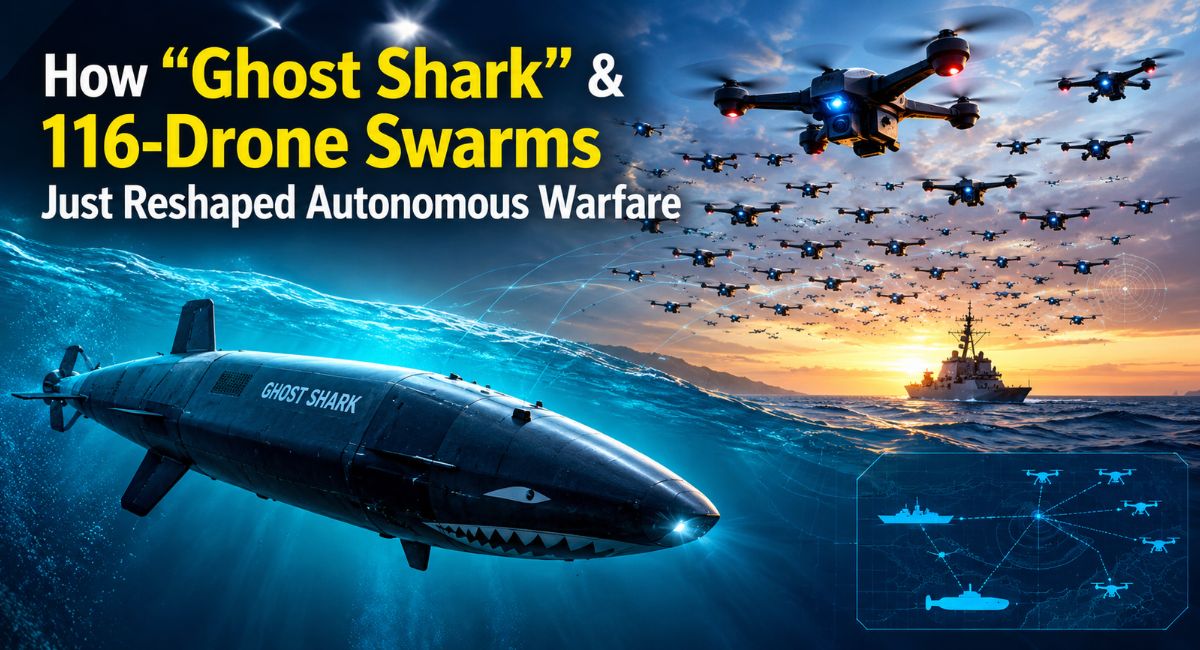
Modern military history is unfolding right before our eyes. For decades, sci-fi movies warned us about autonomous battlefields, artificial intelligence, and robotic forces. Today, that future has officially arrived.
Two groundbreaking technologies the Ghost Shark extra-large autonomous underwater vehicle (XL-AUV) and coordinated 116-drone swarms have fundamentally altered how militaries think about defense, deterrence, and combat.
If you are new to defense technology, terms like autonomous warfare, drone swarms, and uncrewed platforms might sound overwhelming. In this article, we will break down what the Ghost Shark is, how massive aerial drone swarms work, why combining them changes military strategy, and what this means for the future of global security.
What Is Autonomous Warfare?
Before diving into the Ghost Shark, let’s define autonomous warfare. Traditionally, military equipment required human operators inside the vehicle. Think of fighter jets, tanks, or standard submarines. Over time, militaries introduced remotely piloted drone machines controlled by a pilot sitting at a computer console miles away. Autonomous systems go one step further.
Instead of waiting for continuous human remote control, an autonomous machine uses software, sensors, onboard computing, and artificial intelligence to navigate, process surroundings, and execute pre-programmed mission goals on its own. While human operators set rules and boundaries (maintaining human-in-the-loop oversight), the machine makes its own second-by-second navigation decisions.
Now, explore the two technologies leading this revolution.
The Ghost Shark: The Silent Guardian of the Deep
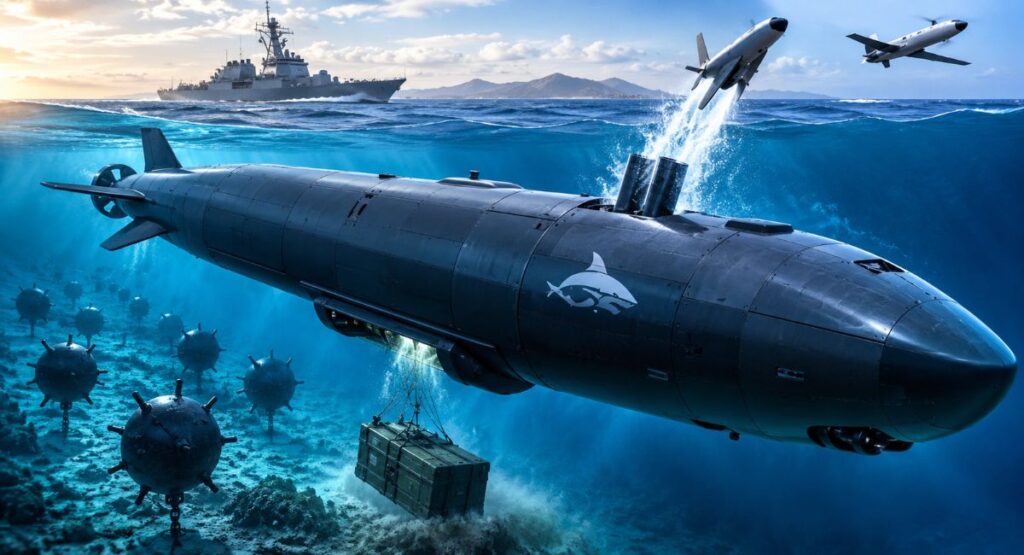
The Ghost Shark is an Extra-Large Autonomous Underwater Vehicle (XL-AUV) developed jointly by defense tech company Anduril Industries and the Royal Australian Navy.
1. What Makes the Ghost Shark Special?
Unlike traditional crewed submarines, which require billions of dollars, years of manufacturing, and dozens of crew members inside a pressurized hull, the Ghost Shark is uncrewed, modular, and mass-producible.
- Size: It is roughly the size of a school bus (around 12 meters long).
- Stealth: It glides silently underwater, making it nearly impossible for surface ships or sonar systems to detect.
- Endurance: It can remain deployed deep underwater for long periods, carrying out surveillance, oceanographic mapping, or monitoring undersea communication cables.
2. Multi-Role Capabilities
The Ghost Shark isn’t just an underwater spy. Recent defense upgrades reveal that this underwater robot carries serious punch:
- Naval Mine Laying: It can carry and deploy up to 12 naval mines without risking human divers or surface ships.
- Logistics Delivery: It can drop supplies or equipment caches silently on the ocean floor for special forces teams.
- Aerial Drone Hub: Most surprisingly, the Ghost Shark can launch tube-packaged aerial drones directly from the ocean to attack or spy on targets far above the surface.
Understanding 116-Drone Swarms: Power in Numbers
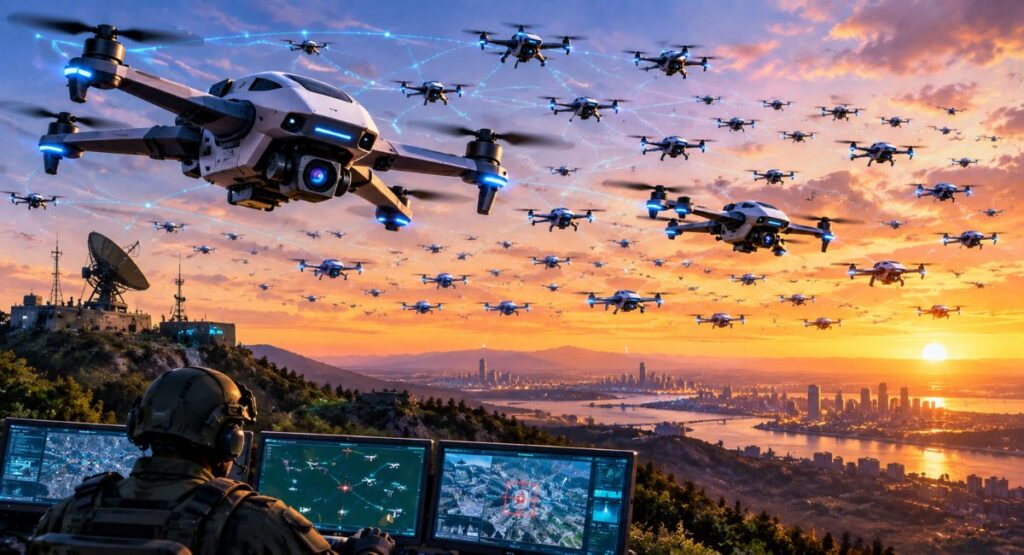
While underwater robotics advanced, surface and aerial defense witnessed another major leap: massive drone swarms.
What Is a Drone Swarm?
A single drone flying over a target is helpful. However, a single drone can be shot down by anti-aircraft systems.
A drone swarm consists of dozens or even hundreds of small, interconnected aerial drones that fly together, communicate with one another, and act as a unified, collective unit.
When 116 drones launch simultaneously, they don’t require 116 individual pilots staring at screens. Instead, advanced algorithms allow the drones to:
- Self-organize: They maintain flight formation automatically.
- Share information: If one drone spots a target, all 115 other drones instantly know about it.
- Dynamic Adaptation: Should hostile forces intercept a few units, the surviving swarm instantly reshapes its formation, recalculates flight paths, and carries out the objective without interruption.
Why the Combination of Underwater & Aerial Drones Changes Everything
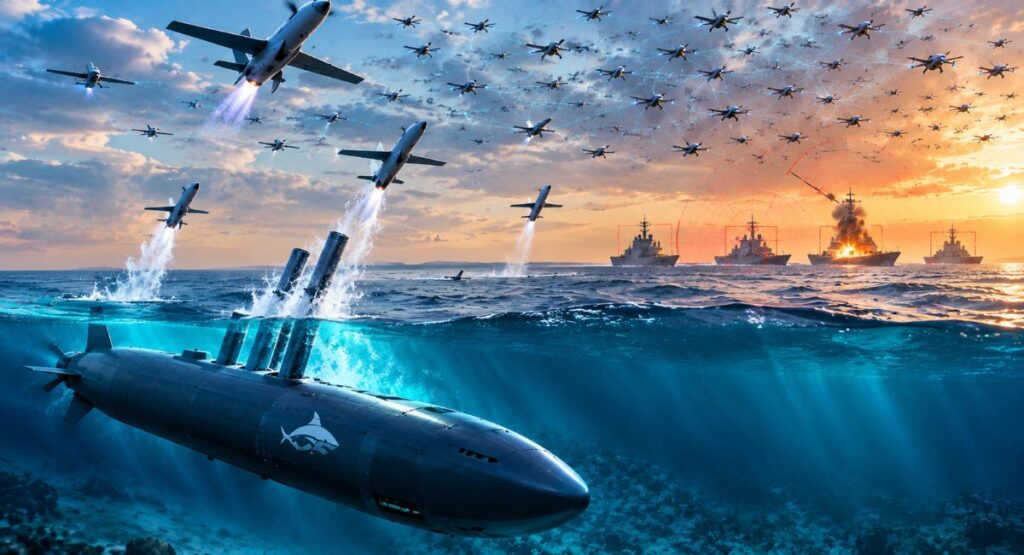
The true revolution happens when you combine an underwater platform like the Ghost Shark with aerial drone swarms. This is known as cross-domain autonomous warfare (connecting sea and sky).
Here is how this combo rewrites the military playbook:
| Traditional Naval Warfare | Autonomous Cross-Domain Warfare |
|---|---|
| High Cost: Multi-billion-dollar aircraft carriers and submarines. | Low Cost: Mass-produced autonomous subs and low-cost drones. |
| High Risk: Hundreds of human crew members put in danger. | Zero Crew Risk: Completely uncrewed systems operated remotely. |
| Single-Point Target: Big ships can be tracked and targeted by missiles. | Distributed Network: 100+ small drones are almost impossible to destroy all at once. |
| Slow Deployment: Requires massive logistical preparation. | Rapid Deployment: Fits inside standard shipping containers for easy transport. |
Scenario: The Surprise Launch
Imagine an enemy fleet patrolling an ocean area. They scan the skies and monitor radar, seeing no incoming aircraft or ships. Unbeknownst to them, a Ghost Shark sits motionless 100 meters below the waves.
On command, the sub releases tube-launched aerial drones (such as the Anduril Altius) that surface, inflate wings, ignite, launch into the air, and instantly link together into a 100+ drone swarm. Within minutes, the enemy goes from facing an empty ocean to dealing with a massive cloud of scouting and strike drones overwhelming their radar systems.
Key Advantages Driving the Shift to Autonomous Warfare
Why are defense departments across the world investing billions in autonomous technology? Here are the primary reasons:
1. Cost-Effectiveness and Scalability
Building a nuclear submarine costs billions of dollars and takes up to a decade. An extra-large underwater drone like the Ghost Shark costs a fraction of that price and can be produced in months in specialized robotic factories.
2. Protecting Human Lives
The clearest benefit of autonomous systems is removing soldiers from high-risk environments. By handling hazardous operations such as disarming naval mines, conducting surveillance along enemy shores, or flying through heavily defended zones, these unmanned platforms keep human troops out of danger.
3. Overwhelming Enemy Defenses (Swarm Intelligence)
Traditional defense systems like air defense missiles are designed to shoot down a few large targets (like jets or incoming missiles). When faced with 116 small, fast, synchronized drones at once, air defense radar suffers from saturation. The defense system simply runs out of ammunition before it can intercept every drone.
4. Shipping Container Portability
One of the most tactical features of modern underwater drones is transportability. Platforms like the Ghost Shark can fit inside standard, everyday shipping containers. They can be moved by commercial transport trucks, cargo planes, or standard freighters, making them deployable anywhere on Earth on short notice.
Ethical Questions & The Future of Warfare
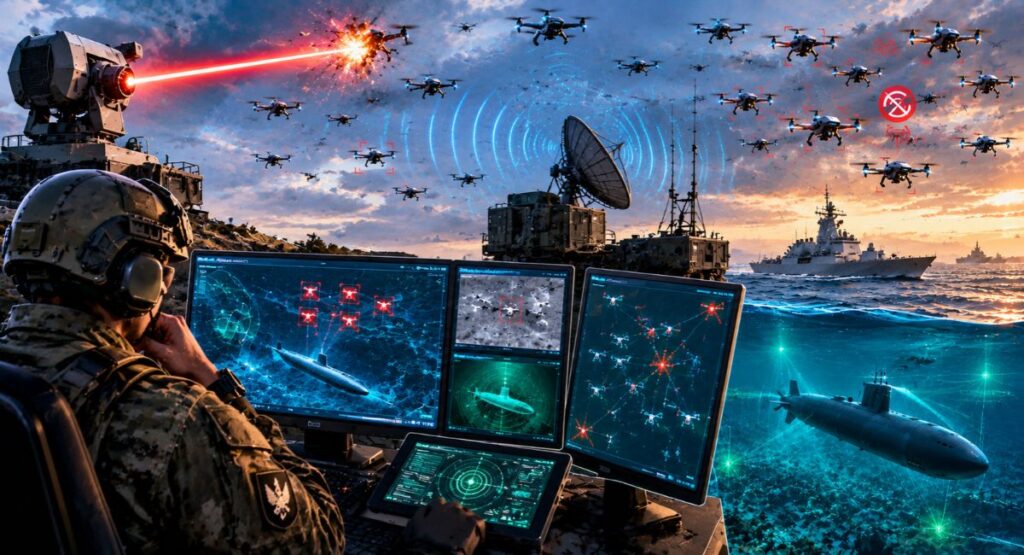
While the technological leap is impressive, the rise of Ghost Sharks and drone swarms raises important ethical questions that governments and military leaders are currently addressing.
Human-in-the-Loop Controls
A major area of debate centers on weapon firing authority. International laws and military doctrines heavily emphasize keeping a human in the loop. This means that while an autonomous system like the Ghost Shark can navigate, track, and position itself independently, a human officer must verify and approve any decision to fire a weapon or drop a munition.
Counter-Drone Technologies
As autonomous swarms advance, defense companies are working equally hard on counter-drone tools, such as:
- High-Powered Lasers: Burning down incoming aerial drones instantly.
- Electronic Jamming: Disrupting radio communications between swarming drones.
- Undersea Sonar Grids: Detecting stealth underwater drones before they deploy payloads.
Conclusion
The combination of the Ghost Shark submarine and large-scale drone swarms marks a permanent shift in modern strategy. Naval battles are no longer defined solely by who has the biggest aircraft carrier or the most expensive battleship. Instead, victory belongs to those who can deploy smart, connected, low-cost, and flexible robotic networks across land, sea, and air.
As AI software and robotics continue to advance, these uncrewed platforms will become even quieter, smarter, and more capable. The future of global security has officially transitioned from the era of heavy machinery to the era of intelligent autonomous networks.