Imagine walking into a gym, sitting in a movie theater, or attending a private meeting, only to realize the person across from you might be secretly recording your every move. For the past few years, smart glasses have promised us a futuristic world straight out of a science fiction movie. You could take photos with a subtle tap, record quick videos hands-free, and ask artificial intelligence questions about what you were seeing in real time.
However, that futuristic dream quickly stumbled into a very grounded reality: people absolutely hate feeling like they are under constant surveillance.
In response to intense public outcry, global bans, and mounting legal scrutiny, Meta made a move that shocked the tech industry. The company began pivoting away from built-in lenses by developing and introducing camera-free versions of its smart glasses. At the same time, Meta implemented aggressive system updates designed to completely disable hardware whenever users try to alter or cover up camera privacy indicators.
Why would a tech giant voluntarily strip away one of its flagship product’s most hyped features?
The answer lies in a combination of social psychology, corporate survival, and a massive shift in how we want artificial intelligence to fit into our daily lives. Here is the complete breakdown of why Meta killed the camera to stop the privacy backlash, what it means for consumers, and why camera-free smart glasses might actually be the smartest thing Meta has ever built.
The Promise and the Paranoia: How Smart Glasses Triggered a Crisis
To understand why Meta had to pivot, we first need to look at how smart glasses gained popularity and why that popularity quickly turned into public paranoia.
From Sci-Fi Dream to Public Nuisance
When Meta partnered with iconic eyewear brand Ray-Ban, the resulting smart frames were praised as a technical triumph. Unlike earlier, clunky attempts like Google Glass, Ray-Ban Meta glasses looked like standard, stylish eyewear. Tiny camera lenses, open-ear audio speakers, micro-smartphones’ worth of processing chips, and multi-microphone arrays were tucked neatly into the corners of the frames.
Wearers could snap photos, record short video clips for Instagram, listen to podcasts, and talk directly to Meta AI. On paper, it was the ultimate consumer gadget.
In practice, it immediately eroded public trust.
Because the glasses looked almost indistinguishable from normal prescription glasses or sunglasses, people in public spaces had no way of knowing whether someone was simply looking at them or secretly filming them. Stories quickly began circulating about individuals wearing smart glasses in sensitive environments:
- Gyms and Locker Rooms: Concerns erupted over non-consensual filming during workouts.
- Schools and Universities: Educators worried about discreet cheating and students filming classmates without consent.
- Beaches, Saunas, and Nightclubs: Venues where privacy is paramount saw a sharp rise in customer complaints.
- Public Transit: Passengers expressed deep discomfort sitting next to wearers staring in their direction.
The Tape Hack and the Failure of Privacy LEDs
Meta anticipated some of these privacy concerns from the beginning. To notify bystanders when the camera was active, Meta embedded a small LED light on the frame that illuminates whenever recording takes place.
However, this privacy light proved to be an imperfect solution. Wearers quickly discovered that they could bypass the indicator light entirely. By placing a small piece of black electrical tape, a dab of dark nail polish, or a tiny sticker over the LED, users could record videos completely undetected.
This tape hack triggered alarm bells among privacy advocates and regulatory bodies around the world. Despite Meta’s insistence that its hardware was designed with privacy in mind, critics pointed out that a feature easily defeated by a piece of tape offered little real protection.
Meta responded by pushing software updates that use optical sensors to detect if the LED light is obstructed or tampered with. If tampering is detected, the device automatically disables the camera altogether. Yet even this technological cat-and-mouse game was not enough to eliminate public anxiety.
Why Meta Had No Choice: The 4 Big Factors Driving the Camera-Free Pivot
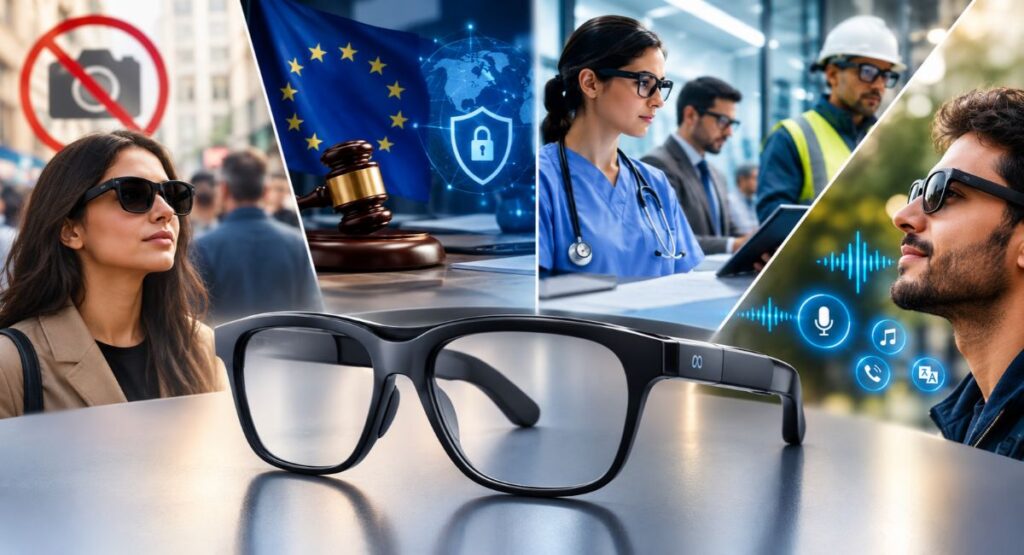
Faced with an escalating public relations nightmare, Meta recognized that incremental software fixes would not fully resolve the problem. To ensure long-term adoption of wearable technology, the company took a more fundamental step: rethinking the necessity of the camera itself.
Here are the four primary factors that compelled Meta to pivot toward camera-free smart glasses.
1. Widespread Public Bans and Social Stigma
Technology only succeeds when society accepts it. Much like Google Glass earned its wearers an unflattering nickname a decade ago, camera-equipped smart glasses began carrying a heavy social stigma.
Around the globe, businesses and public spaces began enacting blanket bans on smart glasses:
- Restricted areas in corporate offices, research labs, and manufacturing facilities.
- Private member clubs, concert halls, and comedy venues looking to prevent unauthorized recording.
- Schools and academic testing centers enforcing strict anti-recording policies.
When a product becomes socially awkward to wear in everyday settings, user engagement plummets. Wearers do not want to justify their glasses or face hostile stares from strangers constantly. By offering a camera-free frame, Meta eliminates this social friction. Users can wear their frames anywhere without raising suspicion or violating venue rules.
2. Rising Regulatory Heat and Legal Class Actions
Privacy regulators across Europe, North America, and the Asia-Pacific region have tightened their oversight of consumer devices equipped with cameras and microphones.
Under strict data privacy frameworks like Europe’s General Data Protection Regulation (GDPR), collecting biometric data or video recordings of individuals in public without explicit consent carries severe financial penalties. Furthermore, privacy organizations and consumer rights groups launched campaigns and protests demanding that tech platforms curb covert recording technology.
Class-action lawsuits raising concerns over unauthorized facial recognition indexing and public surveillance added substantial legal risk. Removing the camera eliminates the risk of illegal recording claims, giving Meta a safer pathway through global regulatory environments.
3. The Massive Enterprise and Workplace Market
While consumer adoption was slowed by social friction, the enterprise sector presented a major missed opportunity.
Companies across healthcare, finance, law, engineering, and government administration were eager to equip employees with hands-free AI assistants. However, security protocols strictly forbid camera-equipped recording devices in facilities where confidential documents, client data, or proprietary technology are present.
By removing the lens, Meta created a device tailored for professional environments:
- Office Workers: Receive voice summaries, manage calendars, and take phone calls completely hands-free.
- Healthcare Professionals: Access medical reference AI without violating patient confidentiality rules.
- Industrial and Field Workers: Get step-by-step audio instructions and real-time translation without introducing security risks.
The business-to-business (B2B) market for camera-free smart eyewear represents a lucrative revenue stream that was previously inaccessible due to camera security restrictions.
4. The Real Value Was Always the AI Audio, Not the Camera
Perhaps the most compelling realization for Meta was a simple truth about how people actually use smart glasses: the audio and AI features are what keep users coming back.
Internal usage data and consumer feedback revealed that while snapping photos was fun initially, the feature users relied on daily was the high-quality open-ear audio paired with voice-based AI assistance. Users consistently praised the ability to:
- Listen to music, podcasts, and audiobooks while remaining aware of their surroundings.
- Make crystal-clear phone calls in noisy environments.
- Ask Meta AI for instant information, summaries, or real-time language translations.
The camera was expensive to build, drained battery life, generated substantial heat, and sparked nonstop privacy debates. Removing the lens simplified the hardware layout while preserving the core features users value most.
What Are Camera-Free Smart Glasses? (And How Do They Work?)
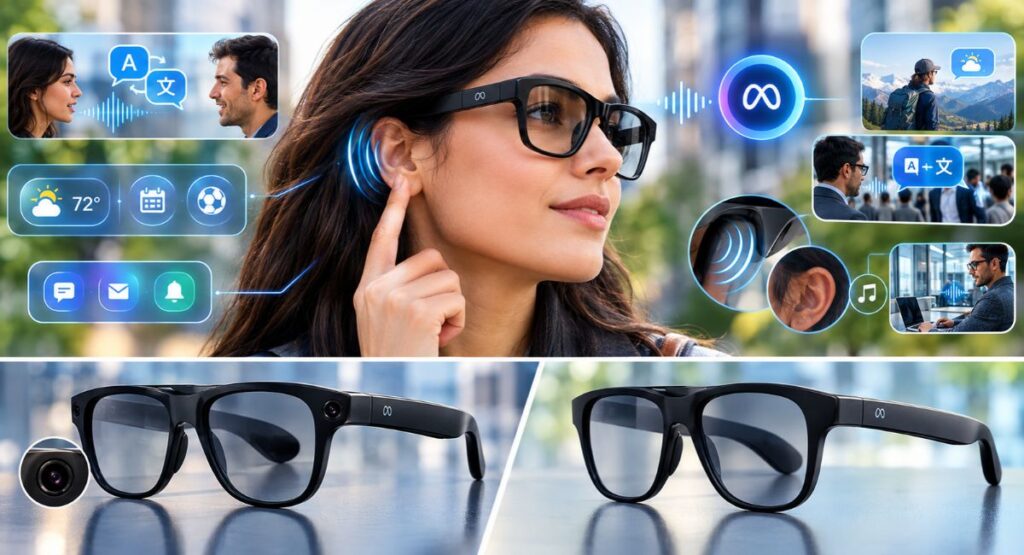
For beginners entering the smart wearable space, camera-free smart glasses might sound counterintuitive at first. If there is no screen and no camera, what exactly do these frames do?
The Audio-First Wearable Experience
Camera-free smart glasses act as a lightweight, invisible personal assistant. Instead of pulling out your phone every time you receive a notification or need information, the glasses deliver clear, spatial audio directly to your ears while leaving your hearing unobstructed.
Here is how key features operate without a camera lens:
- Voice-Activated Artificial Intelligence
You say, Hey Meta, followed by your question. You can ask for weather forecasts, traffic updates, sports scores, calendar schedules, or complex explanations, receiving answers directly through the built-in speakers.
- Live Conversational Translation
When speaking with someone who speaks a different language, the glasses listen through multi-microphone arrays and translate the spoken conversation into your ear in real time.
- Notification Triage
The frames read out priority text messages, emails, and reminders from your smartphone, allowing you to stay connected without constantly looking at a screen.
- Open-Ear Acoustics
Micro-speakers located near your temples beam audio directly toward your ear canal. You enjoy rich, clear sound while remaining fully aware of traffic, conversations, and ambient sounds around you.
Side-by-Side Comparison: Camera vs. Camera-Free Smart Glasses
| Feature | Camera-Equipped Smart Glasses | Camera-Free Smart Glasses |
| Photo & Video Recording | Supported (12MP Camera) | Not Available |
| Privacy Rating | Low / High Controversy | Excellent / 100% Privacy Compliant |
| Public Acceptance | Banned in many venues | Welcomed everywhere |
| Battery Life | Moderate (3 to 4 hours active use) | Long (Extended battery life without camera drain) |
| Weight & Frame Comfort | Slightly heavier due to camera sensors | Ultra-lightweight, feels like standard glasses |
| Meta AI Integration | Voice + Visual Analysis | Voice-First Assistance & Translation |
| Enterprise | Unsuited for confidential workplaces | Fully compliant for corporate environments |
The Big Picture: What This Means for the Future of Smart Wearables
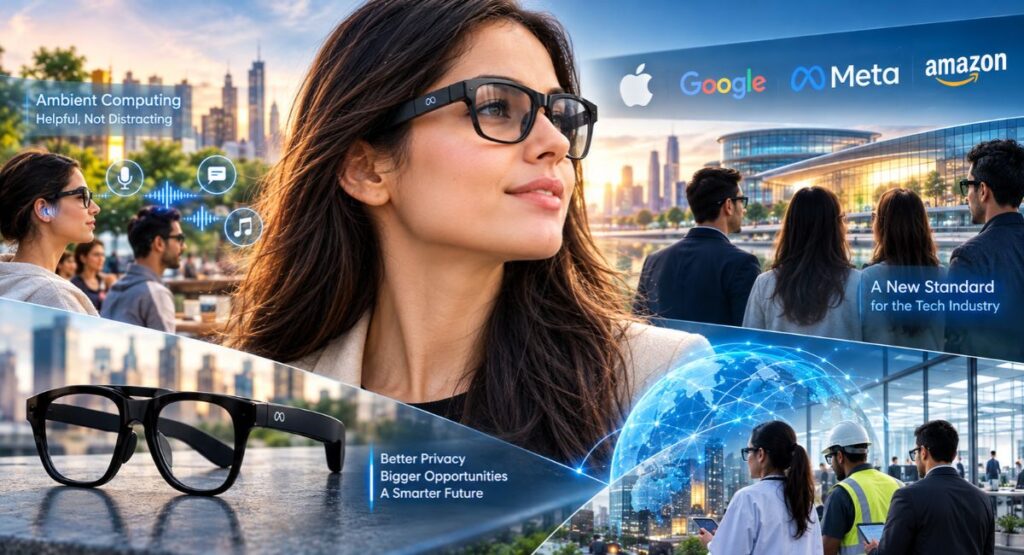
Meta’s decision to embrace camera-free smart glasses marks a significant turning point in the evolution of wearable technology. For years, tech companies assumed that progress meant adding more sensors, more megapixels, and more invasive tracking to every device.
This pivot demonstrates that true technological progress is about subtraction, restraint, and user comfort.
The Transition to Ambient Computing
We are moving away from the era of attention-grabbing technology, where devices constantly demand our visual attention through screens and notification badges, toward ambient computing. Ambient computing sits quietly in the background, assisting us only when needed, without distracting from real-world interactions. Audio-first, camera-free frames fit into this approach naturally.
A New Standard for Apple, Google, and Amazon
Meta is not the only player in this market. Amazon (with Echo Frames) and Bose (with Bose Frames) previously experimented with audio-only eyewear. However, Meta’s massive distribution network, brand reach, and advanced AI models elevate camera-free wearables to a mainstream category.
Competitors like Apple and Google, both of which are investing heavily in augmented reality (AR) and smart wearables, are taking note. Meta’s experience proves that launching camera-heavy devices without strict privacy guarantees can stall product adoption. Future consumer wearables across the industry will likely prioritize privacy-by-design from day one.
Frequently Asked Questions (FAQs)
Q1: Did Meta completely stop selling smart glasses with cameras?
No. Meta continues to sell camera-equipped models alongside camera-free options. However, the company has introduced strict hardware-disabling features for camera models if privacy lights are tampered with, while positioning camera-free frames to appeal to privacy-conscious consumers and corporate markets.
Q2: Can camera-free smart glasses still use Meta AI?
Yes! Camera-free smart glasses retain full access to Meta AI’s voice features. You can ask questions, get live translations, control audio playback, set reminders, and hear incoming notifications without needing a camera lens.
Q3: Why wasn’t the small LED privacy light enough to solve privacy concerns?
The LED light was easy to bypass. Users found they could easily cover the light with tape or paint to film secretly. Furthermore, in bright outdoor lighting, tiny LED indicators can be difficult for bystanders to spot, leading to widespread distrust.
Q4: Are camera-free smart glasses lighter and cheaper?
Generally, yes. Removing complex camera modules, image signal processors, and specialized optical sensors reduces production costs, lowers overall frame weight, and improves battery performance.
Q5: Can I wear camera-free smart glasses in places where regular smart glasses are banned?
In most cases, yes. Because camera-free frames contain no optical recording hardware, they do not violate privacy policies in gyms, schools, offices, or private venues.
Conclusion
Meta’s decision to remove the camera from its smart glasses lineup is not a retreat; it is an intelligent adaptation to consumer demand. By listening to public concerns, respecting privacy boundaries, and focusing on seamless AI audio, Meta has transformed a potential product failure into a sustainable growth strategy.
Technology works best when it empowers users without compromising the comfort or privacy of those around them. Camera-free smart glasses prove that we can enjoy the convenience of hands-free artificial intelligence while keeping our privacy intact.