For over two decades, our relationship with personal electronics has followed a strict, repetitive formula: you provide the command, and the gadget executes the script.
When you wanted to book a flight, adjust your home thermostat, or organize a busy calendar, your smartphone or smart speaker waited idly for your exact tap, swipe, or voice command. Even early Artificial Intelligence (AI) tools mostly acted like digital encyclopedias waiting for a prompt, generating text or images and stopping until you asked another question. That reactive era is officially ending.
We are stepping into the Agentic Age, an era defined by software and hardware that doesn’t just respond to commands; it reasons, plans, and takes proactive steps to accomplish goals on your behalf. Driving this monumental shift is a massive breakthrough in physical engineering: the arrival of 2-nanometer (2nm) microchips.
These tiny silicon powerhouses pack tens of billions of microscopic transistors into spaces smaller than a fingernail, enabling devices to run complex, decision-making AI locally without needing constant connections to distant cloud servers.
Here is a plain-English look at how 2nm semiconductor tech is transforming everyday electronics into fully autonomous digital agents.
From Generative AI to Agentic AI: What Changed?
To understand why 2nm chips are such a game-changer, we first need to distinguish between traditional AI chatbots and autonomous AI agents.
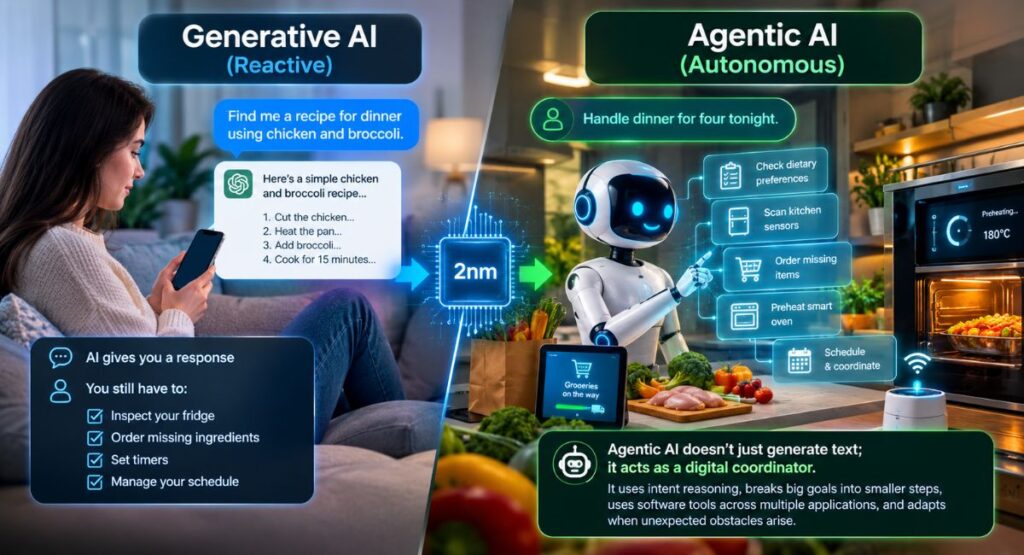
- Generative AI (Reactive)
You ask, Find me a recipe for dinner using chicken and broccoli. The AI writes a recipe. You still have to inspect your fridge, order missing ingredients, set timers, and manage your schedule.
- Agentic AI (Autonomous)
You say, “Handle dinner for four tonight.” An agentic system checks your dietary preferences, scans connected kitchen sensors to see what ingredients you have, orders missing items via a delivery app, and schedules your smart oven to preheat at the right time.
Agentic AI doesn’t just generate text; it acts as a digital coordinator. It uses intent reasoning, breaks big goals into smaller steps, uses software tools across multiple applications, and adapts when unexpected obstacles arise.
The Muscle Behind the Mind: Why 2nm Chips Matter
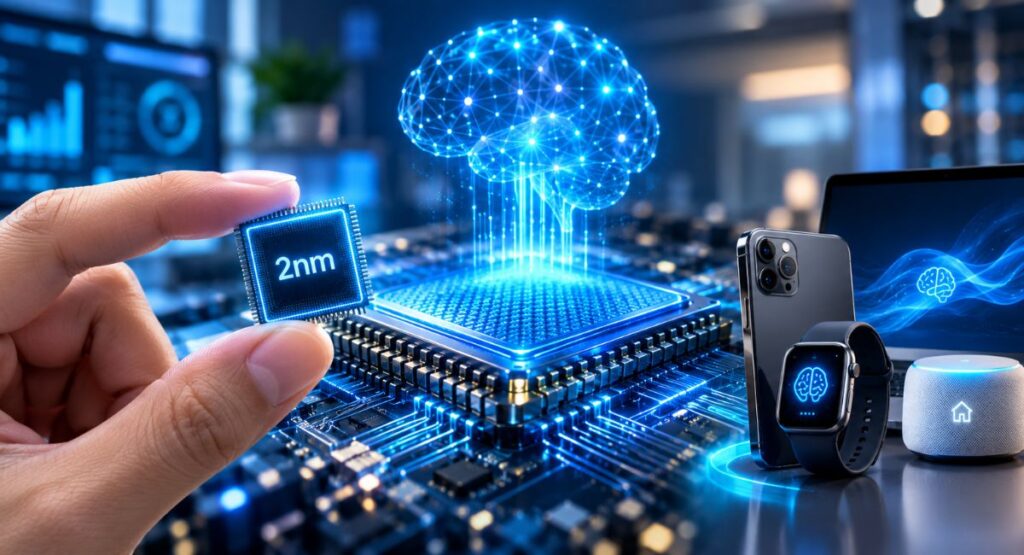
Why couldn’t our gadgets do this two years ago? The bottleneck wasn’t just software; it was physical hardware.
Autonomous reasoning requires continuous background processing. Running large AI models locally on a phone, smartwatch, or home hub drains massive amounts of power and generates intense heat.
The manufacturing shift to 2-nanometer process nodes led by semiconductor foundries using advanced Gate-All-Around (GAA) transistor designs solves these physical limits.
Extreme Shrinking, Massive Gains
In semiconductor manufacturing, a smaller nanometer rating means smaller transistors. Smaller transistors mean electrical signals travel shorter distances, consuming far less power while processing data exponentially faster.
- Up to 35-40% Power Reduction
2nm chips can run complex neural networks without draining your battery in a matter of minutes.
- Unmatched Transistor Density
Engineers can now cram over 300 million transistors into a single square millimeter of silicon.
- Sub-Watt Background Processing
Tiny dedicated Micro Neural Engines can sit on the chip, continuously listening, observing context, and planning in the background while drawing negligible power.
The End of Cloud Dependency: Local Processing & Instant Privacy
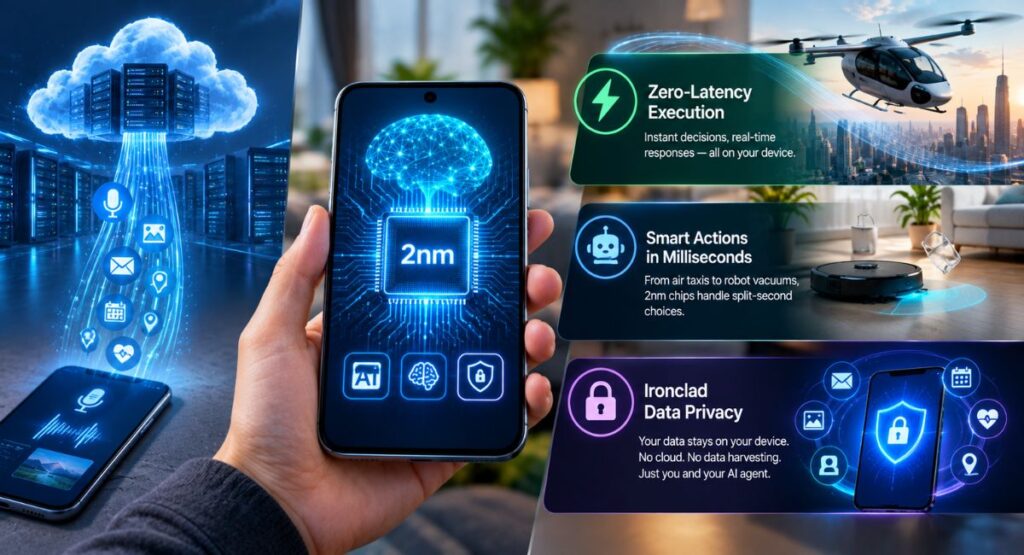
Until now, whenever you used an AI assistant, your voice recording or image was encrypted, sent over the internet to a distant data center, processed by server farms, and sent back to your device.
While cloud computing is powerful, it has three massive flaws: latency (lag), internet dependencies, and privacy risks.
2nm processors change this architecture completely by bringing Edge Intelligence directly onto your local silicon.
Zero-Latency Execution
When an autonomous agent needs to make split-second choices, like an electric air taxi adjusting to wind gusts or a robotic vacuum avoiding a falling glass, it cannot wait half a second for a cloud server to reply. 2nm chips execute reasoning chains in milliseconds directly on the device.
Ironclad Data Privacy
To act as a truly useful personal assistant, an autonomous agent needs to know intimate details about your life: your emails, calendar, health metrics, location history, and personal preferences.
With 2nm chips running AI models locally on your device, your private data never leaves your hardware. The agent learns your routines locally, eliminating data-harvesting risks.
How 2nm Silicon Transforms Everyday Dumb Gadgets
What does this technology look like in consumer hardware? The jump from simple automation to autonomous action is reshaping everyday tech categories:
Smart Home Ecosystems
- Old Gadgets: A smart thermostat follows a rigid schedule you manually programmed.
- 2nm Autonomous Agent: The home system notices your car entering the neighborhood, evaluates current outdoor weather, cross-checks electricity grid pricing rates, learns your thermal comfort levels, and pre-cools only the rooms you plan to occupy.
Wearable Health Monitors
- Old Gadgets: A fitness band logs your daily steps and alerts you if your heart rate spikes above a pre-set threshold.
- 2nm Autonomous Agent: A smartwatch continuously analyzes subtle variations in your heart rate, skin temperature, and sleep cycles. Recognizing early signs of stress or illness, it automatically adjusts your workouts, orders a rest day, and prepares a tailored hydration schedule.
Mobile Computing & Smartphones
- Old Gadgets: You open six apps to copy information, book tickets, text your friends, and update a shared calendar.
- 2nm Autonomous Agent: You give a single broad instruction: Organize a dinner with Alex on Friday night. The on-device agent reads your messages, checks your shared schedules, reserves a table based on past dining choices, and sends calendar invites all locally across your apps.
Comparing Computing Generations
To see how far personal computing has come, examine this evolution across processor generations:
| Feature Dimension | Legacy Silicon (10nm / 7nm) | Early AI Era (5nm / 3nm) | The Agentic Age (2nm Node) |
| Primary AI Engine | Cloud Servers | Hybrid Cloud & On-Device | Primary On-Device Silicon |
| User Interaction | Manual Touch & Taps | Prompts & Text Generation | Intent-Based Goals & Action |
| System Latency | High (Network Dependent) | Moderate | Near-Zero (Sub-millisecond) |
| Data Privacy | Data Sent to Third-Party Servers | Partial Encryption Pipelines | Local On-Chip Execution |
| Device Capability | Reactive Execution | Summarization & Chat | Multi-Step Task Execution |
Challenges Ahead: What Hardware Makers Must Overcome
While 2nm silicon unlocks incredible opportunities, transitioning the global electronics market into the Agentic Age brings distinct hurdles:
1. High Manufacturing Costs & Yield Challenges
Producing silicon at the atomic level requires extremely complex extreme ultraviolet (EUV) lithography machines. Semiconductor foundries face significant manufacturing yield challenges when perfecting new GAA transistor structures, making first-generation 2nm chips expensive to build.
2. Software Safety and Guardrails
Giving autonomous agents access to your apps, payment cards, and home infrastructure requires strict software safeguards. Engineers must build clear boundaries to ensure an agent never misinterprets an instruction or executes unauthorized transactions.
3. Standards for Cross-Device Agent Communication
For agents to work effectively, your smartwatch, smartphone, home hub, and car must speak a unified agentic language. Industry leaders are currently developing open protocols (like the Model Context Protocol) to let autonomous agents share context securely across different brands.
Conclusion
The shift from 3nm to 2nm process technology isn’t just an incremental spec bump it represents a fundamental milestone in how humans interact with technology.
By packing intense neural processing performance into ultra-efficient silicon nodes, hardware makers are giving ordinary hardware the gift of perception, reasoning, and context. As these processors enter mainstream consumer devices, we say goodbye to static apps and greet a new era of true digital partners. The Agentic Age has officially arrived, and it lives right on the chip inside your pocket.