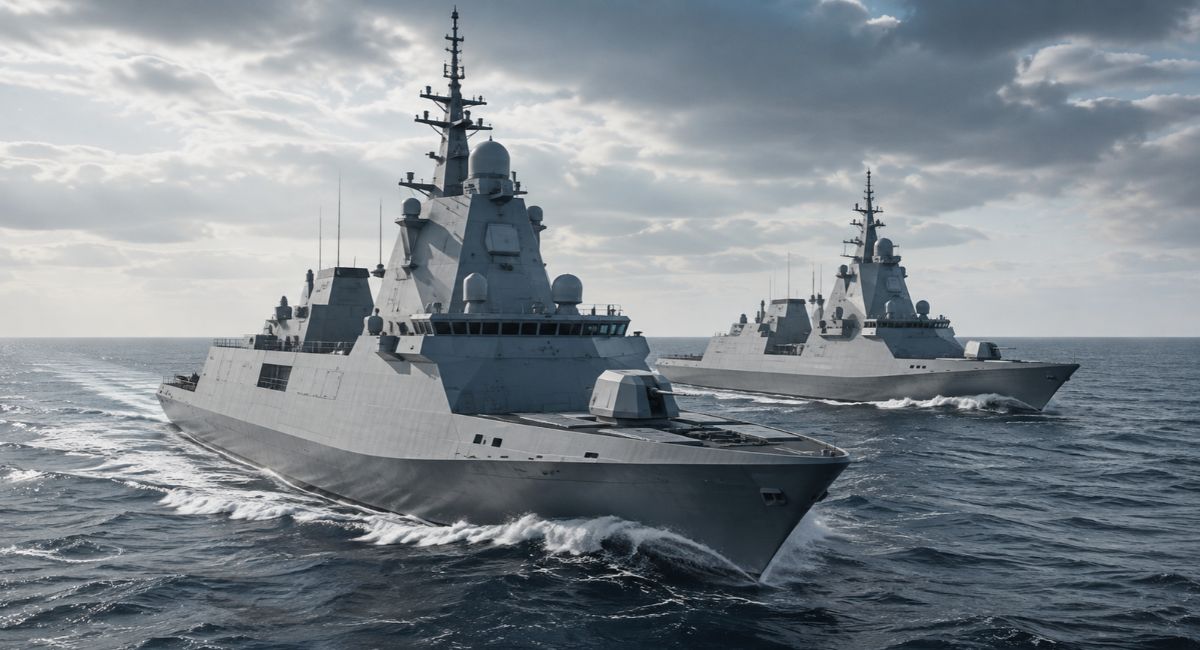
The global naval domain is undergoing a massive structural reset. For over 30 years, surface combatant design prioritized sleek profiles, reduced radar cross-sections, and moderate-displacement hulls tuned for deep-ocean, blue-water endurance.
However, the rapid emergence of hypersonic threats, high-volume uncrewed attack swarms, and high-energy defensive systems has pushed legacy hull forms to their absolute physical limits.
Navies are discovering that you cannot simply bolt modern, energy-hungry sensors and weapon arrays onto older hull frames. The recent contract award for Italy’s DDX Destroyer alongside parallel European redesigns such as the Dutch-Belgian Anti-Submarine Warfare Frigate (ASWF) program signals a major shift in how military vessels are designed. Today, naval architects build warship hull architecture from the inside out, designing ships specifically around power generation, heat management, and physical growth margins.
Physical Displacement and Growth Margins in Warship Hull Architecture
The most visible trend in modern surface combatant design is the steady growth in physical size. Vessels historically classed as mid-tier frigates or destroyers are expanding toward footprints once reserved for guided-missile cruisers.
The DDX Super-Destroyer Baseline
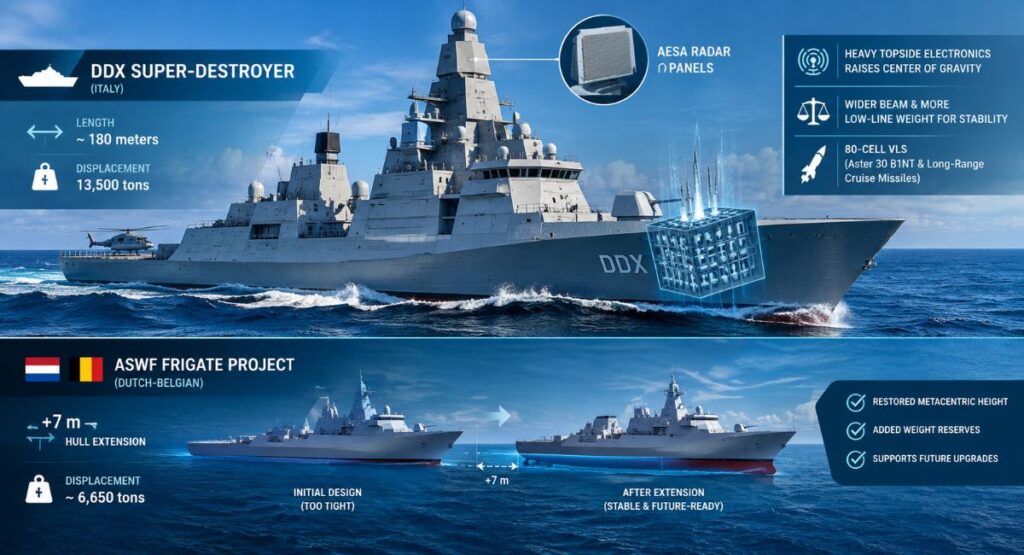
Italy’s DDX Destroyer program clearly demonstrates this shift. Spanning roughly 180 meters and displacing 13,500 tons, the DDX represents a significant leap over the Horizon-class ships it is scheduled to replace. This size increase isn’t for comfort; it is a direct engineering response to heavy topside electronics and complex weapons.
Installing fixed, four-faced Active Electronically Scanned Array (AESA) radar panels high up on a ship raises its center of gravity. To balance this top-heavy design without risking stability in rough seas, naval engineers must broaden the beam and increase low-line hull weight. The DDX uses this larger displacement to house an 80-cell vertical launch system (VLS) array designed for Aster 30 B1NT air-defense missiles and long-range cruise missiles.
The ASWF Hull Lengthening Lesson
The joint Dutch-Belgian ASWF frigate project illustrates what happens when early stability calculations miss the mark. Initial design models proved too tight to support required combat systems while maintaining safe operational margins.
Engineers had to extend the frigate’s hull by 7 meters, raising displacement from early concept levels to roughly 6,650 tons. The extension restored critical metacentric height and provided essential weight reserves for future equipment upgrades. Modern warship design demands substantial physical reserves right from the start.
Power Generation and Integrated Electric Propulsion Architecture
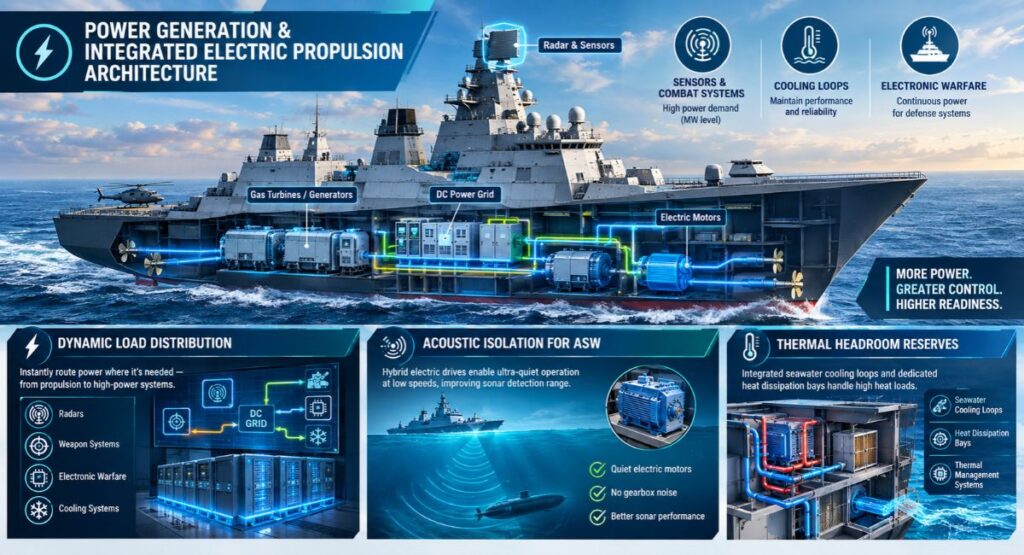
Modern combat systems have transformed warships into floating power plants. Advanced sensors, electronic warfare tools, and high-capacity cooling loops require continuous megawatt-level power.
Old-style mechanical drive arrangements where gas turbines power shafts directly through massive reduction gears are quickly disappearing. Instead, modern designs rely on high-voltage direct current (DC) distribution networks and hybrid drive systems:
Dynamic Load Distribution
Under an Integrated Electric Propulsion (IEP) layout, prime movers supply power directly to a central electrical grid. A vessel cruising at low speed can instantly route thousands of kilowatts to high-powered tracking radars or point-defense arrays without restarting secondary generators.
Acoustic Isolation for ASW
Anti-submarine warfare requires extremely quiet operation. Hybrid electric drives let ships run on electric motors at low patrol speeds, eliminating mechanical gearbox noise. This low noise floor gives hull-mounted and towed sonars clearer underwater detection ranges.
Thermal Headroom Reserves
High-power radar grids produce massive heat loads. Modern hull layouts must include integrated seawater cooling loops and dedicated heat dissipation bays to handle operational heat spikes.
Stealth Features, Acoustic Management, and Hull Geometry
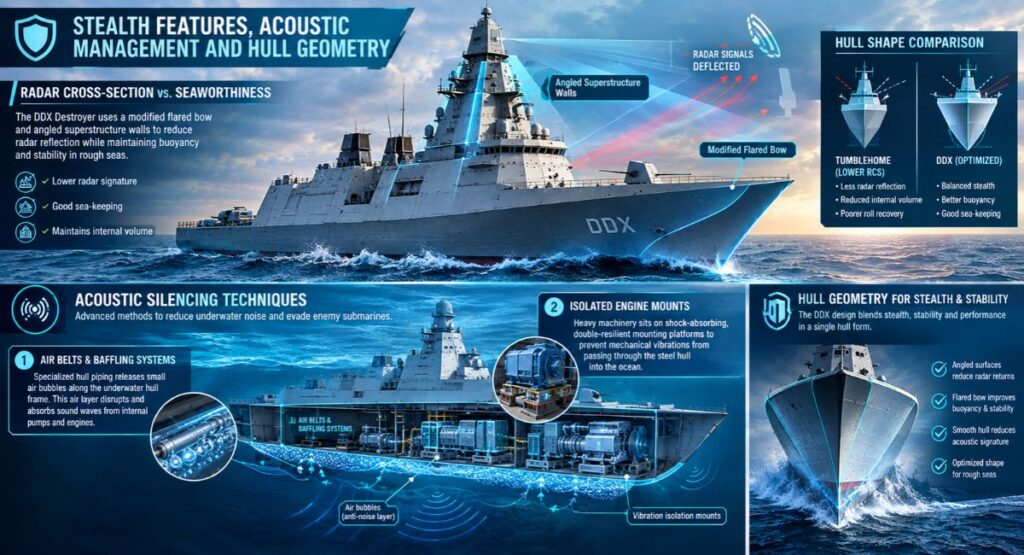
A ship’s hull form serves as its primary passive defense mechanism. Designing a hull that can survive dangerous sea environments requires balancing radar stealth, acoustic dampening, and seaworthiness.
Radar Cross-Section vs. Seaworthiness
Extreme tumblehome hulls lower radar reflection, but they restrict internal volume and can struggle to recover from heavy rolls in rough seas. The DDX Destroyer strikes a balance by using a modified flared bow and angled superstructure walls. This shape retains buoyancy reserves while bouncing incoming radar signals away from dangerous threat angles.
Acoustic Silencing Techniques
To evade enemy submarines, warship hulls use advanced sound-dampening methods:
- Air Belts and Baffling Systems: Specialized hull piping releases small air bubbles along the underwater hull frame. This air layer disrupts and absorbs sound waves produced by internal pumps and engines.
- Isolated Engine Mounts: Heavy machinery sits on shock-absorbing, double-resilient mounting platforms to prevent mechanical vibrations from passing through the steel hull into the ocean.
Operational Modularity and Uncrewed System Bays
Next-generation surface combatants must operate as command centers for autonomous air, surface, and subsurface vehicles. Supporting these off-board assets directly alters stern and superstructure layouts.
Modern designs feature dedicated, flexible mission bays located near the waterline. These spaces include standardized container slots, overhead handling cranes, and stern launch ramps.
This modular layout allows a single ship to switch operational focus quickly:
Anti-Submarine Operations
Deploying active low-frequency towed array sonars alongside uncrewed surface vessels (USVs) fitted with dipping sonars.
Mine Countermeasures
Launching uncrewed underwater vehicles (UUVs) to map underwater sea lanes safely from a distance.
Task Force Defense
Operating uncrewed aerial vehicles (UAVs) to extend radar coverage far beyond the ship’s physical horizon.
Conclusion
The structural shift highlighted by Italy’s DDX Destroyer contract and the ASWF frigate redesign proves a core lesson in modern naval strategy: the hull itself is the foundation of every weapon system. Weapons, radars, and combat software will be upgraded several times over a ship’s 40-year lifespan. However, the steel frame, electrical grid, and hydrodynamic design are locked in on day one. By building extra displacement, high electrical headroom, and modular mission spaces into modern warships, navies ensure their fleets can adapt to future technological threats.