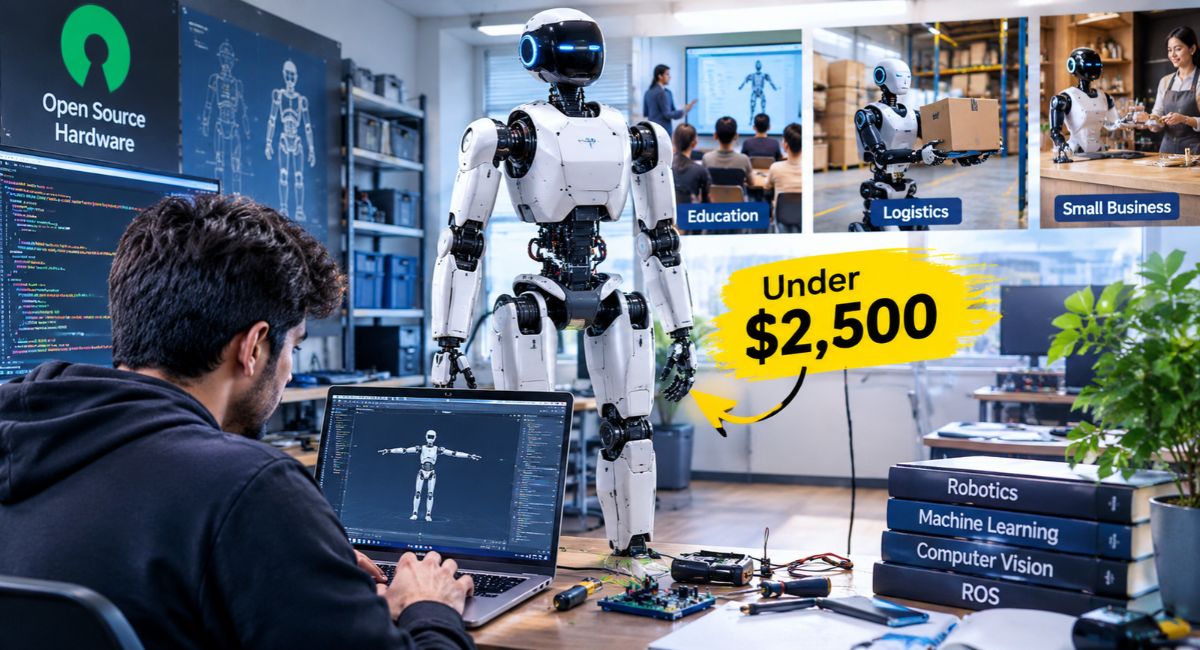
For decades, advanced humanoid robotics remained confined to high-budget university labs, elite research institutions, and multi-billion-dollar tech giants. Early bipedal prototypes often cost upwards of $100,000 to $1,000,000 per unit, making hands-on experimentation impossible for average developers, small businesses, and students. That barrier has officially broken.
Driven by rapid advancements in mass manufacturing, open-source hardware designs, and ultra-efficient Physical AI models, a new generation of functional humanoid hardware is entering the market at price points under $2,500.
This massive drop in hardware costs is causing a structural shift across the tech industry. It is moving physical AI out of theoretical research labs and directly into garages, classrooms, local logistics hubs, and small business workflows. As a result, the skill sets, software tools, and career roadmaps for artificial intelligence and robotics are being completely rewritten.
What Is the Sub-$2,500 Humanoid Pivot?
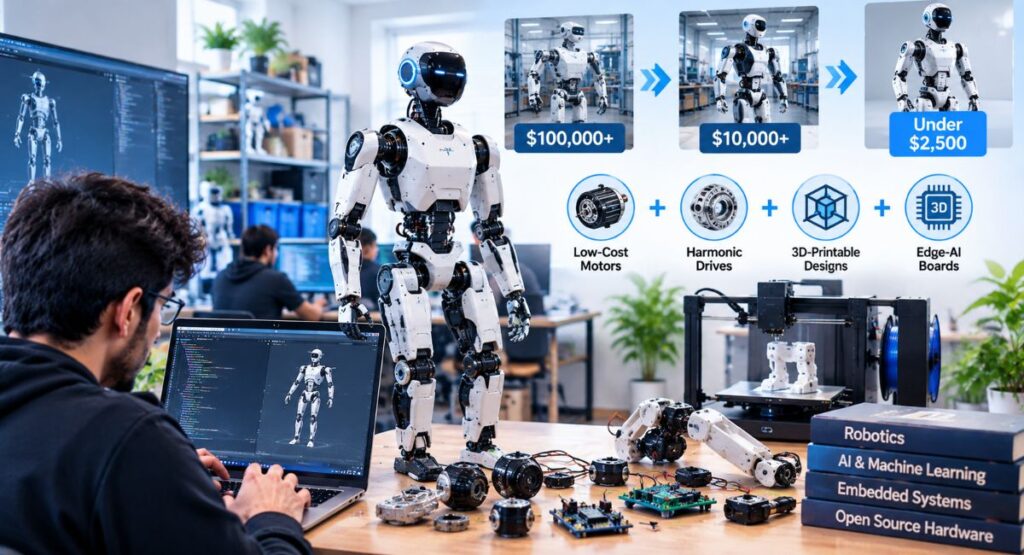
To understand why this price point matters, consider the history of personal computing. When computers occupied entire rooms and cost millions, only government agencies and large corporations could afford them. When microprocessors made PCs accessible to everyday individuals, it sparked an explosion in software development, web design, and digital entrepreneurship. The robotics sector is undergoing its own personal computer moment.
Key Drivers Behind the Price Drop
- Mass production of high-torque, lower-cost brushless motors and harmonic drives has drastically reduced component prices.
- Global engineering communities are sharing modular, 3D-printable bipedal and quadrupedal chassis designs, cutting initial R&D expenses.
- Low-power edge-AI computing boards allow complex neural networks to run directly on small, lightweight physical platforms without expensive server infrastructure.
When high-performance hardware becomes cheap, the focus shifts entirely from hardware engineering to software deployment, training, and integration.
Why Low-Cost Infrastructure Changes Career Pathways
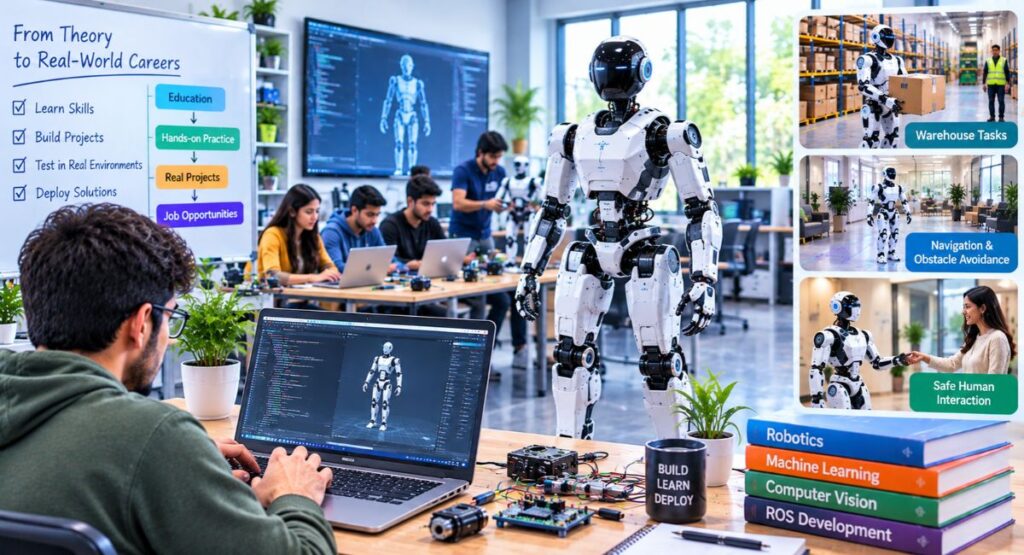
In the past, working in robotics required a Ph.D. in mechanical or electrical engineering, access to proprietary labs, and mastery of complex low-level programming languages. Today, affordable hardware infrastructure allows a far broader group of technical professionals to build, test, and deploy physical systems.
Democratization of Physical AI
Because hardware is now accessible, entry-level developers, boot camp graduates, and self-taught programmers can own a physical humanoid test platform. Rather than running code exclusively in virtual simulations, developers can test spatial intelligence, object manipulation, and locomotion in real-world environments.
The Shift from Building Hardware to Teaching Behaviors
When hardware is modular and inexpensive, tech teams no longer spend years designing custom robotic limbs or proprietary power delivery systems. Instead, the focus moves toward:
- How quickly can this unit learn a specific real-world workflow?
- How reliably can it navigate a cluttered warehouse or office floor?
- How safely can it interact with non-technical human staff?
High-Demand Career Paths in the New Robotics Landscape
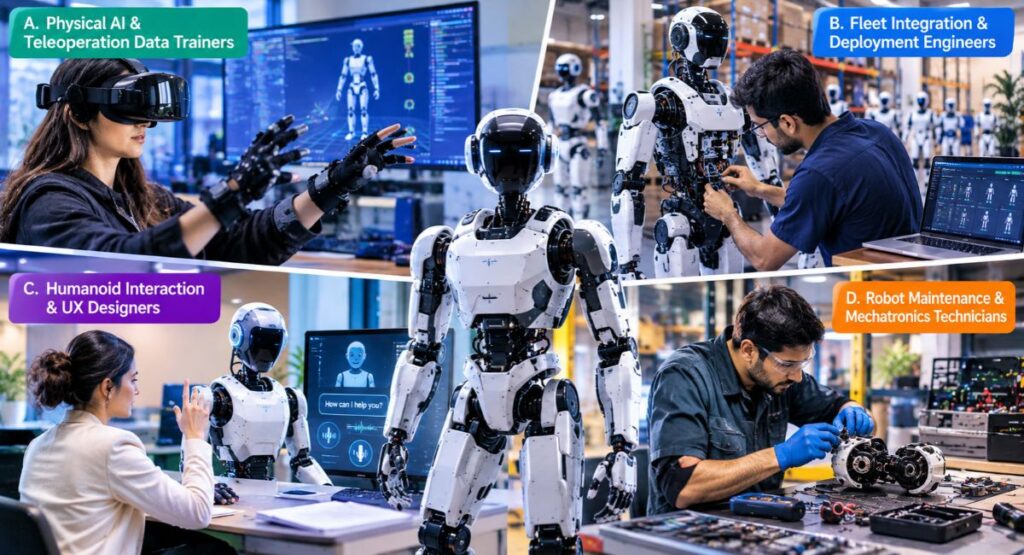
The arrival of sub-$2,500 humanoid infrastructure is expanding the job market, creating specialized roles for tech professionals across diverse backgrounds.
A. Physical AI & Teleoperation Data Trainers
Generative AI models rely on vast text and image datasets; physical humanoid models rely on spatial and movement datasets. Data trainers use virtual reality (VR) headsets, haptic gloves, or teleoperation rigs to guide low-cost humanoids through tasks like lifting boxes, sorting parts, or operating household tools. These recordings are fed into Vision-Language-Action (VLA) models, teaching the robot how to perform tasks independently.
B. Fleet Integration & Deployment Engineers
As small businesses, local fulfillment centers, and healthcare clinics deploy affordable humanoids, they need specialists to integrate these machines into existing workflows. Deployment engineers configure robot fleets, optimize local network connectivity, set up charging stations, and calibrate computer vision sensors for dynamic indoor spaces.
C. Humanoid Interaction & UX Designers
A robot working alongside humans must communicate intent clearly to prevent accidents and avoid causing stress. Interaction designers focus on voice interface design, subtle body movements, sound cues, and visual indicators that make human-robot interaction intuitive and safe.
D. Robot Maintenance & Mechatronics Technicians
Even budget-friendly robots experience mechanical wear and tear, burnt-out actuators, or damaged visual sensors over time. Technicians specializing in modular repairs, sensor recalibration, and battery pack management keep humanoid fleets operational with minimal downtime.
Key Skill Sets for the Sub-$2,500 Era
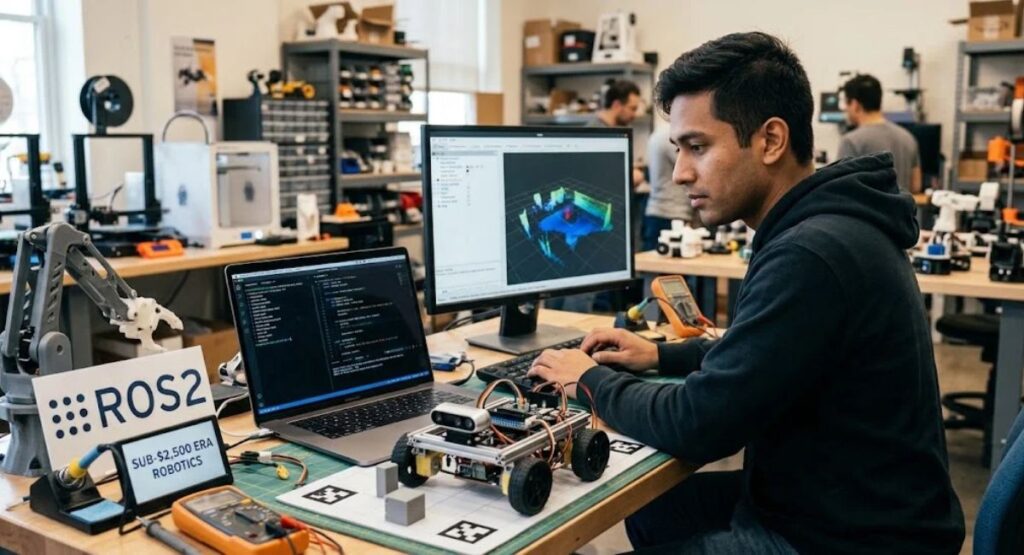
If you are looking to enter or transition into this field, you do not need to start from scratch. Modern robotics leverages many software skills used in traditional web and app development.
Essential Technical Skills
- ROS2 (Robot Operating System 2): The industry-standard open-source framework for building robotic applications, handling message passing, sensor data streams, and motor control commands.
- Computer Vision & Perception: Knowledge of OpenCV, depth-sensing camera integration (e.g., LiDAR, RGB-D), and object detection algorithms.
- Simulation Environments: Familiarity with tools like NVIDIA Isaac Sim or Gazebo to train and test movement policies in virtual worlds before uploading them to physical devices.
- Python & Embedded C++: Python serves as the primary language for AI training and high-level logic, while C++ handles low-level motor drivers and real-time execution
How Beginners Can Get Started Today
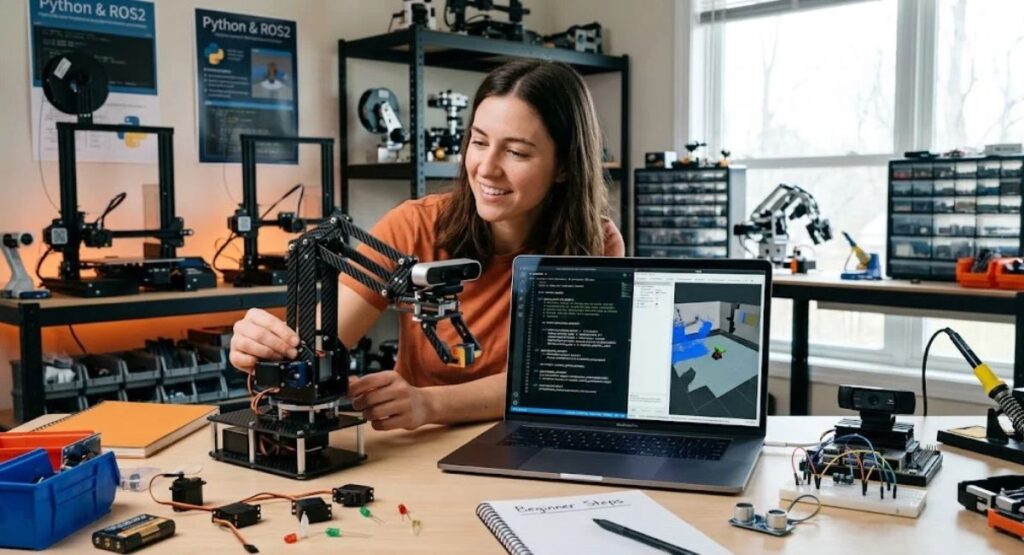
Transitioning into physical AI and affordable robotics does not require massive funding or a specialized university degree. You can build a competitive portfolio with a practical, step-by-step approach:
- Master the Basics of Python and ROS2
Start with free online documentation, tutorials, and community forums. Understanding how software nodes communicate is foundational to all modern robotics.
- Practice in Free Simulation Environments
Download Gazebo or NVIDIA Isaac Sim. You can import open-source humanoid models and practice writing movement and navigation code without spending money on physical hardware.
- Experiment with Modular Hardware
Build small projects using single-board computers (like an NVIDIA Jetson Nano or Raspberry Pi) paired with basic servo motors and a depth camera.
- Document Your Work Publicly
Share your code on GitHub, post demonstration videos of your simulated or physical projects on LinkedIn, and contribute to open-source physical AI projects.
Conclusion
The sub-$2,500 humanoid pivot marks a shift in how we build, deploy, and scale technology. By removing historical cost barriers, low-cost hardware infrastructure has shifted AI’s center of gravity from pure software algorithms to hands-on, physical execution.
Whether your background is in software engineering, data management, design, or practical troubleshooting, the expansion of physical AI creates accessible entry points for motivated learners. The future of robotics is no longer locked behind high-budget corporate doors; you can build, customize, and deploy it.