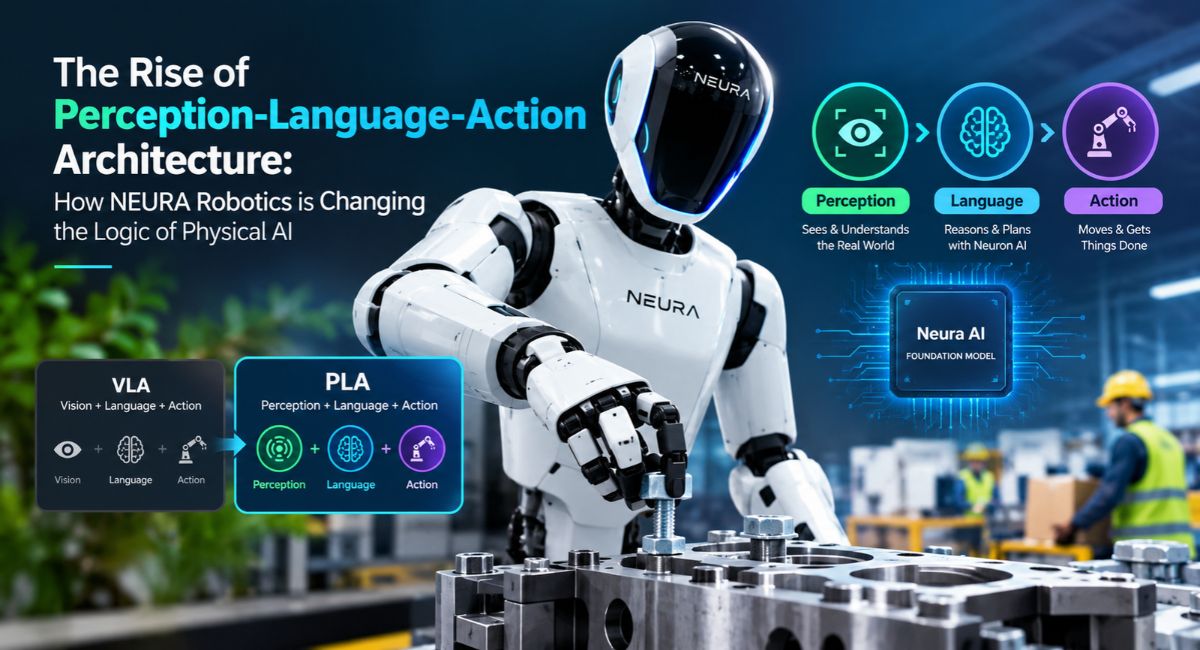
For years, artificial intelligence lived behind screens. It wrote text, generated images, and analyzed spreadsheet data. But when AI steps out of the digital realm and into the real world, the rules change entirely. Digital AI can afford to guess; a physical robot working near human workers cannot.
To bridge this gap, Physical AI has evolved rapidly. Early robotics relied heavily on Vision-Language-Action (VLA) model systems that essentially gave robots eyes (cameras) and a brain (language models) to guide their movements. While impressive, relying on vision alone has clear limits. Cameras can be blinded by glare, blocked by obstacles, or unable to judge if a bolt is fully tightened.
Enter NEURA Robotics and their groundbreaking Perception-Language-Action (PLA) architecture. Powered by their flagship foundation model, Neuron AI, this new paradigm is changing how machines perceive, process, and respond to the physical world.
This article explains what PLA architecture is, why it matters, and how it is redefining the future of robotics.
What Is Perception-Language-Action (PLA) Architecture?
To understand PLA, think about how humans complete everyday tasks. When you plug a cable into a socket, you don’t just rely on your eyes. You feel the plastic align, hear the click when it snaps into place, and remember where the outlet is even if your hand blocks your view.
Traditional VLA models process what a robot sees and turn that into motion. Perception-Language-Action (PLA) architecture goes several steps further. It connects every sensory input vision, touch, force, and sound alongside persistent spatial memory, translating it all into physical action.
By fusing these inputs into a unified spatial intelligence layer, PLA architecture gives machines a true sense of physical cause and effect.
The Core Layers of PLA Architecture
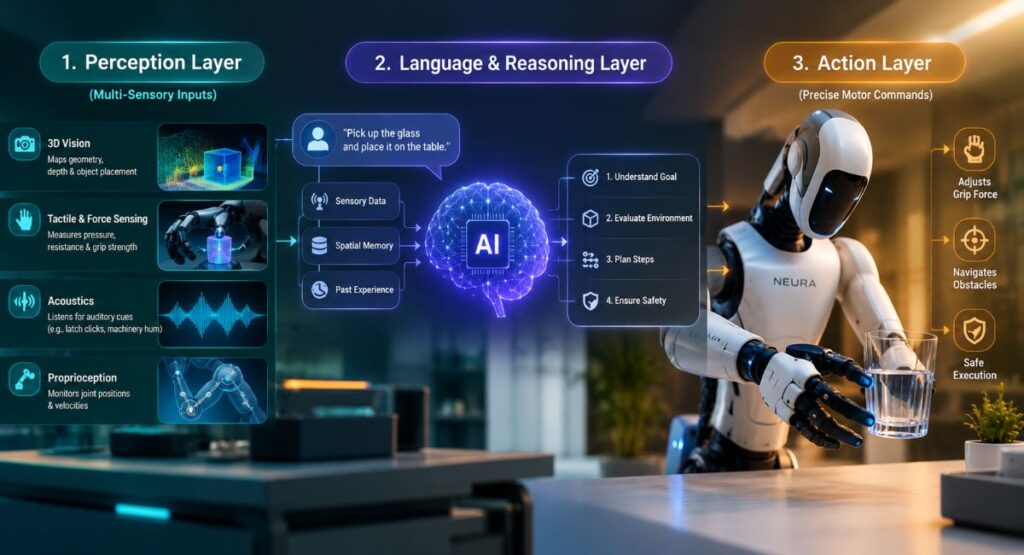
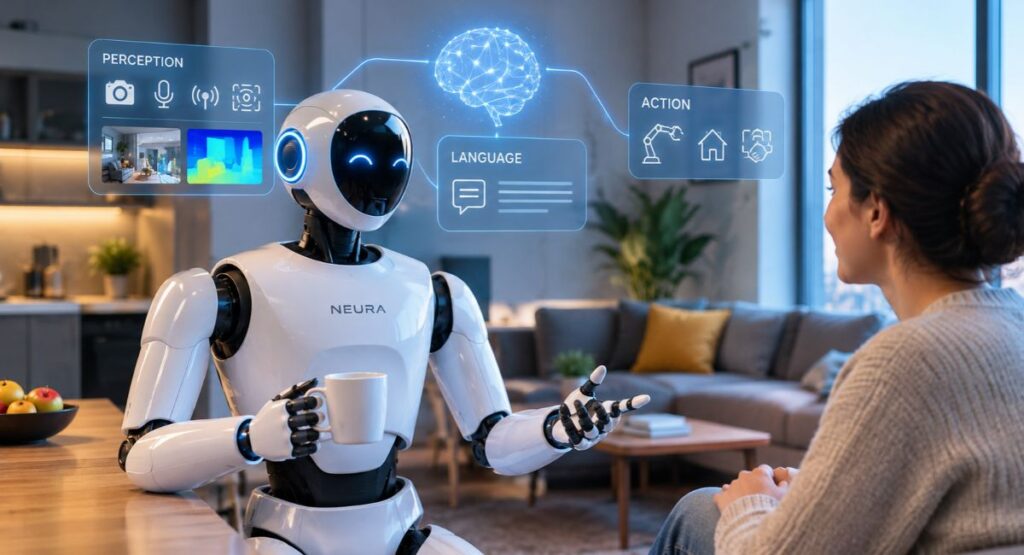
NEURA Robotics structures its PLA framework into three seamless layers that function together in real time:
1. The Perception Layer (Multi-Sensory Inputs)
Instead of capturing flat 2D images, the perception layer ingests a rich stream of environmental data:
- 3D Vision: Maps physical geometry, spatial depth, and object placement in real time.
- Tactile and Force Sensing: Measures contact pressure, resistance, and grip strength.
- Acoustics: Listens for auditory cues like a latch clicking or the distinct hum of industrial machinery.
- Proprioception: Monitors internal motor joint positions and velocities.
2. The Language & Reasoning Layer
This is where the robot turns raw sensory data into understanding. The language model unifies spoken or written human instructions with the incoming sensory inputs. It evaluates the goal, cross-references historical spatial memory, and plans the logical sequence of steps required to complete the task safely.
3. The Action Layer
Once a decision is made, the action model translates high-level reasoning into smooth, precise motor commands. Whether it is adjusting grip force on a delicate glass or maneuvering past an unexpected obstacle, the action layer ensures safe physical execution.
Why Vision Alone Isn’t Enough: VLA vs. PLA
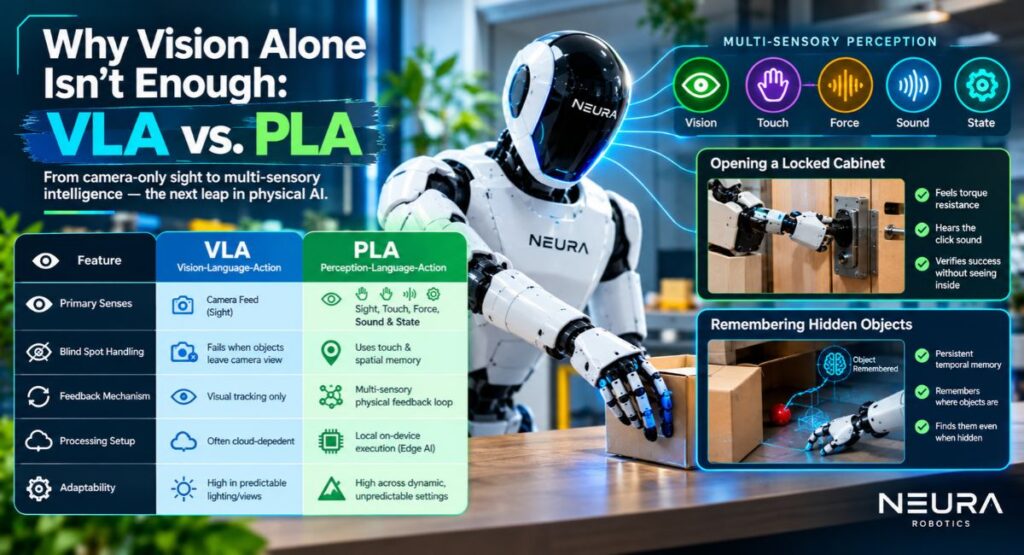
For a long time, vision-centric robotics seemed sufficient for structured environments like assembly lines. However, complex, unstructured human environments expose the limits of camera-only systems.
| Feature | Vision-Language-Action (VLA) | Perception-Language-Action (PLA) |
| Primary Senses | Camera Feed (Sight) | Sight, Touch, Force, Sound & State |
| Blind Spot Handling | Fails when objects leave camera view | Uses touch & spatial memory |
| Feedback Mechanism | Visual tracking only | Multi-sensory physical feedback loop |
| Processing Setup | Often cloud-dependent | Local on-device execution (Edge AI) |
| Adaptability | High in predictable lighting/views | High across dynamic, unpredictable settings |
The Power of Spatial Memory and Tactile Feeling
Consider opening a locked cabinet. A camera cannot see inside the keyhole to check if the lock tumbler turned. A PLA-powered robot feels the torque resistance and hears the internal mechanism click, verifying success without needing to see it.
Similarly, if an object drops behind a box, a standard VLA model often forgets it exists. PLA architectures incorporate persistent temporal memory, allowing the robot to remember where objects are even when hidden from view.
How NEURA Robotics Is Realizing Physical AI
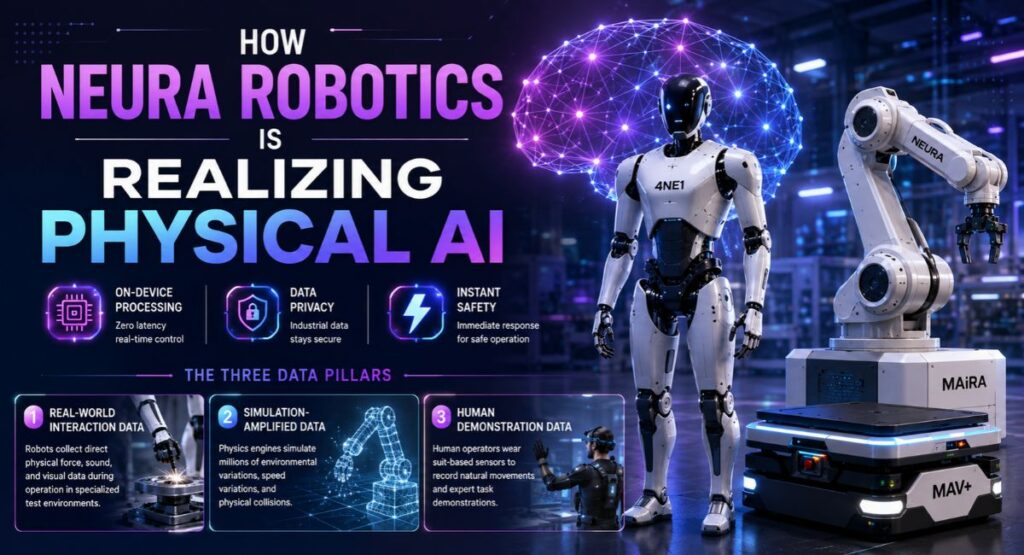
NEURA Robotics has integrated this concept into real-world applications through its foundation model, Neuron AI. Developed in Germany, this software framework runs directly on the robot itself (on-device processing).
Running AI locally on the hardware eliminates network latency, guarantees immediate safety reactions, and ensures industrial data privacy.
By deploying one unified PLA model across different form factors from humanoid assistants like 4NE1 to industrial collaborative arms (MAiRA) and mobile vehicles (MAV+), NEURA Robotics has created a cross-platform system for Physical AI.
Training the Machine: The Three Data Pillars
Training a multi-sensory physical model requires diverse data sources. NEURA builds its intelligence through three complementary training channels:
- Real-World Interaction Data: Robots collect direct physical force, sound, and visual data during operation in specialized test environments.
- Simulation-Amplified Data: Physics engines simulate millions of environmental variations, speed variations, and physical collisions.
- Human Demonstration Data: Human operators wear suit-based sensors to record natural movements and expert task demonstrations.
Real-World Applications of PLA Architecture
Combining multi-sensory cognition with physical execution unlocks opportunities across multiple industries:
- Advanced Manufacturing
Welding robots can listen to the arc sound to monitor weld seam quality in real time. Assembly robots can feel bolt tension without relying on strict, pre-programmed positions.
- Healthcare and Logistics
Healthcare helper robots can navigate crowded hospital corridors safely, handling fragile medical supplies with precise pressure control.
- Domestic Assistance
Humanoid robots can perform intricate multi-step household chores, such as picking up clothes, sorting fabrics, loading a washing machine, and transferring laundry to a dryer completely autonomously.
The Road Ahead for Physical AI
The transition from visual-only robotic systems to true Perception-Language-Action architecture marks a milestone in robotics history. By unifying multi-sensory perception, cognitive reasoning, and motor execution, systems like NEURA Robotics’ Neuron AI bring machines closer to human-like intuition.
As these technologies continue to evolve, robots will move beyond structured factory floors and comfortably enter daily human environments, working alongside us safely, efficiently, and intelligently.
Conclusion
The rise of Perception-Language-Action architecture represents a fundamental paradigm shift in Physical AI. By equipping robots with 3D sight, sound, touch, and spatial memory, NEURA Robotics is solving the long-standing bottlenecks of camera-dependent systems. As PLA models continue to mature, they will set a new benchmark for how artificial intelligence interacts with the physical world.