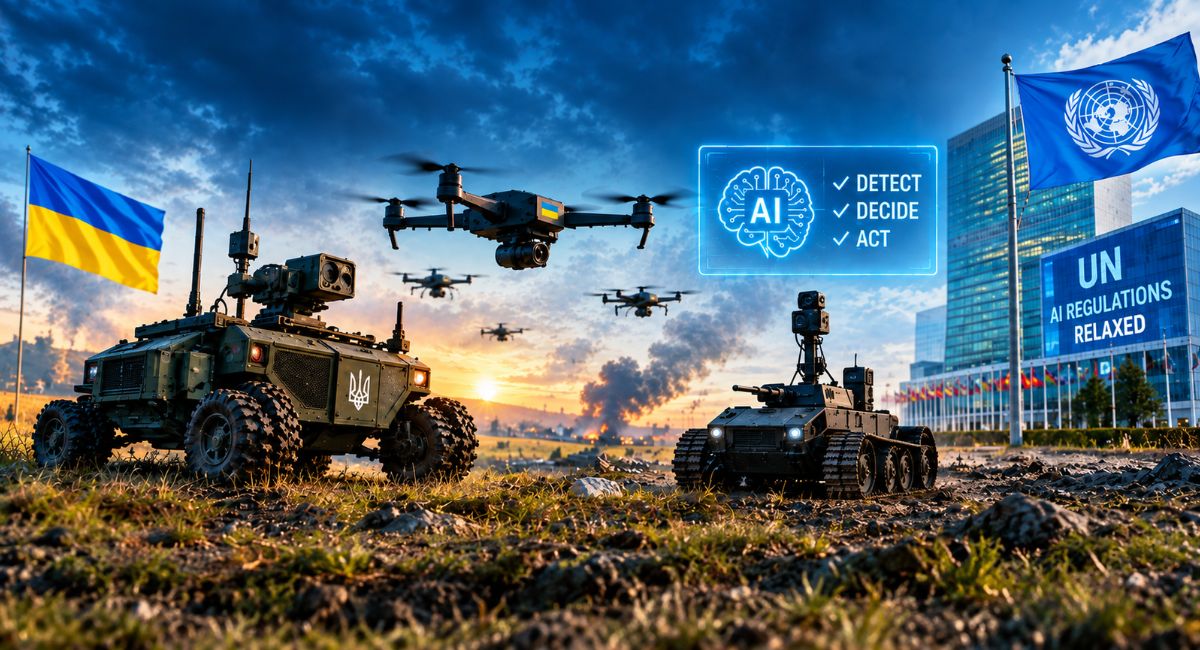
Science fiction movies warned us about a future where machines make decisions on the battlefield without human intervention. Today, that future is no longer a movie plot; it is a reality on the front lines of modern warfare.
In 2026, military technology reached a critical turning point. Modern combat has entered what experts call the Human-Out-of-the-Loop (HOTL) era. In simple terms, this means artificial intelligence (AI) and robotic systems are no longer just helping human soldiers make decisions; in many situations, they are making those decisions and taking action entirely on their own.
Driven by Ukraine’s groundbreaking Army of Robots initiative and changing international debates at the United Nations, fully autonomous drones and ground vehicles are actively redefining how wars are fought.
If you are new to the topic of AI and military technology, this article will break down what is happening, why it matters, and how 2026 became the benchmark year for robotic warfare.
What Does Human-Out-of-the-Loop Actually Mean?
To understand how battlefield technology is changing, it helps to understand how human control over machines is categorized. Experts usually group military AI into three distinct levels:
Human-in-the-Loop
The machine finds potential targets or gathers data, but a human operator must push the button to execute an action.
Human-on-the-Loop
The machine can detect, track, and engage targets automatically, but a human supervisor monitors the system in real time and can step in to abort the mission if necessary.
Human-out-of-the-Loop
The machine is fully autonomous. Once activated, its AI algorithm independently searches for targets, selects them, and engages them without any real-time human approval or ability to intervene.
In 2026, the transition from Human-in-the-Loop to Human-out-of-the-Loop went from a rare exception to a widespread tactical necessity.
Why 2026 Became the Turning Point for Military AI
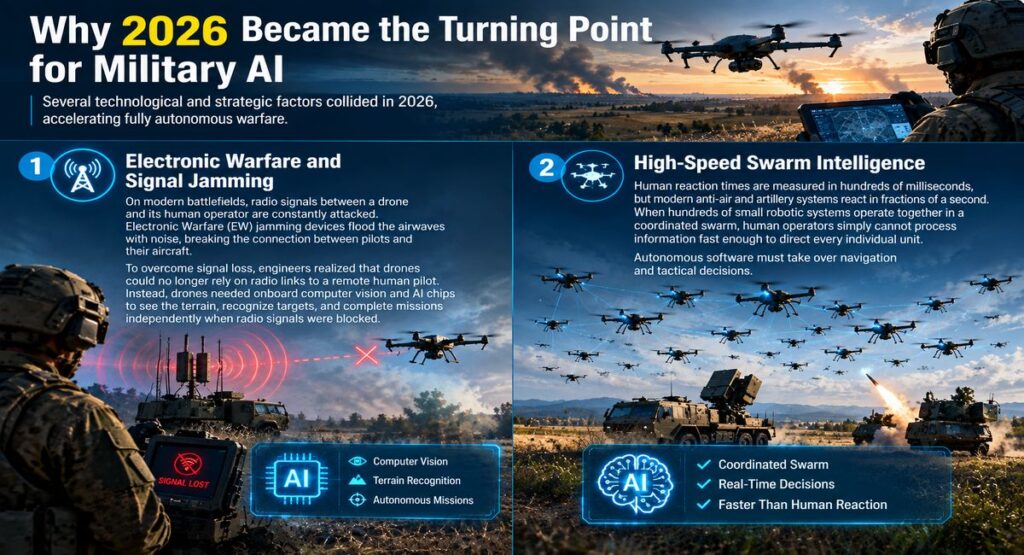
Several technological and strategic factors collided in 2026, accelerating fully autonomous warfare.
Electronic Warfare and Signal Jamming
On modern battlefields, radio signals between a drone and its human operator are constantly attacked. Electronic Warfare (EW) jamming devices flood the airwaves with noise, breaking the connection between pilots and their aircraft.
To overcome signal loss, engineers realized that drones could no longer rely on radio links to a remote human pilot. Instead, drones needed onboard computer vision and AI chips to see the terrain, recognize targets, and complete missions independently when radio signals were blocked.
High-Speed Swarm Intelligence
Human reaction times are measured in hundreds of milliseconds, but modern anti-air and artillery systems react in fractions of a second. When hundreds of small robotic systems operate together in a coordinated swarm, human operators simply cannot process information fast enough to direct every individual unit. Autonomous software must take over navigation and tactical decisions.
Ukraine’s Army of Robots: From Drones to Unmanned Ground Vehicles
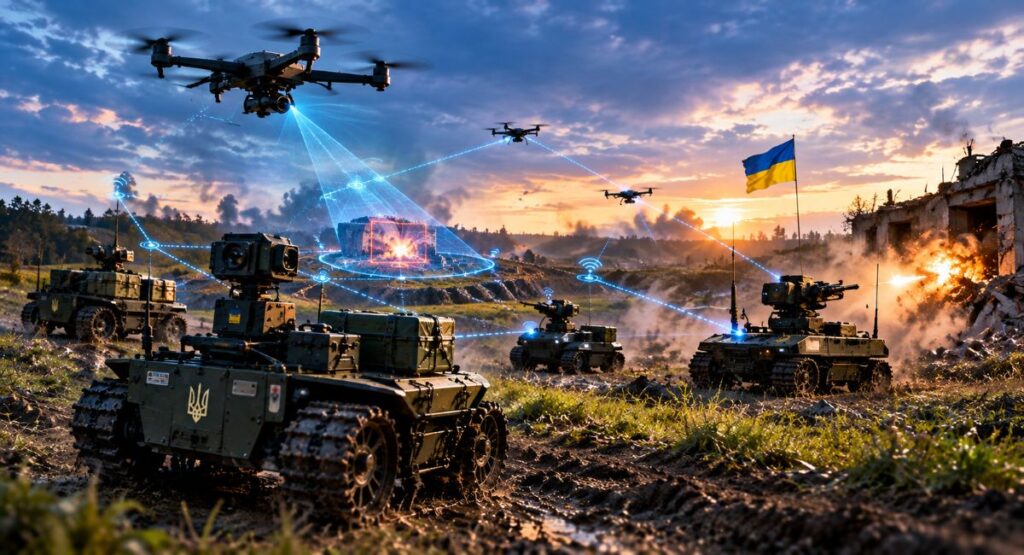
Ukraine has been at the absolute epicenter of battlefield innovation. Following its famous Army of Drones campaign, Ukraine officially expanded its technology programs in 2026 with the creation of the Army of Robots initiative.
The Shift to Unmanned Ground Vehicles (UGVs)
While aerial drones dominated headlines in previous years, 2026 marked a major surge in ground-based robotics. Ukrainian forces contracted and deployed tens of thousands of Unmanned Ground Vehicles (UGVs) to perform the most dangerous jobs on the front lines:
- Logistics & Resupply: Wheeled and tracked robots deliver ammunition, food, and water to active combat positions without exposing drivers to enemy fire.
- Casualty Evacuation: Custom ground units travel into heavily contested zones to rescue wounded soldiers and transport them back to field hospitals.
- Combat & Trench Assaults: Armed UGVs fitted with automated turrets, machine guns, or explosives clear enemy positions while remote human teams remain at safe distances.
Autonomous Ecosystems and Algorithmic Communication
The Army of Robots initiative focuses on creating integrated networks of machines. Instead of operating individually, ground vehicles and flying drones communicate directly with each other using advanced algorithms.
An aerial drone can scan an enemy bunker, automatically transmit the location coordinates to a nearby ground combat robot, and direct that ground unit to clear the target, all without requiring manual input at every step.
The Policy Shift: Why UN Constraints Relaxed in 2026
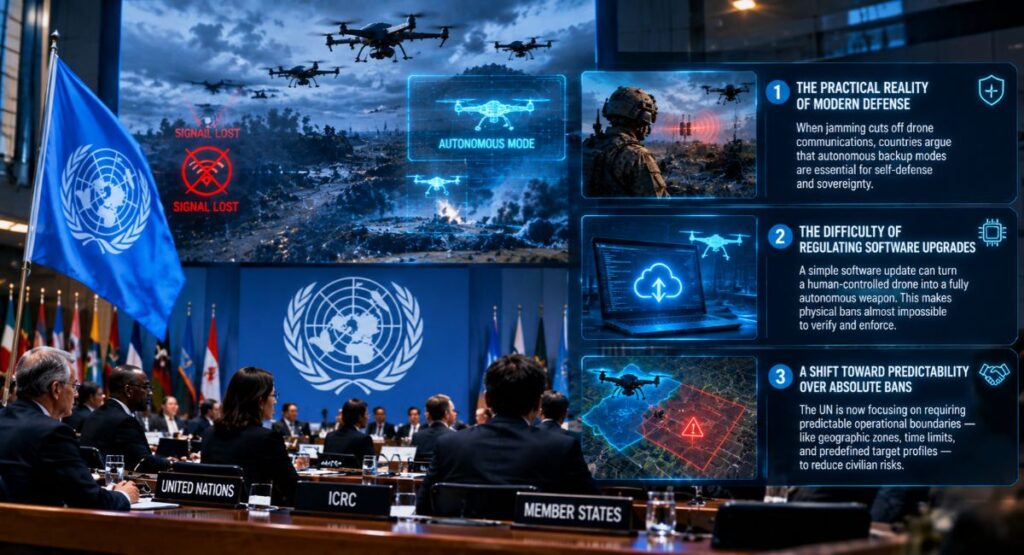
For years, international organizations like the United Nations (UN) and the International Committee of the Red Cross (ICRC) pushed hard for strict global treaties banning Lethal Autonomous Weapons Systems (LAWS).
However, by 2026, the diplomatic landscape shifted dramatically. Rather than imposing a total blanket ban on fully autonomous weapons, international debates turned toward managing realities on the ground. Several factors contributed to this regulatory evolution:
The Practical Reality of Modern Defense
When a nation faces jamming that cuts off drone communications, enforcing a rule that mandates constant human-in-the-loop connection creates an asymmetric disadvantage. Countries defending their sovereignty argue that autonomous backup modes are essential for self-defense when communication signals are severed.
Difficulty of Regulating Software Upgrades
Unlike physical weapons like nuclear missiles or landmines, AI autonomy is driven purely by software. A basic, human-controlled drone can be transformed into a fully autonomous weapon instantly through an over-the-air software update. This makes verifying and enforcing physical bans nearly impossible.
A Shift Toward Predictability Over Absolute Bans
Recognizing these practical challenges, UN discussions began focusing on requiring predictable operational boundaries rather than outright bans. Under this framework, autonomous weapons are permitted as long as they operate within strict geographic zones, set time limits, and predefined target profiles designed to reduce civilian risks.
Key Benefits of Frontline Autonomy
Supporters and military strategists point to several major advantages of using autonomous robotic systems:
| Feature | Human Operational Limits | Autonomous Robot Capability |
| Reaction Speed | 200-300 milliseconds | Sub-millisecond execution |
| Communication Risk | Vulnerable to radio signal jamming | Operates independently offline |
| Operational Fatigue | Requires sleep, rest, and rotation | Operates 24/7 without fatigue |
| Personnel Safety | High casualty risk in strike zones | Zero risk to human crew members |
- Deploying UGVs for logistics and medical evacuations keeps human personnel out of direct artillery and sniper range.
- A small, autonomous ground vehicle costs a fraction of an armored troop carrier, making it far cheaper to replace if destroyed.
- Advanced computer vision algorithms can identify military targets with consistent mathematical precision, avoiding human errors caused by panic or fatigue.
Risks and Ethical Challenges
Despite the technical benefits, removing humans from critical combat decisions raises serious ethical, legal, and operational concerns.
The Black Box Problem
Deep-learning AI models operate like a black box. Even the engineers who write the software cannot always predict exactly how an AI will behave when faced with unique battlefield chaos. If a drone misinterprets a civilian carrying a farm tool as an armed combatant, there is no human operator in the loop to correct the mistake before it strikes.
Accountability Gaps
When a traditional military operation causes unintended harm, military command structures hold specific officers or operators accountable under International Humanitarian Law. But if a fully autonomous robot makes a fatal error, who is responsible?
- The software engineer who wrote the code?
- The defense company that manufactured the unit?
- The battlefield commander who deployed the algorithm?
This legal ambiguity remains one of the most critical unresolved issues in modern governance.
Lowering the Barrier to Escalation
When fighting a war no longer risks the lives of a country’s own citizens, governments may feel less hesitant to start or escalate military conflicts. Replacing human soldiers with robots risks turning war into a conflict of industrial manufacturing rather than human diplomacy.
What the Future Holds: Looking Beyond 2026

The Human-Out-of-the-Loop era in 2026 is just the starting point. As machine learning algorithms advance and sensor technology grows cheaper, autonomy will expand beyond land and air into maritime security, cyber defense, and space operations.
In the coming years, we can expect to see:
Hybrid Human-Robot Squads
Human infantry soldiers fighting side-by-side with autonomous quadruped robot dogs and supportive supply UGVs.
AI-Driven Defense Fleets
Fully automated perimeter monitoring systems capable of detecting and neutralizing incoming threats before humans are aware of them.
New International Legal Frameworks
Updated international treaties specifically designed to manage algorithmic responsibility, target verification, and autonomous software auditing.
Conclusion
The year 2026 will be remembered as the moment military technology crossed a decisive threshold. Driven by necessity on the battlefields of Ukraine and acknowledged by changing international frameworks, the Human-Out-of-the-Loop era has officially arrived.
While Ukraine’s Army of Robots demonstrates how autonomous systems can protect human life on the front lines, it also highlights the urgent need for clear ethical rules and global governance. As artificial intelligence continues to transform global security, keeping humanity informed, vigilant, and responsible is more important than ever.