
Artificial intelligence has completely reshaped the modern landscape. From chatbots answering everyday questions to advanced algorithms creating artwork and automating entire business operations, AI feels unstoppable. Big tech corporations, venture capitalists, and startups have poured astronomical amounts of money into AI in recent years.
However, a serious warning from top industry analysts is making waves across global financial markets. A detailed Gartner research report estimates that more than $3.5 trillion in AI infrastructure spending could be impaired by 2030.
In simple terms, an impairment means that companies are spending trillions of dollars building physical hardware, server facilities, and data centers that may never generate enough revenue to pay for themselves.
This raises an uncomfortable question: Is the technology industry accidentally building a massive software bubble that is destined to burst?
If you feel confused by terms like asset write-downs, neoclouds, or capital expenditure, do not worry. This article explains what’s happening, why it matters, and where tech goes next.
What Is the $3.5 Trillion AI Impairment Warning?

To understand the core problem, start with the basic numbers driving this warning.
Tech companies are building data centers, massive facilities packed with powerful computer chips (like GPUs) at an unprecedented pace. Financial forecasts project companies will spend roughly $7 trillion on AI infrastructure through the end of the decade.
When a company builds a massive data center, it expects to earn that money back by selling AI subscriptions, cloud services, and enterprise software. To pay off the hardware, financing fees, and deliver a standard return on investment, the industry would need to collect roughly $8.5 trillion in cumulative revenues by 2030.
The Revenue Gap
Here is where the math runs into trouble:
- Total Spending Needed: ~$8.5 Trillion
- Projected AI Revenue: ~$3.6 Trillion
- The Shortfall: Over $3.5 Trillion
Because expected revenues cover less than half of the total costs, analysts warn that trillions of dollars spent on computer hardware and facilities will eventually have to be marked down as lost value on accounting ledgers. This loss of value is what accountants refer to as asset impairment.
What Is a Software Bubble and How Does It Form?

A financial bubble occurs when the price or investment level in an asset class far outpaces its real-world economic value or profit potential.
We have seen this happen before in technology history:
The Dot-Com Crash of 2000
During the late 1990s, investors poured billions of dollars into any company with Dot-com in its name. Thousands of miles of fiber-optic internet cables were laid underground. When most of those early internet startups failed to generate real revenue, the stock market crashed, and trillions in paper wealth disappeared.
Interestingly, that physical infrastructure the underground fiber cables eventually powered the modern internet years later, but many early investors lost everything in the short term.
The Current AI Parallel
Today, industry experts worry that history is repeating itself. Instead of fiber-optic cables, tech firms are rushing to buy hundreds of thousands of high-end microchips, construct sprawling server parks, and sign massive power agreements.
While AI software is genuinely useful, the current pace of spending reflects a gold-rush mentality: everyone is trying to build the plumbing for AI at the same time, assuming customer demand will grow exponentially forever.
Why Are Tech Companies Spending So Much Money?

If the math looks risky, why are tech leaders continuing to invest billions every single month? The answer lies in competitive pressure and rapid technological evolution.
Fear of Missing Out (FOMO)
For giant tech conglomerates (often called hyperscalers like Microsoft, Google, Amazon, and Meta), building AI capacity is seen as a matter of survival. No CEO wants to be the executive who underinvested and lost market dominance to a rival. The risk of being left behind feels far worse than the risk of spending too much money.
The Fast Hardware Refresh Cycle
Unlike traditional buildings or factories that last for decades, AI computer hardware depreciates rapidly.
- A standard data center building might last 30 years.
- An advanced AI chip becomes outdated in just 3 to 5 years as newer, faster microchips hit the market.
Because chips age so quickly, companies do not have decades to earn back their money. They must generate massive revenues immediately before their current hardware becomes obsolete.
Who Is Most at Risk? Big Tech vs. Specialized Cloud Providers
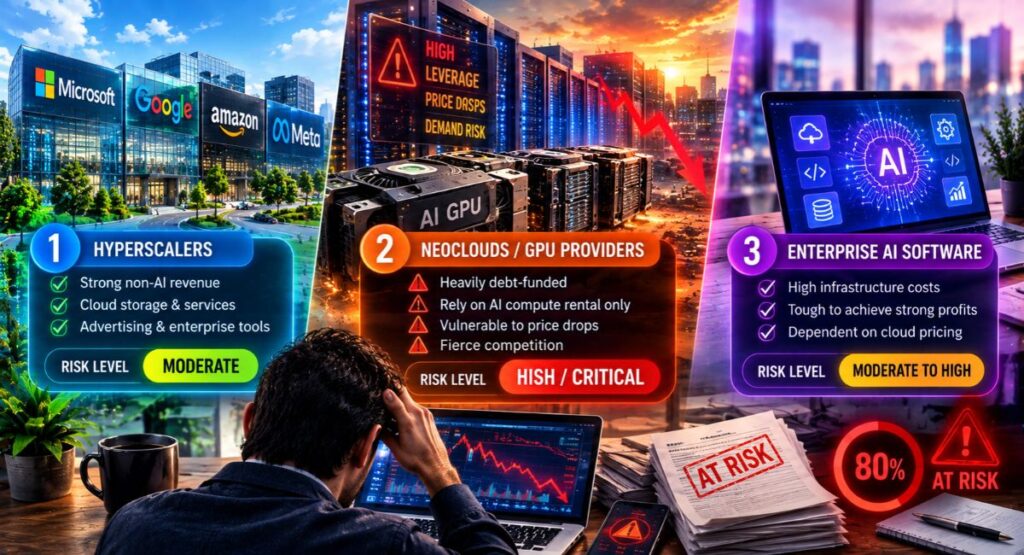
Not all tech companies are in the same financial boat. The impact of this spending gap will likely hit different market players in very different ways.
| Category | Typical Examples | Risk Level | Why? |
| Hyperscalers | Microsoft, Alphabet, Amazon | Moderate | They have massive, highly profitable non-AI businesses (cloud storage, advertising, enterprise tools) to cushion the blow. |
| Neoclouds / GPU Providers | Specialized AI cloud platforms | High / Critical | Over 80% rely almost entirely on renting out AI compute power. If pricing drops or demand slows, they lack alternative revenue. |
| Enterprise AI Software | Startups building AI apps | Moderate to High | High infrastructure costs make it difficult for software startups to achieve strong profit margins. |
The Threat to Neoclouds
Specialized providers, often termed neoclouds, borrow heavily to buy AI chips and build specialized infrastructure. Gartner predicts that cost pressures and fierce competition could force over 80% of independent neocloud providers to cease independent operations or consolidate by 2030.
The Enterprise Productivity Paradox
Why isn’t consumer and corporate spending keeping up with all this new computer power?
This gap stems from what economists call the productivity paradox. While millions of everyday users love playing with conversational AI tools, enterprise adoption inside large corporations is moving at a much slower pace.
- High Implementation Costs
Integrating AI into old enterprise software systems requires rewriting code, retraining staff, and reconfiguring databases.
- Unclear Return on Investment (ROI)
Many corporations report that while AI saves a few minutes here and there, it has not yet drastically reduced overall operating costs.
- Data Privacy and Security
Large banks, healthcare systems, and legal firms are hesitant to feed sensitive business data into cloud-based AI models due to regulatory concerns.
Until businesses find ways to turn AI into predictable, game-changing profits, software subscription prices cannot grow fast enough to justify a $7 trillion buildout.
What Happens If the AI Infrastructure Bubble Bursts?

If a major correction or write-down occurs over the coming years, what does that actually look like for everyday consumers, workers, and investors?
Market Consolidation and Mergers
Smaller AI cloud companies will likely be acquired by larger tech giants at heavy discounts. Instead of hundreds of independent AI infrastructure startups, a handful of mega-corporations will end up owning most of the compute capacity.
Shift Toward Smarter Spending
Rather than endlessly building massive data centers, companies will pivot toward capital efficiency. Developers will focus on building smaller, more efficient AI models that run locally on laptops or smartphones rather than requiring massive cloud server farms.
Cheaper Compute for Developers
Just like the excess fiber-optic cable from the year 2000 made high-speed internet cheap and accessible for the next generation of web companies, an oversupply of AI data centers could eventually drive down the cost of using AI for developers in the long run.
Key Takeaways for Beginners
- The Core Issue
Tech companies are spending roughly $7 trillion building AI servers and data centers, but projected revenue by 2030 is less than half that amount.
- What Impairment Means
Over $3.5 trillion in infrastructure may lose accounting value because it cannot earn back its original cost in time.
- It Is Not the End of AI
The technology itself is powerful and here to stay. The warning is about financial overbuilding, not the usefulness of artificial intelligence.
- Expect Realignment
Expect tech giants to tighten budgets, consolidate smaller cloud providers, and focus heavily on proving real ROI for enterprise customers.
Conclusion
The $3.5 trillion AI impairment warning serves as a healthy reality check for an industry moving at breakneck speed. Artificial intelligence is undoubtedly one of the most transformative technologies of our era. However, building physical capacity faster than the market can create sustainable business value creates significant financial risk.
As the tech sector matures past the initial rush, the focus will inevitably shift from how fast we can build to how efficiently we can create real economic value. The upcoming years will separate the companies that merely spent heavily from those that built sustainable, profitable AI products.