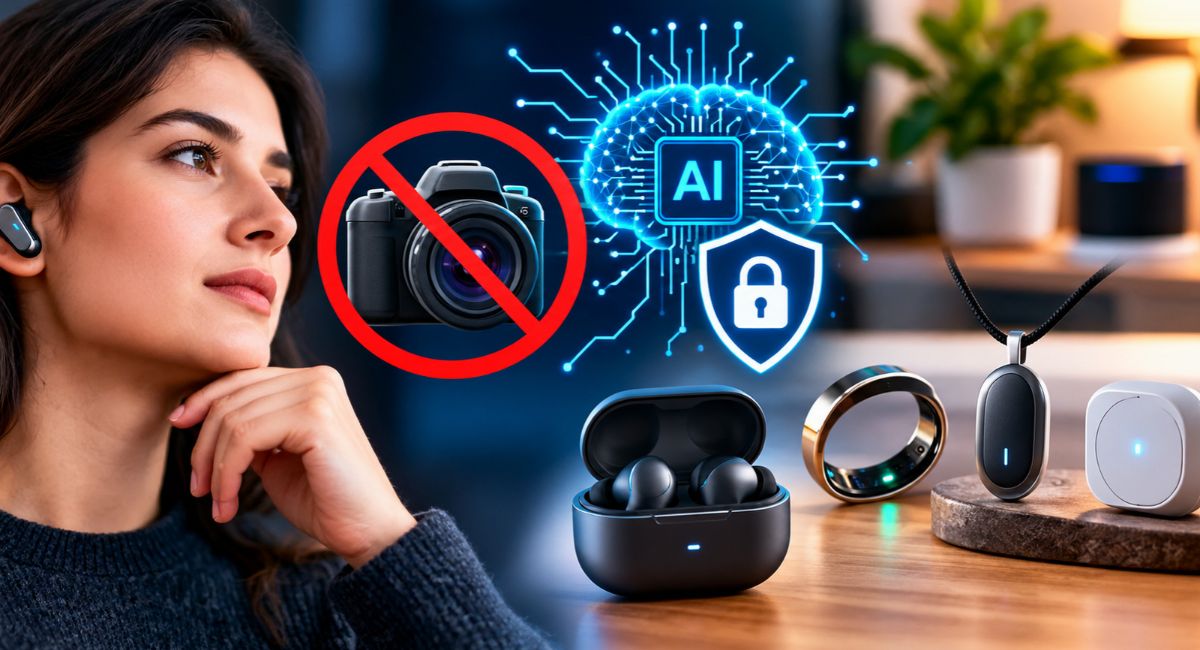
For over two decades, the formula for consumer technology was simple: add more lenses. Smartphones competed over quad-camera arrays, smart displays brought high-definition webcams into our kitchens, and wearable devices tried to turn our eyeglasses into floating recording studios. However, a fundamental shift is happening in the world of personal technology.
As artificial intelligence moves from cloud servers into our daily lives, a growing wave of modern gadgets is intentionally leaving cameras out of the equation entirely. Screenless audio pins, minimalist smart rings, ambient home sensors, and voice-first pendants are proving that hardware can be intelligent without constantly watching you.
Why are hardware designers suddenly backing away from visual sensors? The answer lies at the intersection of consumer burnout, massive privacy risks, and breakthroughs in camera-free artificial intelligence.
The Dark Side of Constant Optical Surveillance
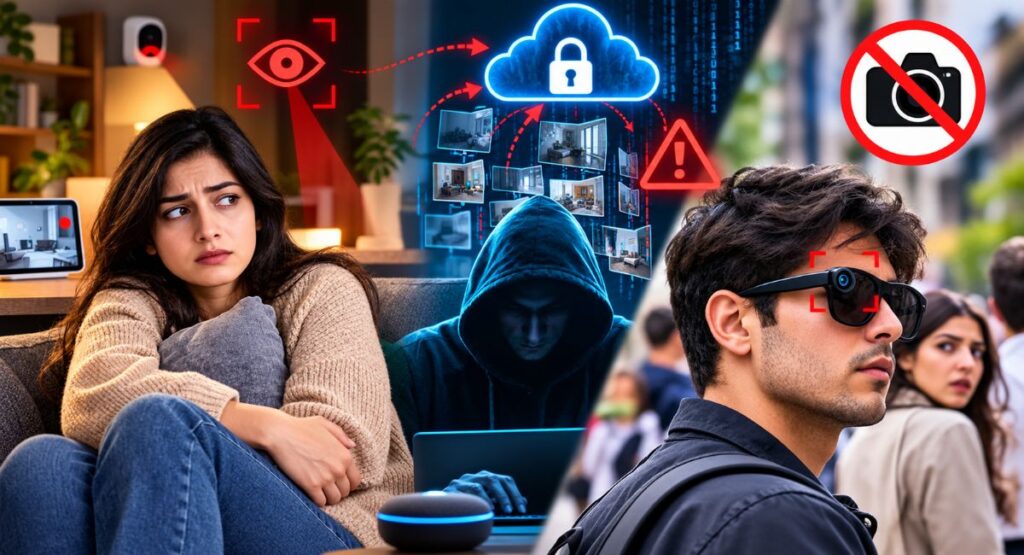
To understand why tech companies are removing cameras, we first have to look at why consumers are growing tired of them.
1. The Death of Personal Privacy at Home
When smart displays and home robots were introduced, they promised convenience. But that convenience came with an unsettling trade-off: living with active lenses pointing at your sofa, kitchen table, or workspace 24/7.
When a camera is built into a smart device, every moment inside your sanctuary becomes potential data. Even when an indicator light says off, users are left wondering whether their visual environment is truly private.
2. High-Profile Data Leaks and Cloud Hacks
Optical video feeds generate enormous files that are frequently uploaded to third-party cloud servers for processing. Over the past few years, repeated cloud database breaches, unauthorized internal viewing by contractors, and exposed smart-home video feeds have damaged public trust. Consumers realize that once visual data leaves a device, it becomes almost impossible to keep control over.
3. The Social Friction of Wearable Cameras
Remember the social backlash early smart glasses faced? People felt uncomfortable talking to someone wearing an obvious camera lens. Devices that record video in public places create social friction, raising immediate concerns about consent, bystander privacy, and public surveillance.
How AI Works: Genius Magic Without Sight
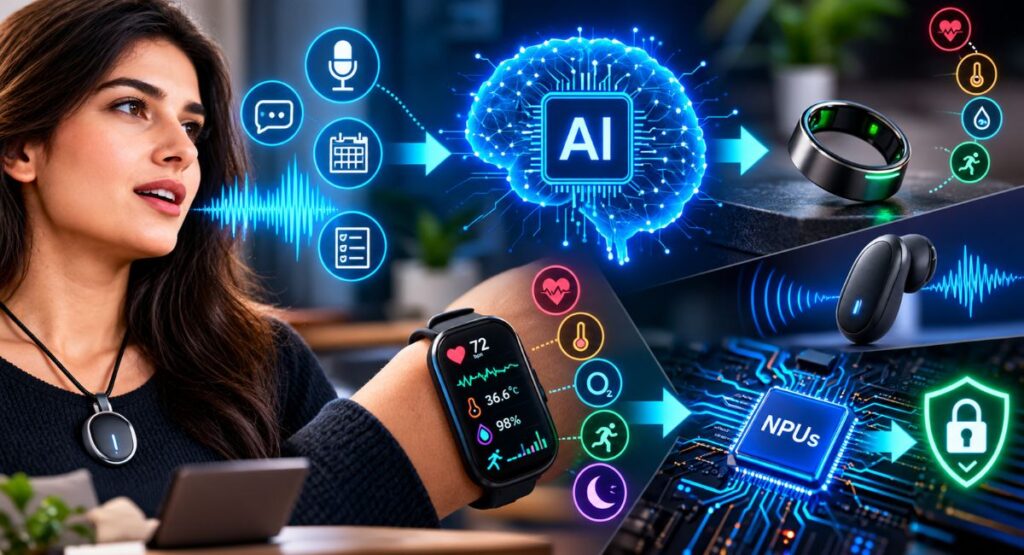
A common myth is that artificial intelligence needs visual input to understand your context. In reality, modern machine learning models can extract rich contextual awareness without taking a single photo.
Voice and Acoustic Intelligence
Next-generation AI doesn’t need to see your expression to understand how you feel or what you are doing. Advanced audio-processing models analyze vocal tone, cadence, background noises, and acoustic signatures. An AI audio pendant or smart pin can summarize meetings, track your daily schedule, and manage reminders using micro-microphones, all without ever needing an optical sensor.
Biometric and Motion Tracking
Smart rings, wristbands, and health trackers capture vital health metrics such as heart-rate variability (HRV), body temperature, blood oxygen levels, and microscopic movement patterns using basic infrared and thermal sensors. They can detect stress levels, track sleep phases, and evaluate workout intensity without capturing a single pixel of video data.
On-Device Processing (Edge AI)
Instead of sending raw footage to distant servers, modern hardware relies on microchips called NPUs (Neural Processing Units). NPUs process sensor inputs locally, directly on the device. By limiting raw inputs to simple audio or motion vectors, these chips run lightweight AI models locally, meaning your personal environment stays on your hardware and off the internet.
Comparing the Approaches: Camera-Free AI vs. Vision-Based AI
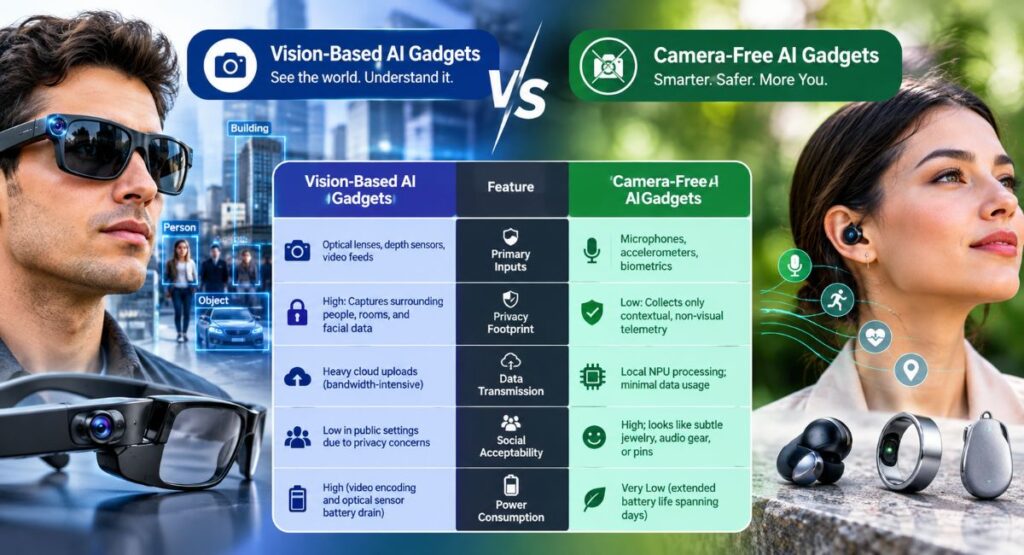
To help you understand the core differences between traditional camera-equipped tech and the new wave of camera-free AI gadgets, here is a quick side-by-side comparison:
| Feature | Vision-Based AI Gadgets | Camera-Free AI Gadgets |
| Primary Inputs | Optical lenses, depth sensors, video feeds | Microphones, accelerometers, biometrics |
| Privacy Footprint | High: Captures surrounding people, rooms, and facial data | Low: Collects only contextual, non-visual telemetry |
| Data Transmission | Heavy cloud uploads (bandwidth-intensive) | Local NPU processing; minimal data usage |
| Social Acceptability | Low in public settings due to privacy concerns | High; looks like subtle jewelry, audio gear, or pins |
| Power Consumption | High (video encoding and optical sensor battery drain) | Very Low (extended battery life spanning days) |
The Unexpected Benefits of Ditching the Camera Lens
By stripping out cameras, hardware developers are unlocking major product improvements that directly benefit everyday users.
1. Unmatched Battery Life
Processing continuous HD video feeds drains battery power rapidly and generates heat. Devices that rely on lightweight voice and biometric sensors use a fraction of that energy, stretching battery life from hours to days.
2. Sleeker, Truly Invisible Form Factors
Without bulky lens assemblies, glass covers, and heavy image processors, devices can shrink dramatically. Designers can fit advanced AI capabilities inside lightweight rings, subtle lapel pins, or comfortable audio earbuds.
3. Lower Cost for Consumers
High-grade optical sensors and visual processing units are expensive. Omitting camera hardware lowers manufacturing costs, allowing brands to offer premium, highly intelligent products at far more accessible prices.
What Does This Mean for the Future of Tech?
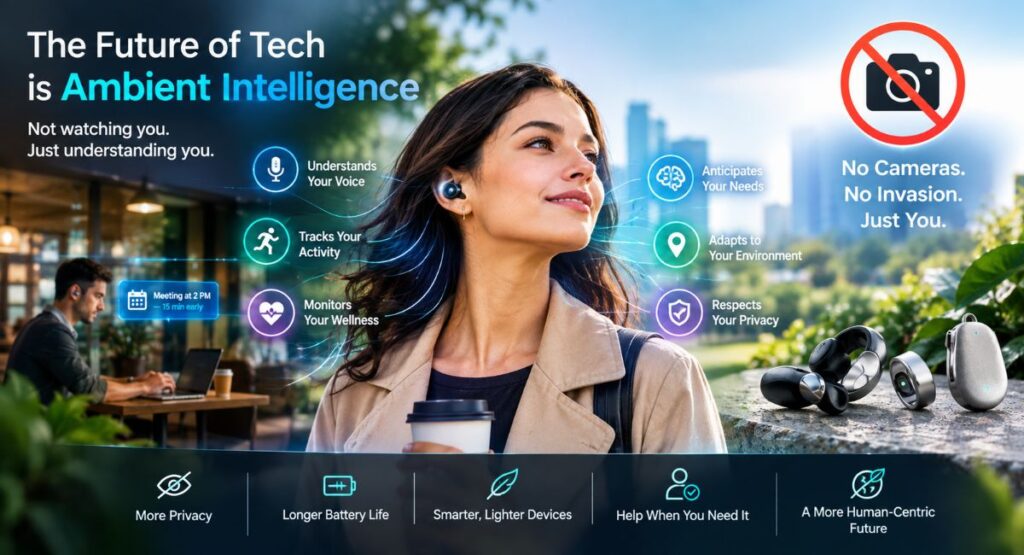
We are entering a new era of technology: Ambient Intelligence.
The future of hardware isn’t about staring into displays or capturing every second of our day on video. It is about quiet, helpful technology that runs in the background, respects personal boundaries, and assists us only when asked.
By purposefully dropping camera lenses, next-generation device makers are making a clear point: True intelligence doesn’t need to watch your every move; it just needs to understand your needs.
Conclusion
The shift away from camera-laden hardware represents a major win for everyday privacy. As hardware developers lean into audio AI, biometric monitoring, and local on-device processing, users no longer have to trade peace of mind for modern convenience. Choosing camera-free devices lets you enjoy the power of artificial intelligence while keeping your private life completely private.