
For decades, global defense was defined by massive hardware. The army with the heaviest tanks, the largest aircraft carriers, or the fastest fighter jets dominated the field.
In 2026, that formula has fundamentally shifted. While physical armor and firepower remain crucial, modern military capability is defined by speed, connectivity, and electronic intelligence.
Global defense spending and innovation have reached unprecedented heights. Advanced military powers are deploying a new generation of defense systems designed to intercept faster threats, process operational data instantly, and defend against low-cost automated attacks.
This beginner’s guide breaks down the core technologies driving next-generation defense systems in 2026, explaining how they function and why they matter for future global security.
Artificial Intelligence and Agentic Battle Networks

At the core of 2026 defense technology is Artificial Intelligence (AI). Military forces no longer use AI simply to analyze old surveillance footage; they integrate autonomous AI models directly into command-and-control networks.
From Days to Seconds: Accelerating the Kill Chain
In traditional military operations, detecting a threat, identifying its coordinates, confirming it with commanders, and launching a countermeasure could take minutes or hours. In defense terms, this sequence is known as the OODA Loop (Observe, Orient, Decide, Act).
With hypersonic missiles traveling at five times the speed of sound, human decision-making alone is too slow. Modern AI systems continuously evaluate sensor feeds from satellites, radars, and high-altitude drones. The AI flags immediate threats, calculates optimal defensive responses, and presents commanders with recommended actions in fractions of a second.
Generative and Agentic AI in Field Operations
Defense departments are deploying dedicated, highly secure artificial intelligence platforms (such as enterprise-level military LLMs and agentic AI models) across field installations. These systems assist personnel by:
- Translating intercept communications in real time.
- Predicting equipment maintenance needs before a part breaks down in the field.
- Automatically organizing complex logistics for supplies, fuel, and ammunition across thousands of miles.
Directed Energy Weapons: Lasers and High-Power Microwaves
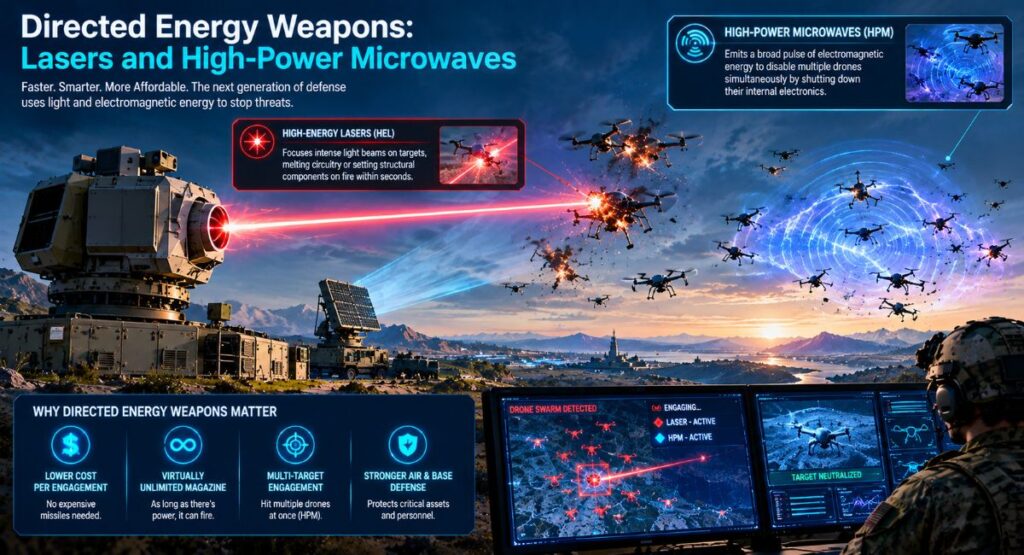
One of the most significant operational shifts in 2026 is the widespread deployment of Directed Energy Weapons (DEWs). These systems use focused light (high-energy lasers) or electromagnetic energy (high-power microwaves) to disable or destroy targets.
Stopping Drone Swarms with Deep Magazines
The surge in low-cost, uncrewed attack drones created a serious financial challenge for modern militaries. Firing a $1 million air-defense missile to destroy a $5,000 drone is financially unsustainable.
Directed energy weapons solve this cost-exchange ratio problem:
- High-Energy Lasers (HEL)
Systems ranging from 50 kW to 300 kW focus intense light beams onto incoming targets, melting internal circuitry or setting structural components on fire within seconds.
- High-Power Microwaves (HPM)
Instead of targeting a single object, microwave systems emit a broad pulse of electromagnetic energy that instantly disables the internal electronics of multiple incoming drones simultaneously.
Because laser and microwave weapons rely on electrical power rather than physical kinetic rounds, they offer a virtually unlimited magazine; as long as the host vehicle or station has electrical power, it can continue to engage targets.
Autonomous Swarms and Uncrewed Combat Platforms
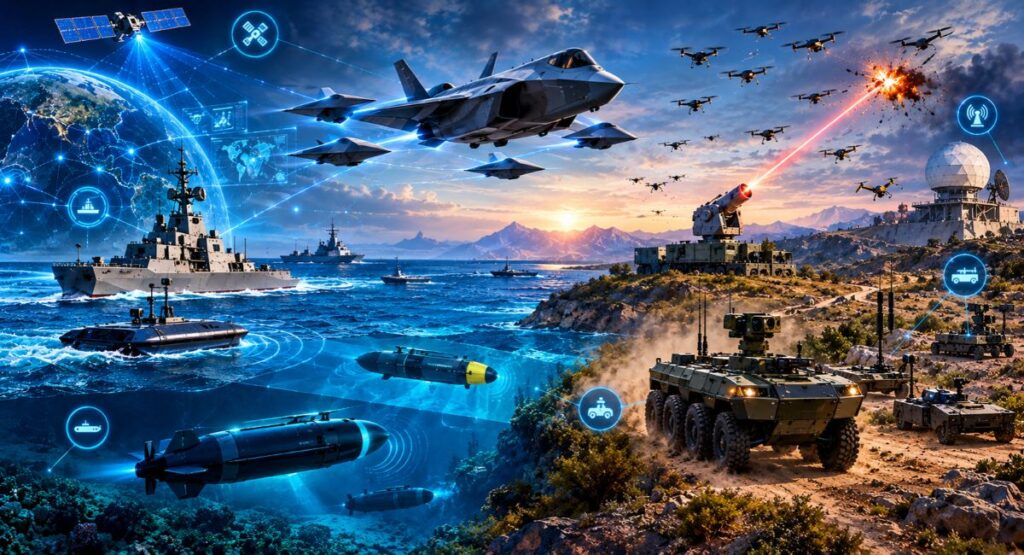
Uncrewed systems have evolved far beyond remotely piloted reconnaissance drones. In 2026, autonomous systems operate across every combat domain: air, land, sea, and underwater.
Collaborative Combat Aircraft (CCA)
Air forces are integrating Collaborative Combat Aircraft(CCA), commonly known as Loyal Wingmen. These are semi-autonomous, pilotless jets that fly alongside crewed stealth fighters.
Guided by onboard AI, Loyal Wingmen perform high-risk tasks:
- Flying ahead to map out hostile air-defense networks.
- Jamming enemy radar systems using specialized electronic warfare suites.
- Carrying extra munitions to extend the firepower of crewed jets.
Autonomous Maritime and Ground Vehicles
The naval domain has adopted Uncrewed Surface Vessels (USVs) and Uncrewed Underwater Vehicles (UUVs) to monitor vital sea lanes and undersea infrastructure. These autonomous ocean craft can spend months at sea tracking submarine activity or clearing naval minefields without putting human crews in danger.
On land, autonomous ground vehicles handle hazardous resupply runs, clear explosive hazards, and provide transport in active contested zones.
Multi-Layered Hypersonic Defense Architectures
Hypersonic weapons missiles capable of flying faster than Mach 5 (over 3,800 mph) while maneuvering unpredictably have forced a complete overhaul of global air and missile defense systems.
| Defense Layer | Primary Technology Used | Operational Purpose |
| Space Layer (LEO Satellites) | Hypersonic & Ballistic Tracking Sensors | Detects launch thermal signatures and tracks low-orbit glide trajectories. |
| Upper Atmosphere Layer | High-Altitude Interceptors (GMD/THAAD) | Engages ballistic threats and long-range hypersonic gliders during mid-course flight. |
| Terminal / Point Defense | High-Power Lasers & Short-Range Missiles | Neutralizes low-altitude cruise missiles and tactical drones near the target area. |
Space-Based Tracking Constellations
Because hypersonic missiles fly at lower altitudes than traditional ballistic missiles and can change direction mid-flight, ground-based radars often detect them too late.
To solve this, 2026 defense networks rely heavily on dense constellations of Low Earth Orbit (LEO) satellites. Positioned hundreds of miles above the planet, these space-based infrared sensors track the heat signatures of hypersonic vehicles from launch through their entire flight path, feeding tracking coordinates directly to ground and naval interceptors.
Quantum Technology and Cyber Resilience

As defense networks become increasingly reliant on cloud connectivity and real-time data sharing, protecting those networks against cyber interference is paramount.
Quantum-Resilient Encryption
Quantum computing poses a potential threat to traditional data encryption. In response, modern defense organizations are transitioning to Post-Quantum Cryptography(PQC). These mathematical encryption algorithms are designed to secure military communications, nuclear command protocols, and satellite networks against interception even by future quantum computers.
Spectrum Dominance and Cognitive Electronic Warfare
Modern battlefields are filled with electronic interference designed to block GPS signals and break radio communications. Cognitive Electronic Warfare (EW) systems use real-time machine learning to detect enemy jamming attempts instantly. When a jamming signal is detected, the cognitive system automatically shifts communication frequencies or adjusts transmission patterns to keep the defense network online.
Key Challenges Facing Next-Gen Defense Systems
While these technological advances offer enhanced security and faster response times, they also introduce complex operational challenges:
- Massive Power Requirements
High-energy lasers, advanced AESA radars, and on-board AI computing demand immense electrical power, requiring warships and ground vehicles to be completely re-engineered with high-voltage propulsion architectures.
- Software & Interoperability
Connecting systems built by different manufacturers across different military branches requires strict, universal data standards.
- Cyber & Spoofing Vulnerabilities
Highly networked battle systems create broader attack surfaces for adversary hackers and electronic warfare units.
Conclusion
The landscape of next-gen defense systems in 2026 represents a major shift from isolated heavy hardware to interconnected, high-speed digital networks.
By pairing artificial intelligence, uncrewed autonomous swarms, and directed energy weapons with space-based tracking networks, modern defense architectures are designed around rapid data processing and multi-layered protection. In this new era, security relies not just on physical strength, but on the ability to perceive, analyze, and respond to dynamic threats at the speed of relevance.