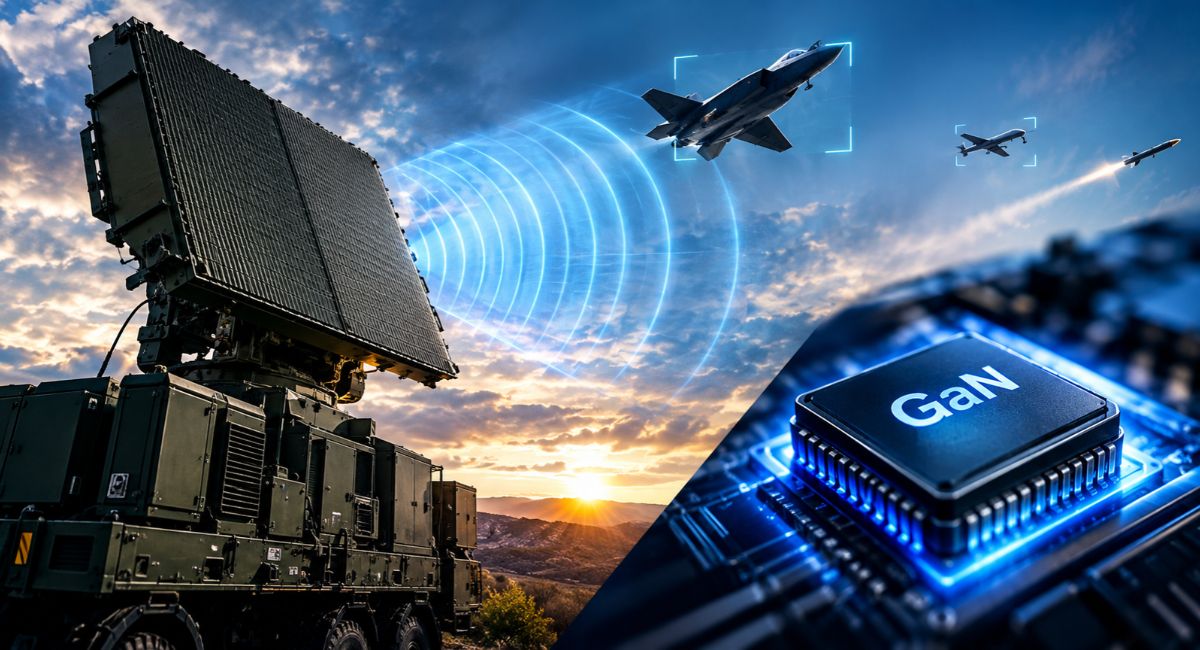
When you think of modern air defense, you might picture massive missile launchers, fighter jets, or high-tech control rooms. However, the true backbone of any air defense system is something invisible to the naked eye: radar waves.
Without radar, even the most advanced interceptor missiles are blind. Radar systems scan the skies, locate potential threats, track their movement, and guide defensive weapons to intercept them before they reach their targets.
In 2026, air defense is facing threats never seen before. Modern battlefields are crowded with low-flying stealth drones, high-speed hypersonic missiles, and complex electronic jamming systems. To keep up with these fast, hard-to-detect hazards, military forces around the world have upgraded their radar systems with a breakthrough material called Gallium Nitride (GaN).
This article will break down what GaN technology is, how it works, and why it is revolutionizing global air defense in 2026.
The Radar Challenge: Why Legacy Systems Are Falling Behind
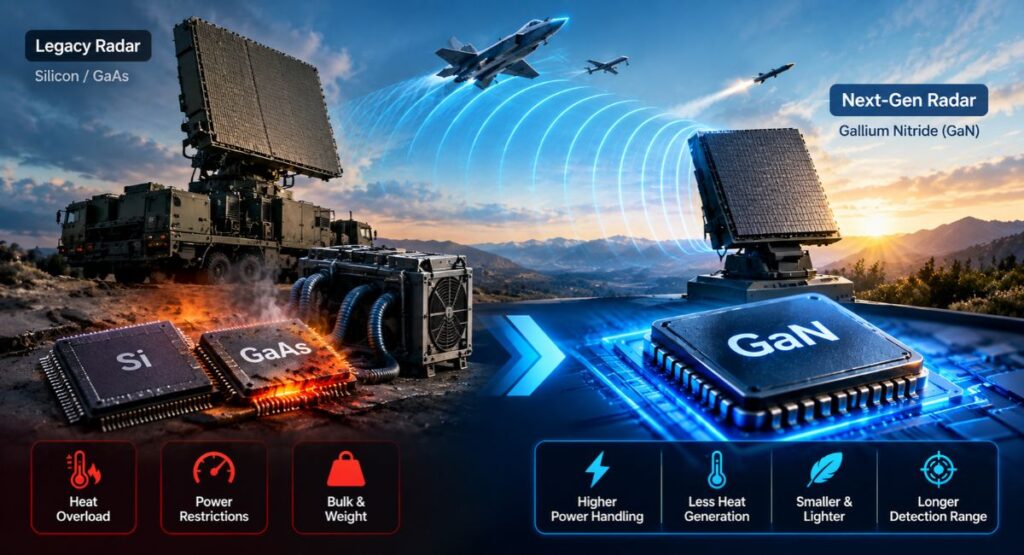
To understand why Gallium Nitride is such a game-changer, it helps to look at how radar technology traditionally worked and why legacy systems hit a physical limit.
How Radar Works
At its core, radar operates on a simple principle:
- When those waves hit an object (like an airplane, drone, or missile), they bounce back.
- A receiver catches the reflected waves and calculates the object’s speed, distance, altitude, and direction.
The Problem with Silicon and Gallium Arsenide (GaAs)
For decades, radar transmitters relied on semiconductor materials like Silicon (Si) and later Gallium Arsenide (GaAs). While these materials worked well for traditional aircraft and ballistic missiles, they have strict physical limitations:
- Heat Overload
Pushing high amounts of electrical power through silicon or GaAs chips generates extreme heat. If the chips get too hot, they fail.
- Power Restrictions
To prevent overheating, older radars had to operate at lower power levels, which limited their overall detection range.
- Bulk and Weight
Keeping legacy radar chips cool required heavy, complex liquid-cooling equipment. This made radar units bulky, expensive, and difficult to transport quickly.
As threat speeds increased and targets grew smaller, military engineers needed a semiconductor material that could handle massive power levels without overheating. That solution is Gallium Nitride (GaN).
What is Gallium Nitride (GaN) Technology?
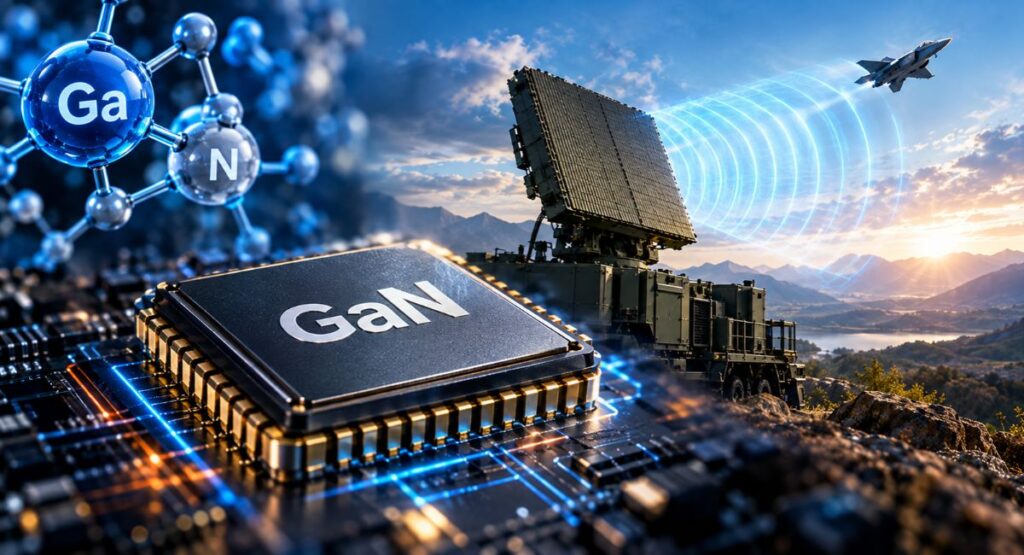
Gallium Nitride (GaN) is a wide-bandgap semiconductor material made by combining gallium and nitrogen atoms. While that sounds like complex chemistry, what matters most is how the material handles electricity and heat.
Compared to older materials like Gallium Arsenide, GaN can handle significantly higher electrical voltages and operate at much higher temperatures without breaking down.
Key Performance Advantages of GaN:
- 5x Power Density
GaN chips can output up to five times more power per square millimeter than GaAs chips.
- Higher Thermal Conductivity
GaN transfers heat far more efficiently, allowing components to operate safely at much higher temperatures.
- Higher Efficiency
GaN converts electrical power into radar energy with minimal wasted heat, slashing energy consumption by up to 30-35%.
- Broader Bandwidth
GaN supports wider frequency ranges, making it easier for radars to switch channels and dodge enemy jamming attempts.
How GaN Supercharges Active Electronically Scanned Array (AESA) Radars
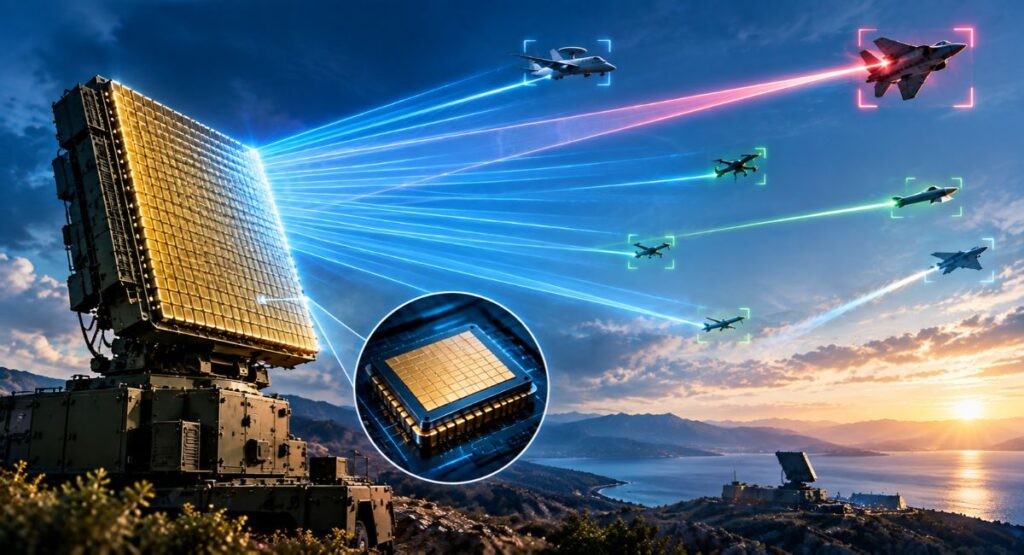
In 2026, the standard for advanced military radar is the Active Electronically Scanned Array (AESA).
Unlike traditional mechanical radars that physically rotate like a spinning dish on top of a tower, an AESA radar features a flat face made up of thousands of tiny individual Transmit/Receive (T/R) modules. Each module acts like a mini radar station, emitting its own micro-beam. By adjusting the timing of these modules, the radar can steer its beam electronically across the sky at the speed of light without moving a single physical part.
By replacing older GaAs modules inside AESA radars with GaN modules, defence manufacturers achieved massive performance boosts:
- Thanks to higher output power, GaN-based AESA radars can double their detection distance, giving air defense units precious extra minutes to track and engage approaching threats.
- A single GaN-enabled AESA radar can simultaneously track hundreds of targets, including fighters, low-flying cruise missiles, and small stealth drones, without dropping a single track.
- Because GaN modules handle immense power across broad frequencies, an AESA radar can focus a tight beam of high-power radio energy directly at an enemy aircraft to jam its sensors while continuing to scan the sky for other threats.
Core Advantages of GaN in 2026 Air Defense Systems
The widespread adoption of GaN technology in 2026 provides several practical benefits for military commanders on the ground, at sea, and in the air.
Spotting Low-Observable (Stealth) Targets and Drones
Stealth aircraft and small commercial attack drones are designed to bounce radar waves away from the receiver or absorb them entirely. To detect a small drone with a tiny radar signature, a radar system needs sheer transmission power.
GaN enables radar systems to blast high-power signals into the sky and detect faint reflections from small, carbon-fiber drones or stealth airframes at much greater distances.
Defending Against Hypersonic Missiles
Hypersonic weapons fly at speeds greater than Mach 5 (five times the speed of sound) while maneuvering unpredictably low in the atmosphere.
When a threat travels at nearly a mile per second, every second of early warning counts. GaN-powered radars provide the extended range and high update rates required to track hypersonic glide vehicles early in their flight paths, allowing defense networks to calculate intercept solutions before it is too late.
Smaller Size, Lighter Weight, and Air-Cooling
Because GaN operates so efficiently, systems don’t generate as much waste heat. This eliminates the need for massive, heavy liquid-cooling units.
Modern GaN radars can be fully air-cooled, making them roughly half the weight and size of legacy units. This allows advanced AESA radars to be mounted on:
- Compact 4×4 tactical military trucks.
- Uncrewed Aerial Vehicles (UAVs) and light combat aircraft.
- Naval vessels with limited deck space and power grids.
Superior Electronic Protection (Anti-Jamming)
In modern warfare, enemies flood the airwaves with electronic noise to blind defense radars. GaN radars overcome jamming through sheer power density and frequency agility. They can rapidly shift operational frequencies across a broad spectrum or burn through enemy jamming signals using high-powered directional beams.
GaN vs. Legacy Radar Technologies: A Quick Breakdown
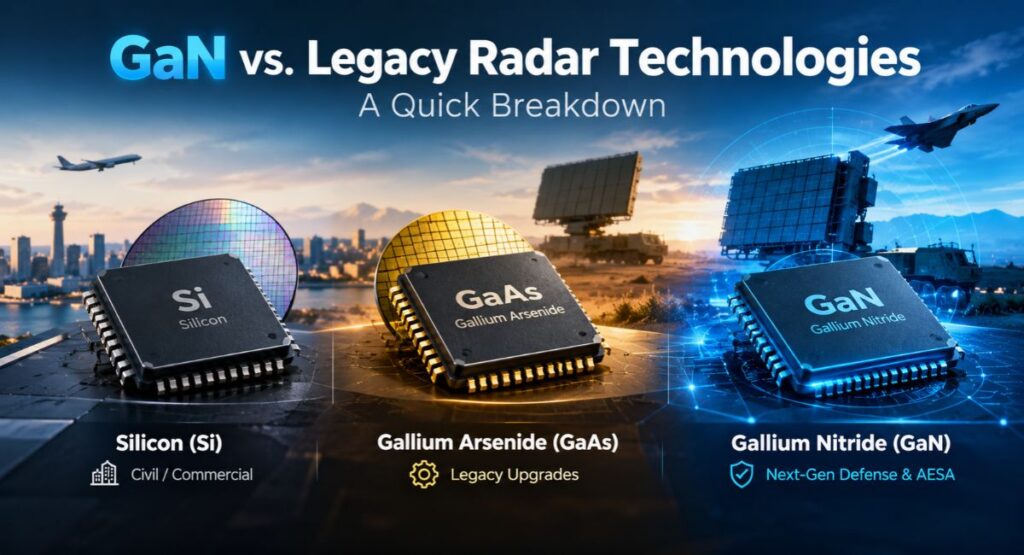
To see how GaN compares against older semiconductor generations, look at the key metrics below:
| Feature | Silicon (Si) | Gallium Arsenide (GaAs) | Gallium Nitride (GaN) |
| Power Density | Low | Medium | Extremely High (5x GaAs) |
| Operating Voltage | Low (~10V) | Moderate (~12V) | High (28V – 48V+) |
| Heat Resistance | Low | Moderate | Superior |
| Cooling Requirement | Heavy Liquid Cooling | Liquid Cooling | Air-Cooled Options Available |
| Detection Range | Baseline | Moderate Extension | Maximized (Up to 2x GaAs) |
| Primary 2026 Use | Civil/Commercial | Legacy Upgrades | Next-Gen Defense & AESA |
Real-World Applications of GaN Radars in 2026
GaN technology is no longer confined to experimental research labs; it is deployed in major air defense architectures across land, sea, and air domains:
360-Degree Ground Defense
Systems like the U.S. Army’s Lower Tier Air and Missile Defense Sensor (LTAMDS) use GaN-powered AESA panels to monitor 360 degrees of surrounding airspace simultaneously. Unlike older stationary Patriot radars that could only look in one direction at a time, GaN-enabled arrays eliminate operational blind spots.
Naval Air Defense
Modern guided-missile destroyers use GaN-based radars to monitor high-altitude ballistic threats, sea-skimming anti-ship cruise missiles, and incoming drone swarms from a single naval platform.
Naval Air Defense
Next-generation stealth fighters and uncrewed Loyal Wingman combat aircraft use lightweight GaN AESA radar noses to detect adversary jets long before they themselves are detected.
The Future Beyond 2026: What’s Next for Radar Tech?
While GaN is the reigning king of radar materials in 2026, material science continues to evolve. Researchers and defense engineers are already looking at next-step technologies to pair with or follow Gallium Nitride:
GaN-on-Diamond
By bonding Gallium Nitride layers directly to synthetic diamond substrates, engineers can draw heat away from radar modules up to five times faster than current designs. This will allow future radars to run at even higher power levels without thermal degradation.
AI-Integrated Waveforms
Combining GaN’s raw power with artificial intelligence enables cognitive radar systems that automatically analyze battlefield noise and adjust their signals in real time to defeat adaptive electronic jamming.
Gallium Oxide (Ga2O3)
Researchers are testing ultra-wide-bandgap materials like Gallium Oxide, which promise even higher voltage limits for ultra-long-range strategic space and missile tracking.
Conclusion
The evolution of military radar has always been a game of speed, range, and clarity. In 2026, as hypersonic missiles, low-flying drones, and dense electronic warfare redefine global battlefields, traditional radar technology simply cannot keep pace.
Gallium Nitride (GaN) has filled this critical gap. By delivering unprecedented power density, thermal efficiency, and broad-spectrum flexibility, GaN allows modern air defense networks to see farther, track smaller objects, and operate reliably in hostile electronic environments. It is not just an incremental improvement; GaN is the foundational technology keeping global skies secure in 2026 and beyond.