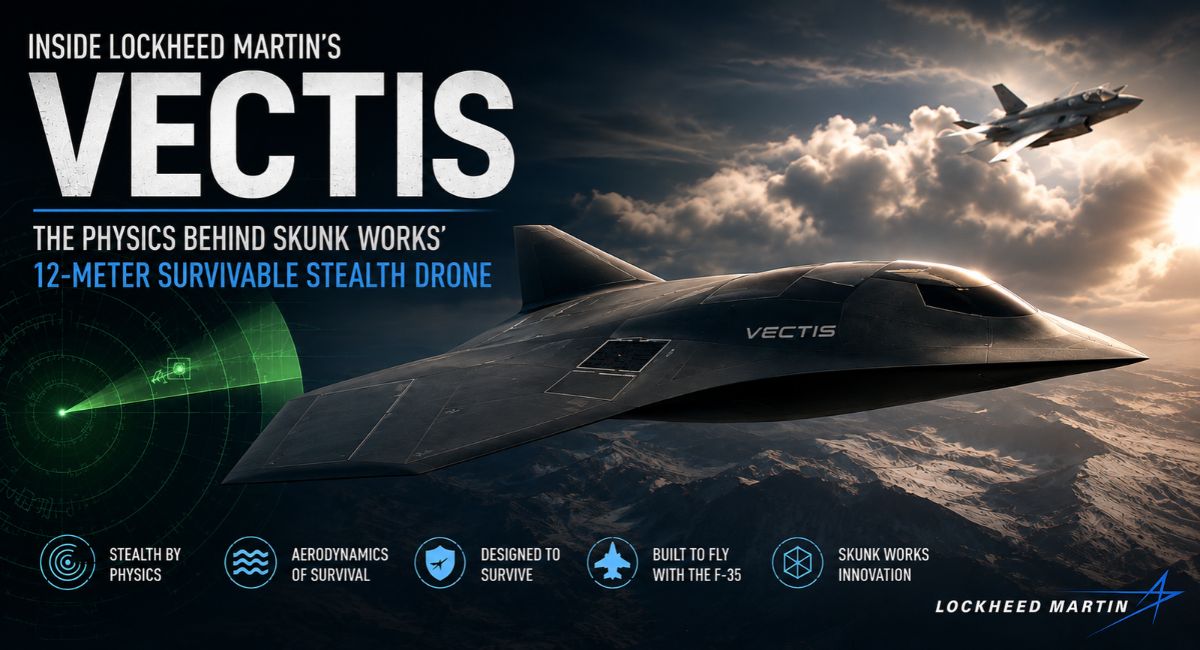
When you hear the word stealth, you might picture an invisible spy plane gliding silently through the night sky. But in modern military aviation, stealth is not about being invisible; it is about mastering the laws of physics.
Enter Lockheed Martin’s Vectis, a cutting-edge uncrewed aerial vehicle (UAV) designed by the world-famous Skunk Works team. Spanning roughly 12 meters, this high-tech stealth drone is built to fly alongside advanced fighter jets like the F-35 and survive in some of the most dangerous airspace on the planet.
How does a 12-meter aircraft fly straight past modern radar systems undetected? What allows it to survive where older drones would be shot down immediately?
To answer those questions, we need to look beyond the sci-fi headlines and explore the core physics driving stealth design, radar mechanics, and aerodynamic flight.
What Is Lockheed Martin’s Vectis Drone?
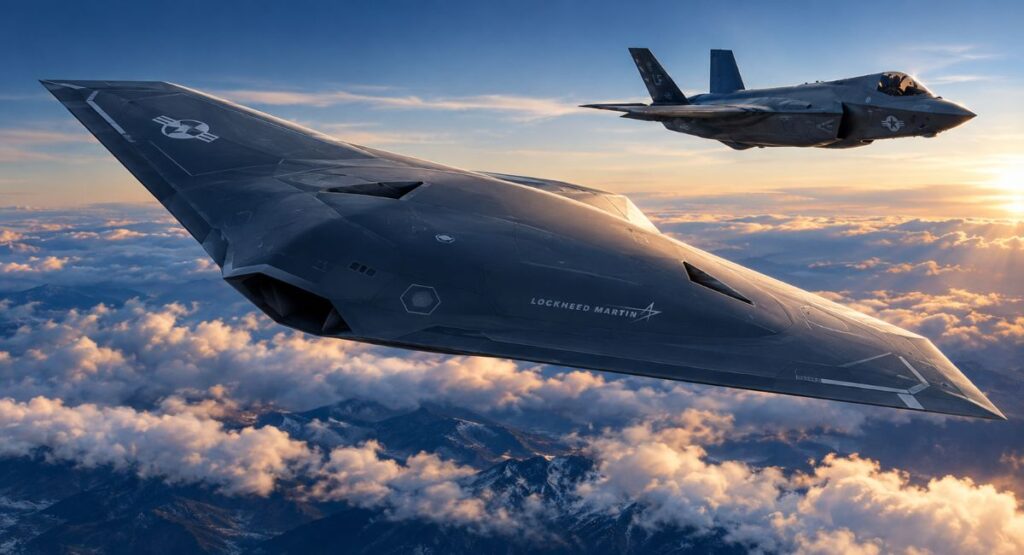
Before diving into physics, let’s get clear on what Vectis actually is.
Lockheed Martin Vectis is a Group 5 Collaborative Combat Aircraft (CCA). In plain English, it is an autonomous, uncrewed jet aircraft designed to work as a loyal wingman. It can fly missions alongside human-piloted fighters, taking on high-risk tasks like surveillance, electronic warfare, or direct strikes.
Developed by Skunk Works, the legendary Advanced Development Programs division responsible for iconic aircraft like the U-2, SR-71 Blackbird, and F-117 Nighthawk, Vectis puts a massive emphasis on survivability.
Key Characteristics of Vectis
| Size | Approximately 12 meters in length. |
| Design | Tailless, low-observable flying-wing layout. |
| Role | Uncrewed autonomous wingman paired with 5th-generation (F-35) and next-generation fighters. |
| Primary Objective | Deliver high-end stealth and operational flexibility at a realistic cost. |
The Physics of Radar: Why Standard Drones Get Caught
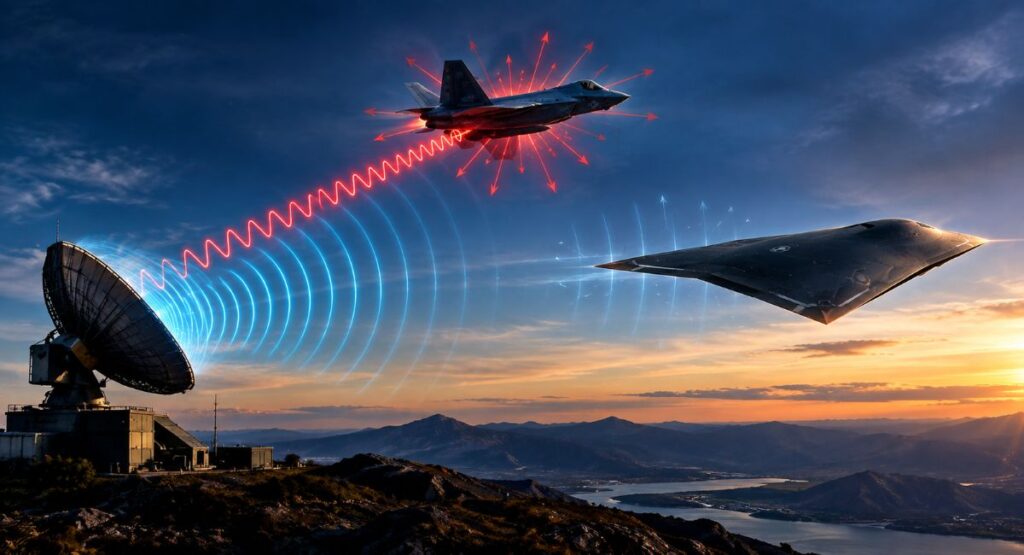
To understand how Vectis hides, you first need to understand how radar finds aircraft.
Radar stands for Radio Detection and Ranging. A ground radar station sends out radio waves (electromagnetic radiation) into the sky. When those waves hit a metal object like a traditional plane, they bounce off it and scatter in all directions. A portion of that reflected energy travels straight back to the radar receiver.
By measuring how long it takes for the signal to return, the radar system calculates:
- Distance: How far away the aircraft is.
- Speed: How fast it is moving (using the Doppler effect).
- Direction: Where it is heading.
How visible an aircraft appears on radar is called its Radar Cross-Section (RCS). A giant commercial airliner has an RCS of about 100 square meters. A traditional combat drone might have an RCS the size of a door. Vectis, through clever manipulation of physics, shrinks its RCS to the size of a small bird or marble, making it nearly impossible for enemy systems to lock onto.
Shaping and Reflection: Deflecting Radar Energy Away
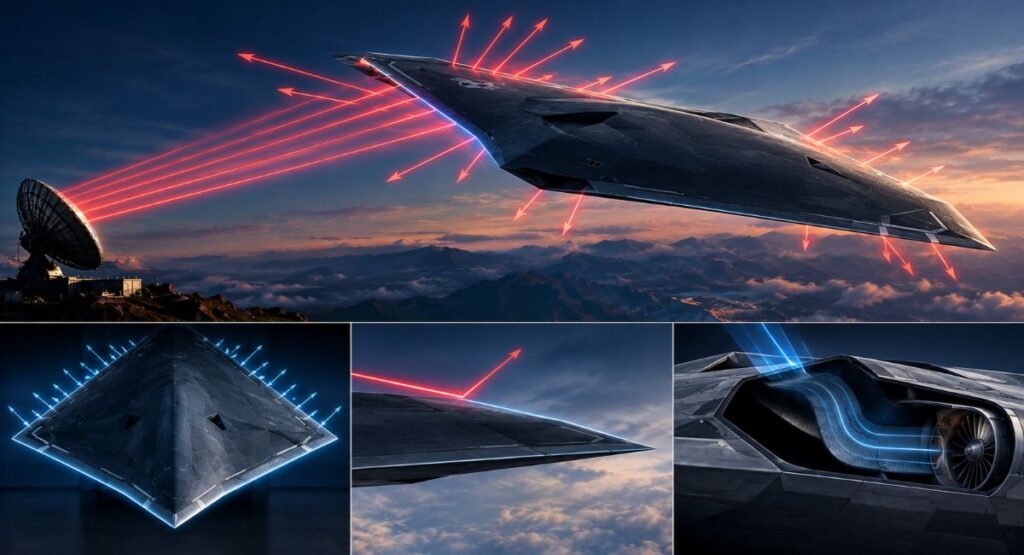
The primary secret to the Vectis stealth design lies in its shape. Instead of trying to absorb 100% of incoming radar waves, which is physically impossible, Skunk Works engineered the body of Vectis to deflect radar energy away from the receiver.
The Tailless Design
Traditional aircraft have vertical tails (rudders) to help them turn and stay stable. However, vertical tails act like giant mirrors for ground-based radar. Radar waves hit the vertical tail at a 90-degree angle and bounce straight back to the radar dish.
Vectis drops the traditional tail altogether. By using a sleek, tailless airframe, it eliminates one of the biggest sources of radar reflections.
Edge Alignment and Continuous Curves
If you look closely at stealth designs, you will notice that angles match across the aircraft. The leading edge of the wing runs parallel to the trailing edge.
This alignment ensures that any radar energy that does bounce off the drone is directed into very narrow, specific spikes away from the radar receiver, rather than scattering in every direction.
Submerged Air Inlets
Jet engines require massive amounts of air to operate. However, jet engine compressor blades act like bright flashlights under radar waves; the metal blades reflect energy straight back to the source.
To solve this, Vectis features a specialized submerged air inlet located on top of the airframe. This design buries the engine face deep inside the fuselage behind an S-duct path. Incoming radar waves cannot travel in a straight line to hit the reflective engine fan blades; instead, they strike curved, radar-absorbing walls inside the intake.
Material Physics: Radar Absorbent Materials (RAM)
The airframe handles most incoming radar waves, but what about the rest? That is where Radar Absorbent Materials (RAM) come into play.
RAM consists of specialized coatings and composite structures applied to the drone’s skin. RAM works by converting electromagnetic energy into thermal energy (heat).
How RAM Works Step-by-Step
- Wave Penetration: A radar wave strikes the drone’s outer surface.
- Magnetic Interaction: The coating contains microscopic particles (often iron, carbon, or ferromagnetic compounds).
- Energy Conversion: As the electromagnetic wave passes through these particles, it creates microscopic resistance and magnetic hysteresis.
- Heat Dissipation: This resistance transforms the radio wave energy into a harmless, tiny amount of heat, preventing the wave from reflecting out.
By pairing precise physical shaping with advanced RAM coatings, Vectis ensures that the tiny amount of energy bouncing off its surface is too weak for radar algorithms to distinguish from background atmospheric noise.
Thermal Signature Control: Hiding in the Infrared Spectrum
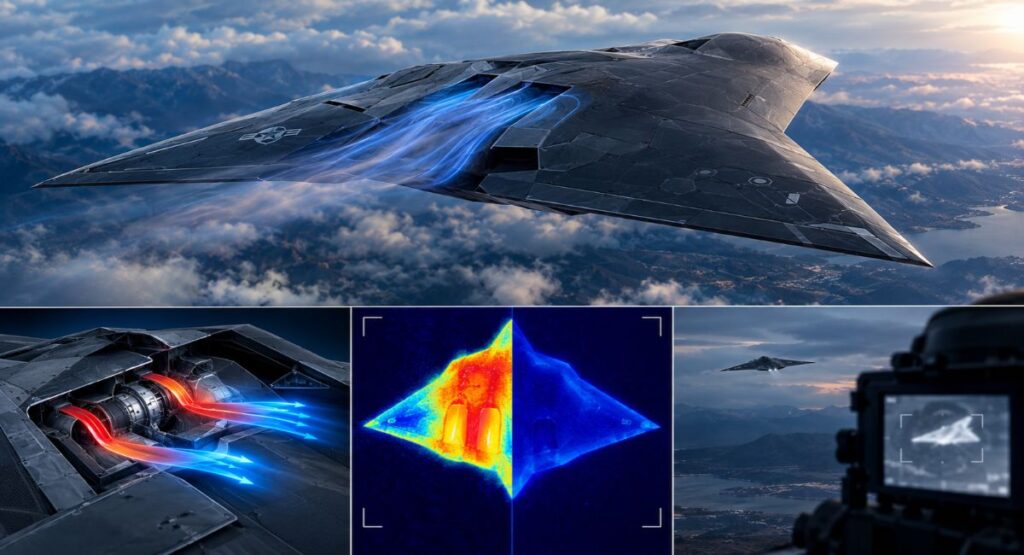
Radar is not the only way hostile forces track aircraft. Heat-seeking missiles and high-resolution ground cameras track aircraft using Infrared (IR) sensors.
Every jet engine produces intense heat from exhaust gases and hot metal components. According to Planck’s Radiation Law, warmer objects emit more infrared radiation. If Vectis had a glowing hot exhaust pipe, infrared sensors could easily track it, rendering its radar stealth useless.
To achieve true survivability, Skunk Works engineered Vectis with strict thermal signature management:
- The engine exhaust is routed through flattened, line-of-sight shielded nozzles on top of the rear airframe. This prevents ground-based IR sensors from seeing the hottest engine parts.
- Cool ambient air is mixed with the hot engine exhaust before it exits the airframe, rapidly lowering the exhaust temperature.
- Advanced carbon-composite materials distribute heat evenly across the airframe skin rather than allowing localized hot spots to form.
Aerodynamics vs. Stealth: How Vectis Stays Stable
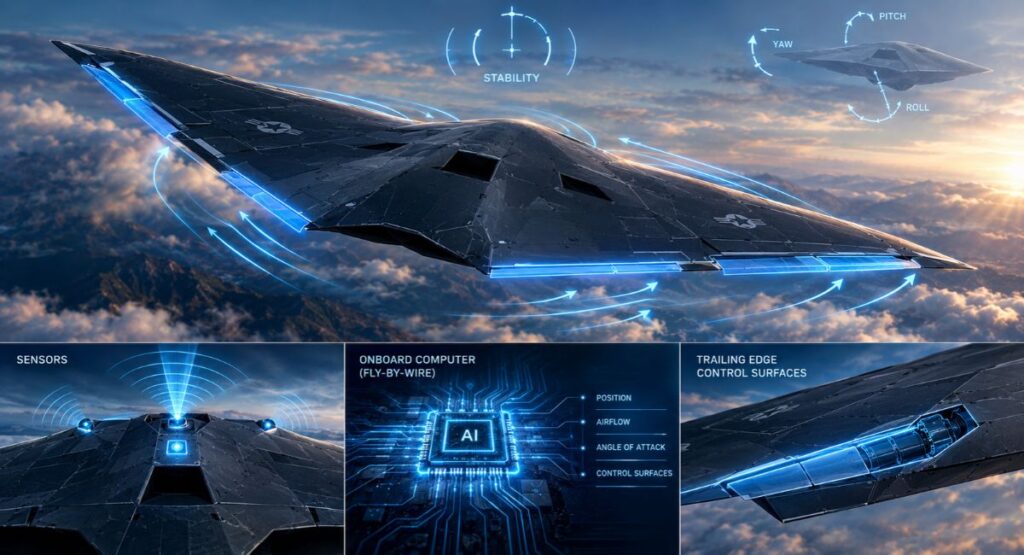
In traditional aircraft design, stability is king. Aircraft use tails, movable flaps, and wing dihedral angles to ensure they fly straight and smoothly.
However, aerodynamically stable shapes are terrible for stealth. Stealth shapes like the tailless wing of Vectis are naturally aerodynamically unstable. Without a vertical tail, a plane naturally wants to pitch, roll, and yaw unpredictably. So how does a 12-meter stealth drone stay safely in the air?
The answer is digital fly-by-wire flight control systems.
Vectis uses high-speed onboard computers running autonomous algorithms. Hundreds of times per second, sensors measure the drone’s position, airflow, and angle of attack. The computer continuously makes microscopic adjustments to control surfaces along the wing trailing edges, artificially creating stability where physics wants to cause chaos.
The Role of Vectis in Modern Air Combat
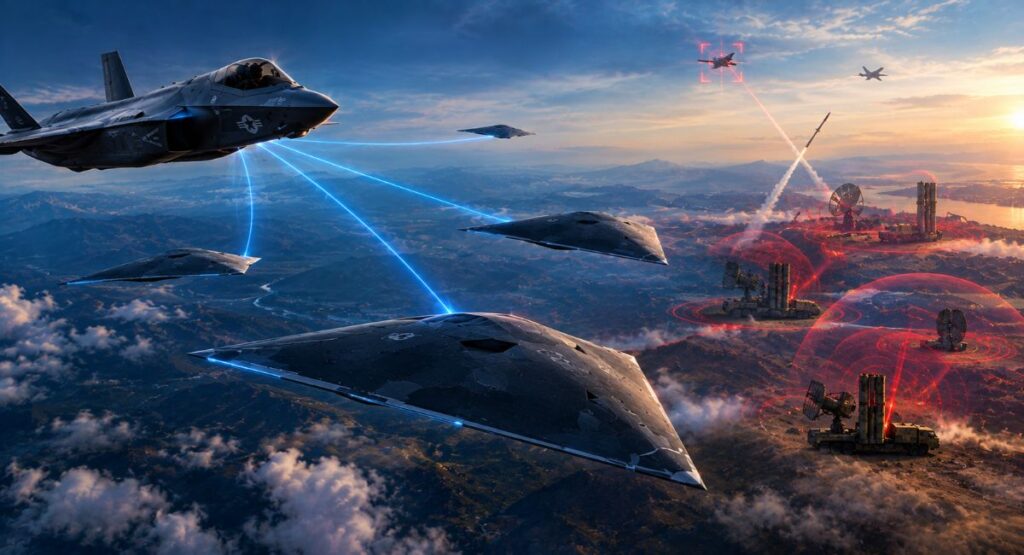
Stealth physics is impressive on paper, but why build a 12-meter uncrewed aircraft like Vectis?
Modern air defense networks (like S-400 and S-500 missile systems) cover vast distances with overlapping radar bands. Sending human pilots into these Anti-Access/Area Denial (A2/AD) zones carries extreme risk.
Advantages of the Vectis Design
- A single human pilot in an F-35 can command multiple Vectis drones. The drones can fly ahead, map out enemy air defenses, scramble enemy radars, or carry precision munitions.
- While Vectis is sophisticated and built to survive multi-mission deployments, it does not carry a human pilot. Military commanders can deploy it into ultra-high-threat environments without risking human life.
- Skunk Works designed Vectis using advanced digital engineering and modern manufacturing techniques, lowering production costs compared to traditional crewed stealth fighters.
Summary of Vectis Stealth Physics
| Feature | Physical Mechanism | Operational Benefit |
| Tailless Airframe | Eliminates 90-degree surface reflections | Drastically lowers Radar Cross-Section (RCS) |
| Submerged Inlets | Curving S-duct hides compressor blades | Prevents radar reflection from engine face |
| RAM Coatings | Converts radio wave energy into heat | Absorbs remaining radar signals |
| Shielded Exhaust | Cools exhaust and blocks line-of-sight | Reduces infrared (thermal) signature |
| Fly-By-Wire Autonomy | High-speed computerized surface adjustments | Maintains stable flight in an unstable airframe |
Conclusion
Lockheed Martin’s Vectis is more than just an advanced uncrewed aircraft; it is a masterclass in applied physics. By combining radar energy deflection, material science, thermal management, and autonomous flight controls, Skunk Works has created a 12-meter drone built to survive the world’s most hostile airspace.
As autonomous technology and stealth engineering continue to evolve, aircraft like Vectis represent the future of military aviation: smart, survivable, and powered by the fundamental laws of science.