Have you ever wondered who owns the highways to the stars? For decades, getting a satellite into Earth’s orbit was a luxury reserved for giant government agencies or a tiny handful of billionaire-backed private conglomerates. When just two or three corporations control all the transportation to space, they hold a monopoly.
They set the prices, control the schedules, and decide who gets to launch. However, the modern space economy requires something different: flexibility, lower costs, and rapid turnaround times.
That is where Italian aerospace manufacturer Avio comes in. Moving through 2026, Avio is executing a historic operational shift that is breaking up old industry monopolies. By transitioning from a mere parts manufacturer into an independent launch service operator and pioneering eco-friendly engine tech, Avio is helping rewrite the rules of modern spaceflight.
This article explains how Avio’s 2026 evolution is reshaping next-generation space propulsion and opening orbit to the rest of the world.
What Is a Rocket Monopoly and Why Is It Changing?
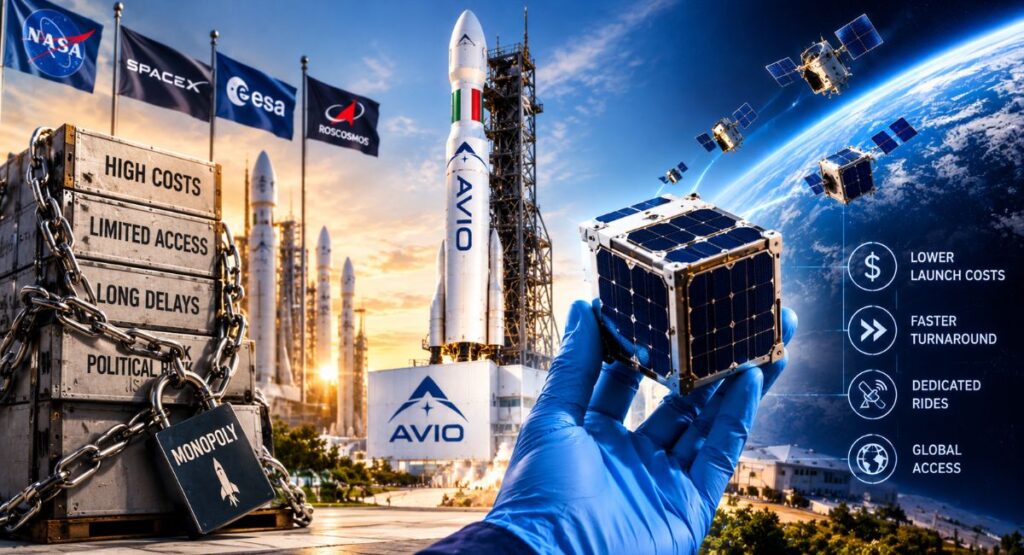
To understand why Avio’s shift is such a big deal, it helps to look at how the space industry used to operate.
For a long time, building and launching rockets required billions of dollars. Legacy aerospace contractors built massive, expensive rockets paid for by government budgets. Later, commercial mega-players stepped in, but even then, power remained concentrated in very few hands.
The Danger of Monopolies in Space
- High Launch Costs: Without strong competition, providers can charge premium prices for satellite delivery.
- Bottlenecks and Delays: Small satellite companies often have to wait months or even years as rideshare passengers on giant rockets that prioritize large payloads.
- Geopolitical Vulnerability: Depending on a single country or company for launch capability leaves entire nations stranded if political or technical issues ground those specific rockets.
Breakthroughs in miniaturized technology now allow small satellites, some no larger than a shoebox, to perform complex missions, like tracking global climate trends or providing high-speed internet. These lightweight satellites do not need colossal, expensive rockets; they need agile, affordable, dedicated rides. Avio recognized this gap and stepped up to fill it.
Who Is Avio? From Subcontractor to Space Authority
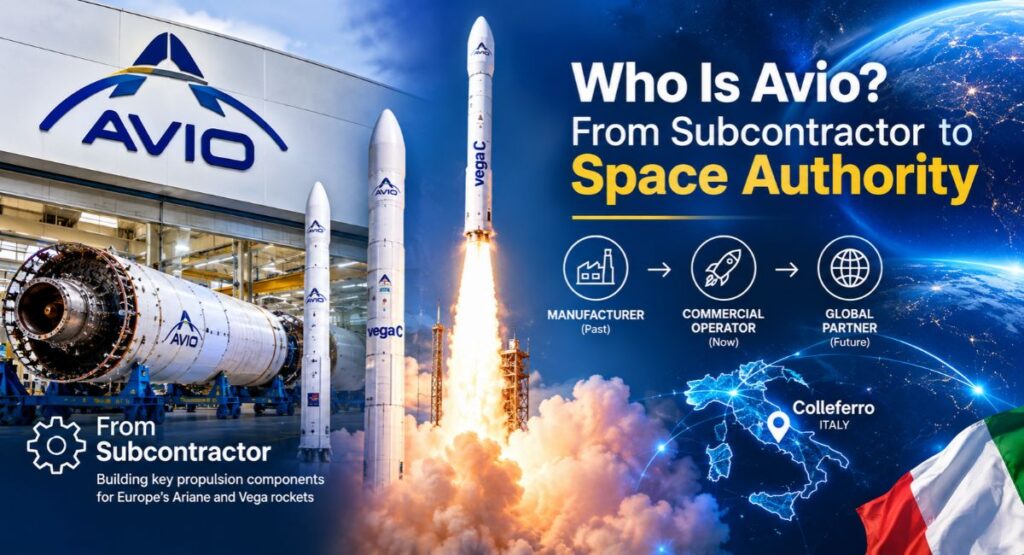
Based in Colleferro, Italy, Avio S.p.A. has been a foundational pillar of European rocketry for more than 50 years.
Historically, Avio was best known as a high-tier supplier. They built key propulsion components, like the massive solid rocket motors used on Europe’s heavy-lift Ariane rockets, as well as the light-lift Vega launcher series.
The Strategic 2026 Pivot
Under updated agreements formalized through European space authorities and expanded global partnerships, Avio has shifted from being solely a hardware manufacturer to an independent commercial operator. Instead of passing its rockets off to third-party distribution agencies, Avio now directly markets, books, and operates its own launches starting with the Vega C light-class rocket.
By taking direct control over commercial flight operations, Avio cuts out middleman overheads, lowers costs for customers, and significantly speeds up launch scheduling.
Key Innovations Driving Avio’s Propulsion Shift
Avio isn’t just changing how it sells rockets; it is fundamentally revolutionizing how rockets are propelled. The company’s 2026 technological roadmap centers on three main pillars: green propellants, 3D printing, and solid rocket motor scaling.
A. Methane and Liquid Oxygen (LOX) Propulsion
For decades, many rocket upper stages used toxic hypergolic propellants or highly complex liquid hydrogen systems. Avio has pivoted heavily toward Liquid Oxygen (LOX) and Methane engine architectures.
- Methane burns cleaner than traditional kerosene, leaving virtually no soot inside the engines.
- Clean combustion makes engines far easier to inspect, refresh, and fly again without complete rebuilds.
- Methane is widely available, cheap, and easier to store than liquid hydrogen.
B. 3D Printing and Advanced Manufacturing
Building a traditional rocket engine requires assembling thousands of individual, complex parts manually. Avio uses Additive Manufacturing (3D Printing) to print critical engine components like combustion chambers and turbopump housings as single monolithic pieces. This approach slashes manufacturing time from months to days, reduces weight, and dramatically lowers production costs.
C. Scaling Solid Rocket Motors (SRM)
Beyond liquid engines, solid propulsion remains the gold standard for reliable, high-thrust liftoffs. Avio’s high-capacity solid rocket motors (such as the P120C and P160C series) are designed to serve both commercial space launchers and global defense applications, providing unmatched structural strength and immediate thrust at ignition.
How Avio Restructures Next-Gen Space Flight
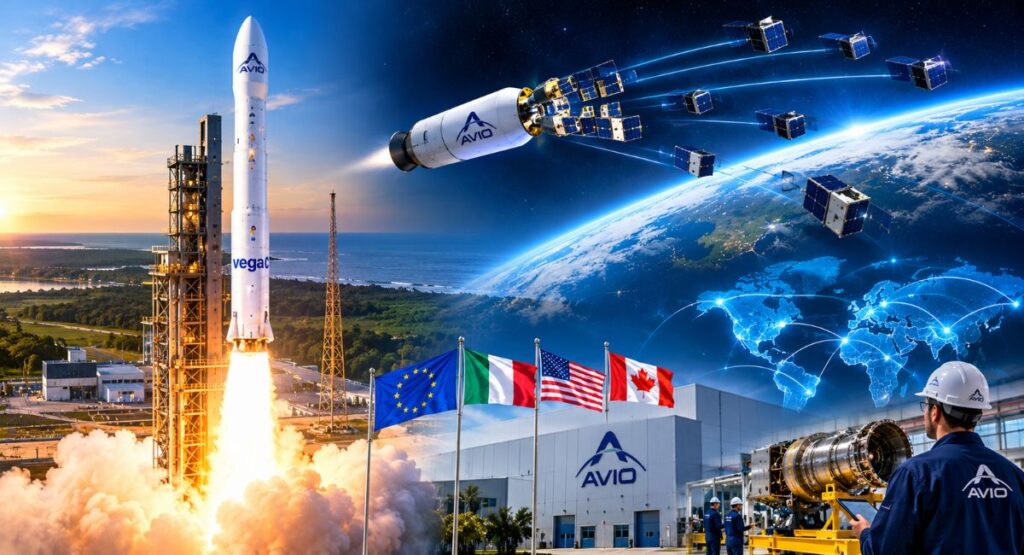
How does Avio’s shift actively disrupt the existing launcher monopoly? The ripple effects are being felt across the entire space supply chain.
1. High Flight Cadence and Operational Speed
By streamlining assembly pipelines and taking over launch pad logistics at the Guiana Space Centre in French Guiana, Avio is scaling Vega C operations to target up to 6 to 9 launches per year. Higher frequency means satellite companies no longer have to wait years for a ride.
2. Flexible Ride-Sharing Solutions
Small satellites often don’t need a whole rocket to themselves. Avio’s payload adapters allow dozens of microsatellites to share a single flight smoothly. The rocket can reignite its upper-stage engines multiple times in space, dropping off different satellites into completely different orbits on a single mission.
3. Strengthening Supply Chain Resiliency
Monopolies create single points of failure. If one company suffers a factory issue, the whole world’s access to space stalls. Avio’s expansion, including major strategic partnerships across Europe and North America, adds vital manufacturing capacity and supplier diversity to the global space ecosystem.
Old Space vs. Avio’s Next-Gen Era
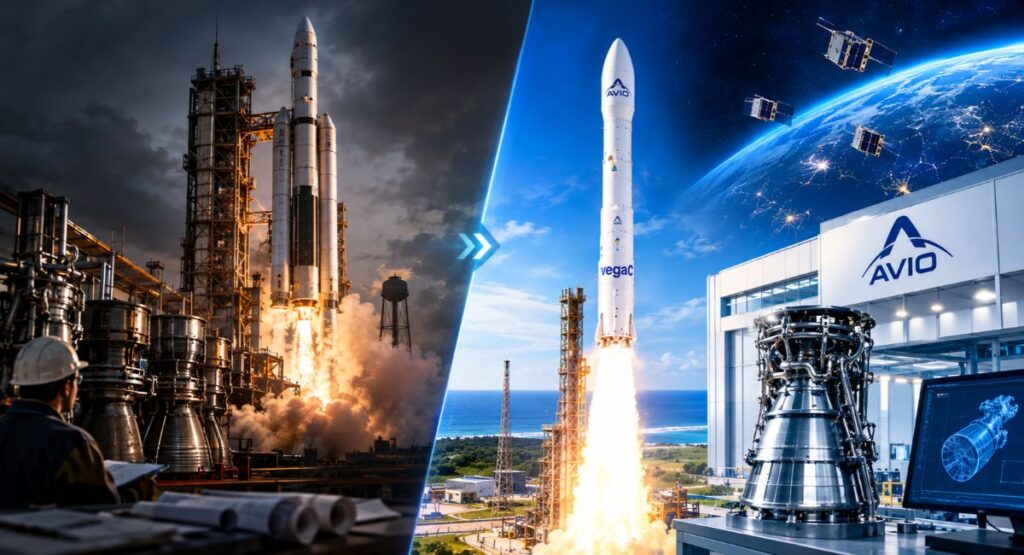
To see how far the industry has come, here is a quick comparison of traditional space launch dynamics versus the new landscape Avio is helping build:
| Feature | Legacy Space Monopoly Era | Avio’s 2026 Next-Gen Era |
| Market Control | Concentrated among 1–2 dominant providers | Multipolar, competitive, accessible |
| Propellant Tech | Toxic hypergolics or complex hydrogen | Clean Methane & Liquid Oxygen (LOX) |
| Manufacturing | Months of manual machining | 3D-printed engine components |
| Launch Model | Dependent on multi-tiered subcontracts | Direct commercial operator model |
| Mission Flexibility | Single orbit drop-offs | Multi-orbit, multi-burn deployments |
What This Means for the Future of Space Access
When access to orbit becomes faster, cheaper, and more reliable, everyone on Earth benefits, not just scientists and astronauts.
- Better Climate Tracking: Affordable launches make it easier to send up environmental satellites (like ESA’s Sentinel and FLEX missions) that monitor deforestation, sea temperatures, and crop health in real time.
- Global Connectivity: More small-satellite deployments mean faster broadband internet for remote, rural, and underserved communities.
- Fostering Innovation: When launch costs drop, smaller tech startups, university researchers, and developing nations can launch their own space experiments without needing a multi-million-dollar budget.
Avio’s 2026 evolution demonstrates that the future of space doesn’t belong to a single country or corporate giant. It belongs to a open, competitive marketplace driven by smart engineering and efficient operations.
Conclusion
The rocket industry is undergoing its biggest transformation since the dawn of the Space Age. By stepping up as an independent commercial launcher, pioneering clean liquid methane propulsion, and utilizing 3D-printed manufacturing, Avio is breaking up old rocket monopolies. This 2026 shift is laying the groundwork for a safer, greener, and far more accessible space economy for generations to come.