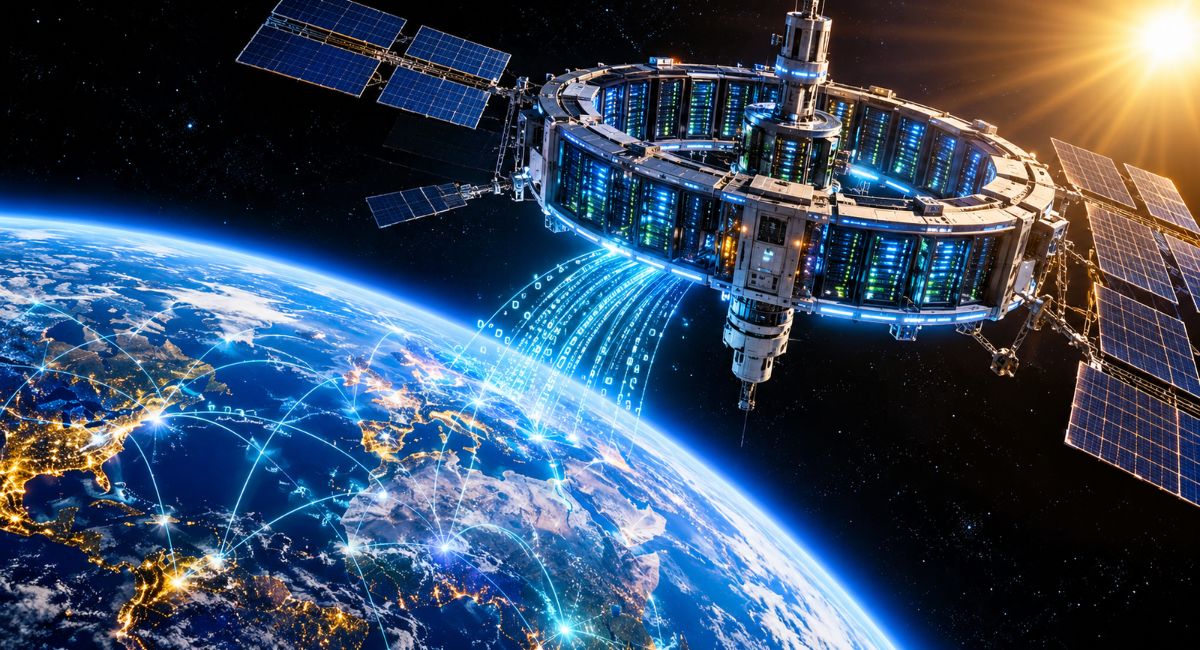
Imagine walking into a modern data center on Earth. The first thing you notice isn’t the hum of supercomputers; it is the roar. Dense banks of high-performance hardware produce immense thermal output, demanding heavy-duty HVAC networks, large-scale chillers, and huge daily volumes of water to prevent catastrophic overheating.
Now picture that same data center, but remove the walls, the concrete, and the water-cooling towers. Instead, place it hundreds of miles above your head, floating weightlessly in the dark void of space, powered by endless sunlight and cooled by the vacuum of the cosmos.
While this might seem like pure sci-fi, it is quickly becoming a reality. As artificial intelligence (AI) demands more electricity and computing power than ever before, aerospace engineers and tech visionaries are seriously asking: Can we move the cloud into space?
Let’s pull back the curtain on this futuristic frontier and explore the fascinating engineering realities behind orbiting AI cloud data centers.
Why Earth’s Data Centers Are Reaching Their Breaking Point

To understand why anyone would want to launch a server rack into orbit, we first need to look at the massive challenges facing data centers right here on solid ground.
The Power and Water Crisis
Artificial intelligence models require immense computational muscle. Training a single advanced large language model consumes as much electricity as dozens of average American homes use in a year. Multiply that by the thousands of AI applications launching every month, and you have a global energy crisis.
Power grids are straining to keep up. Worse yet, traditional data centers consume millions of gallons of water daily for evaporative cooling. In drought-prone areas, these facilities create severe competition with local residents for limited water supplies.
The Hidden Cost of Terrestrial Cooling
Heat is the ultimate enemy of computer chips. When electricity flows through a processor, resistance generates thermal energy. If that heat isn’t removed instantly, the silicon chips will literally fry themselves. On Earth, we rely on fans, liquid coolants, and massive cooling towers to dissipate that heat into the surrounding air or local water bodies. But as AI chips get denser and hotter, our cooling methods are hitting physical limits.
Enter Space: The Promise of Orbiting AI Clouds
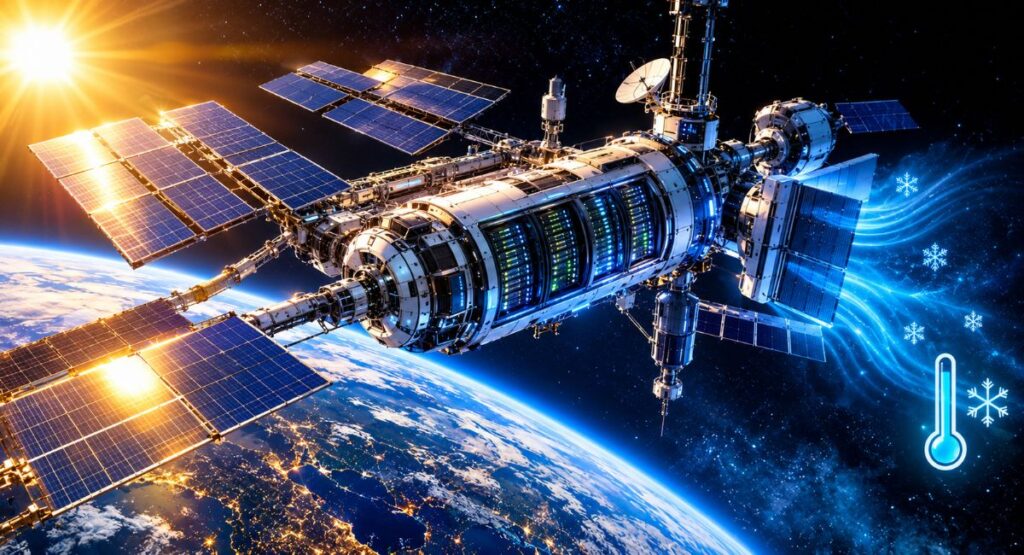
If Earth is running out of cheap power and cooling capacity, why not look up? Space offers two virtually limitless resources that modern computing desperately needs: solar energy and extreme cold.
Endless Solar Power Without Nighttime Interruptions
On Earth, solar panels only work when the sun is shining, and their efficiency drops on cloudy days or at night. In low Earth orbit (LEO), satellites can harness unfiltered solar radiation 24/7. Positioned correctly, orbiting solar arrays can capture sunlight without atmospheric interference, providing a clean, continuous torrent of electricity to power heavy-duty AI workloads.
A Natural Vacuum (Or Is It?)
Space is famously known as a vacuum. To a beginner, it is easy to assume that because space is cold, it acts like a giant refrigerator for hot computers.
Unfortunately, physics is rarely that simple. This misconception brings us to the hardest engineering puzzle of them all.
The Core Engineering Realities: How Do You Cool a Computer in Space?
If you took a standard laptop, turned it on, and left it floating in the vacuum of space, it would quickly overheat and destroy itself. Why? Because space lacks something vital that Earth has in abundance: air.
The Vacuum Trap: Why Space Isn’t Actually Cold for Computers
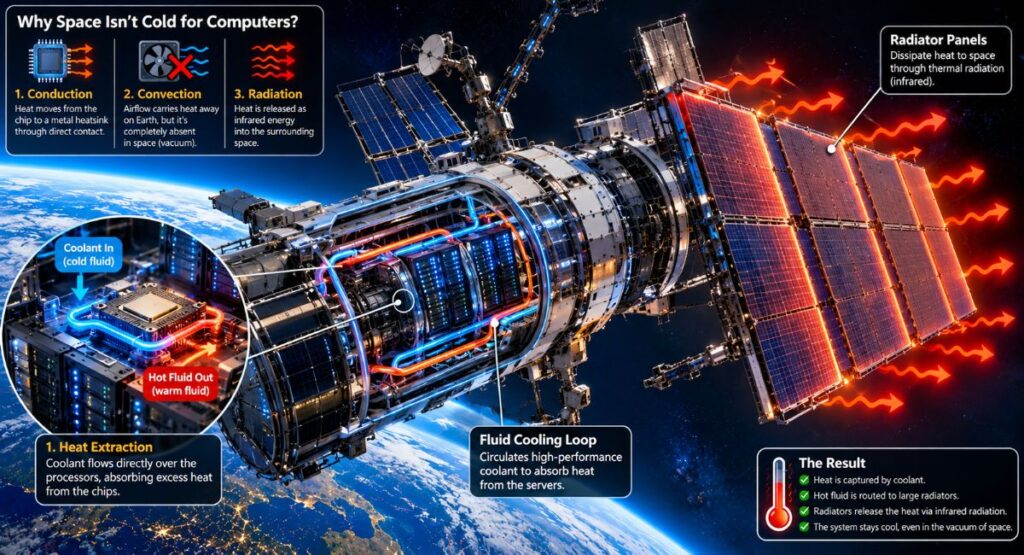
On Earth, heat moves away from your computer in three ways:
- Conduction: Heat transfers directly from the hot chip to a metal heatsink.
- Convection: Air flows past the heatsink, carrying the heat away.
- Radiation: Heat radiates outward as infrared energy.
In the vacuum of space, convection is completely missing. No air molecules can absorb heat from the server. Without an effective path to dissipate thermal buildup, the processors accumulate extreme internal heat until the system fails completely.
Designing Massive Radiators
So, how do engineers solve this? If you cannot use air to carry heat away, you must rely entirely on thermal radiation and fluid loops.
Orbital facilities must circulate high-performance fluid coolants directly across processing units to extract excess thermal energy. That hot liquid is then piped out to massive radiator panels mounted on the outside of the spacecraft. These panels glow with invisible infrared radiation, dumping the heat directly out into the cold expanse of space.
Since radiative heat transfer is far less efficient than air cooling, these thermal radiators require vast surface areas, frequently dwarfing the footprint of the server modules themselves.
Other Major Hurdles: Radiation, Launch Costs, and Latency
Heat management is only one piece of a very complicated puzzle. Launching the cloud into the stars comes with several other monumental hurdles.
Surviving Cosmic Radiation
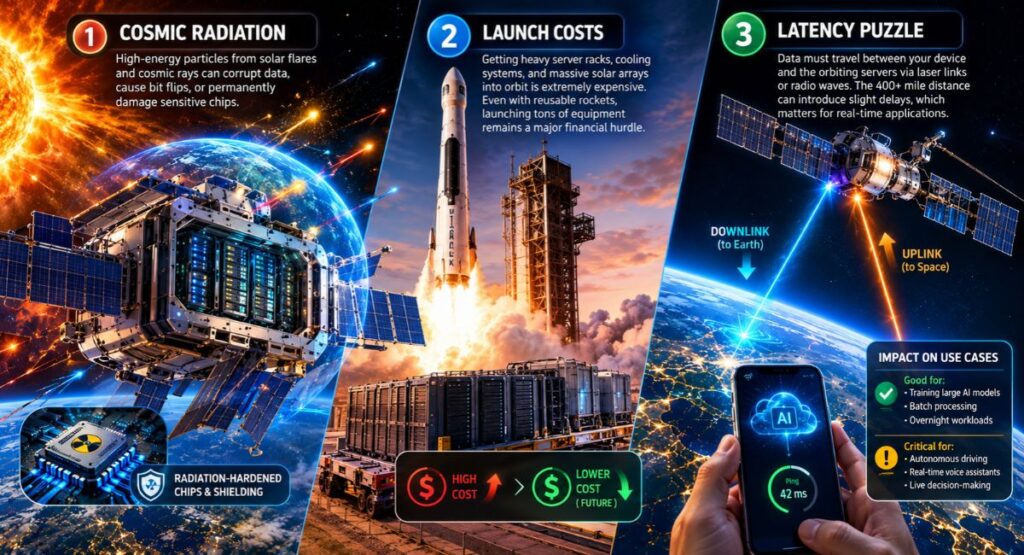
Earth’s thick atmosphere and magnetic field act as a protective shield against cosmic rays and solar flares. In space, unprotected electronics are constantly bombarded by high-energy particles. These particles can cause bit flips, random errors in data processing, or permanently fry sensitive microchips.
To make orbiting data centers viable, engineers must develop radiation-hardened semiconductors or build thick, heavy shielding around the servers. However, weight is your worst enemy in aerospace engineering.
Getting Hardware Off the Ground
Every single pound you launch into orbit costs money and fuel. While reusable rockets from companies like SpaceX have drastically lowered launch costs, hauling thousands of heavy server racks, cooling loops, and massive solar arrays into space remains an astronomical financial investment. Until launch costs drop even further, space data centers will remain an elite, niche solution.
The Latency Puzzle
Latency is the delay it takes for data to travel from your device to the server and back. If an AI data center is orbiting 400 miles above the Earth, data has to travel up and down through the atmosphere via laser links or radio waves. While light travels fast, this distance can introduce small delays. For background tasks like training massive AI models overnight, latency doesn’t matter. But for real-time applications like autonomous driving or instant voice assistants, terrestrial data centers will still hold the crown.
Who Is Working on This Right Now?
You might think orbiting cloud computing is decades away, but private companies and space agencies are already testing the waters. Startups and aerospace firms are launching small edge-computing satellites to test how AI chips perform in orbit.
The goal isn’t to replace every data center on Earth overnight. Instead, the initial vision is to handle heavy, energy-hungry AI training workloads in space, where green solar energy is abundant, leaving Earth’s grids free to power our homes and local businesses.
The Future of Computing in the Stars

The transition from terrestrial cooling to orbiting AI cloud data centers represents one of the boldest engineering shifts of our lifetime. While we still have to overcome massive hurdles in thermal radiation, radiation shielding, and launch economics, the sheer pressure of our growing energy demands on Earth makes this futuristic dream more urgent than ever.
We are standing on the precipice of a new era where the cloud won’t just be a metaphor floating in the digital ether; it will be a physical constellation of glowing, solar-powered hubs shining quietly among the stars.
Conclusion
Moving AI infrastructure into space solves some of humanity’s biggest terrestrial challenges like water scarcity, grid overload, and dirty energy consumption while introducing fascinating new engineering puzzles. As technology advances and launch costs decrease, orbiting data centers may soon transform from science fiction into the backbone of our digital future.