For decades, military power was measured by single weapons. The fastest jet, the thickest tank armor, or the quietest submarine usually took the crown. When radar-evading stealth technology debuted, it completely changed air warfare. A stealth fighter jet could fly deep into hostile territory, execute its mission, and return home without ever appearing as a crisp dot on an enemy radar screen.
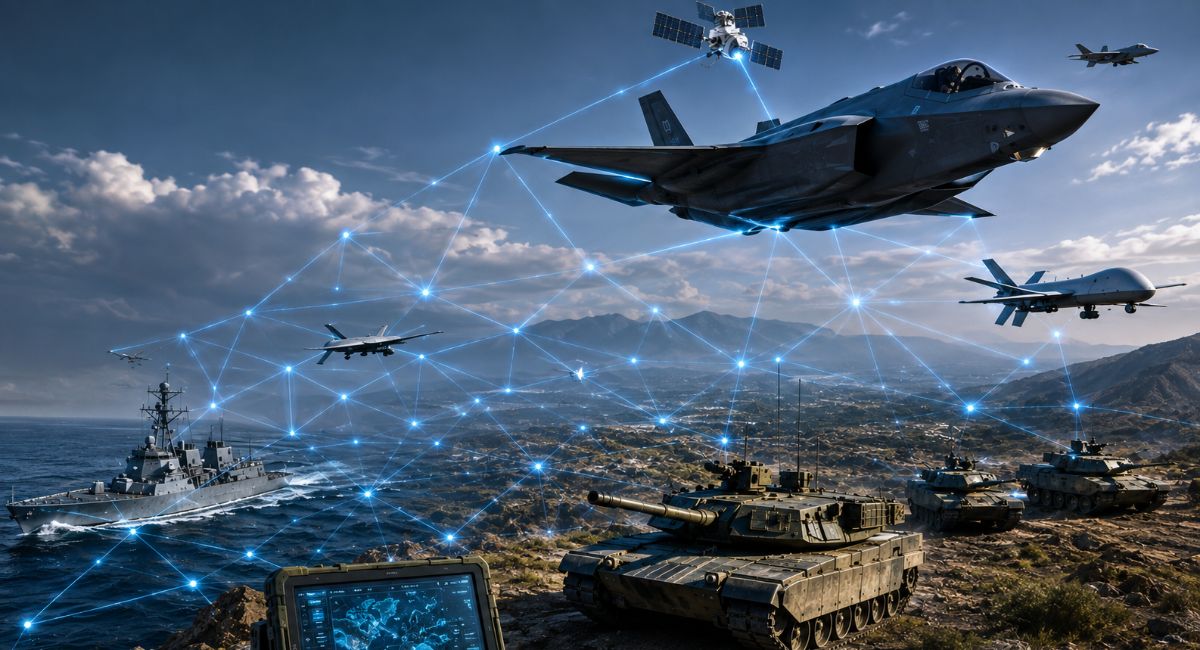
However, modern warfare has shifted away from isolated super-weapons. Today, stealth is just an entry ticket. The real game-changer in modern defense strategy is the Fifth-Generation Sky Grid. This invisible, ultra-fast digital web links stealth aircraft, uncrewed combat drones, and heavy ground armor into a single living system.
Instead of fighting as separate units, these vehicles share data instantly across air, land, sea, and space. This guide breaks down what the fifth-gen sky grid is, how it functions in real time, and why it is redefining the future of defense technology.
What Is the Fifth-Generation Sky Grid?
The fifth-generation sky grid (often referred to in defense circles as Multi-Domain Command and Control or the Combat Cloud) is a tactical data-sharing network.
Think of it like a high-speed, military-grade Wi-Fi network powered by artificial intelligence, satellite crosslinks, and encrypted radio frequencies.
In traditional combat, a fighter jet’s radar scans the sky, a ground tank’s sensors scan the horizon, and a drone records a video feed. Each platform holds a piece of the puzzle, but passing that information between different military branches often takes crucial minutes.
The sky grid solves this bottleneck. It strips away communication delays by turning every vehicle on the battlefield into an active data node. If a high-altitude drone spots a hidden artillery unit, that target’s exact coordinates appear instantly on the head-up displays of surrounding stealth jets and the fire-control computers of nearby armored vehicles.
The Core Pillars of Sky Grid Architecture
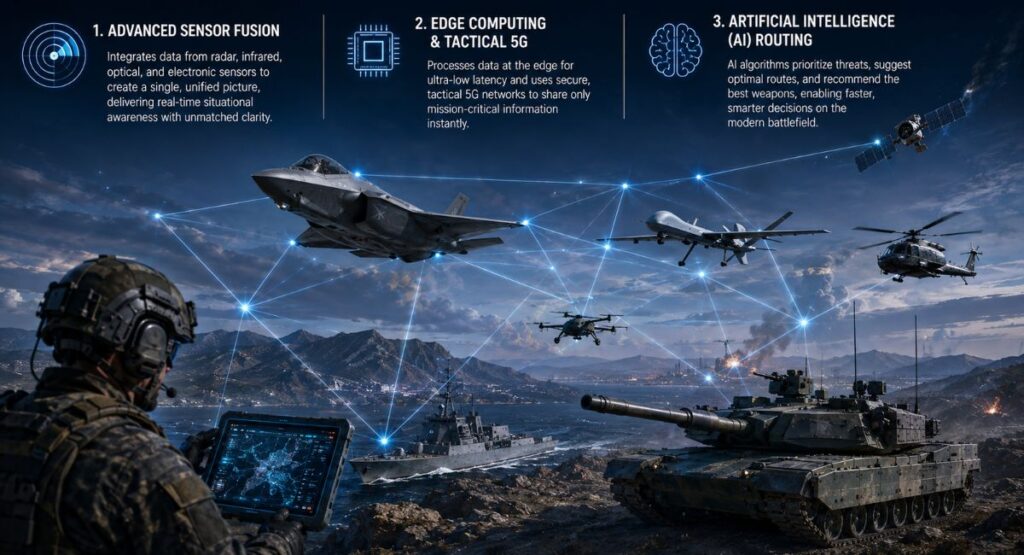
To understand how the grid functions, it helps to examine its three main technological building blocks.
1. Advanced Sensor Fusion
Modern combat vehicles are packed with sensors: infrared cameras, radar arrays, optical trackers, and electronic signals intelligence. In older platforms, pilots and drivers had to look at multiple screens and combine that information mentally.
Sensor fusion automates this chore. High-powered onboard computers take incoming data streams from dozens of sources, clean up the clutter, and present a single, clean map to the operator.
2. Edge Computing and Tactical 5G
Transmitting raw, high-definition radar data back to a central headquarters thousands of miles away requires too much bandwidth and introduces dangerous delays.
To keep communication instantaneous, sky grid systems use edge computing. Processing power sits directly inside the jet, drone, or armored vehicle. Microprocessors filter out irrelevant noise and transmit only essential, verified target data using tactical, low-latency networks.
3. Artificial Intelligence (AI) Routing
The volume of information on a modern battlefield can overwhelm human operators. AI algorithms operate inside the grid to prioritize targets based on immediate threat levels, suggest navigation routes around enemy anti-aircraft zones, and select the optimal weapon for a target.
How the Sky Grid Connects the Battlespace
The true power of this network becomes obvious when observing how different military branches interact during an active operation.
| Asset Type | Traditional Role | Role in the Fifth-Gen Sky Grid |
| Stealth Fighter Jets | Primary attack and air superiority platform | Airborne battle managers, forward sensor nodes, and strike directors |
| Uncrewed Drones | Remote reconnaissance or basic missile strikes | Loyal Wingmen distractions, electronic warfare jammers, and shield platforms |
| Armored Ground Armor | Direct ground assault and territory defense | Mobile command posts, heavy missile launchers, and perimeter defense |
Stealth Jets as Airborne Battle Commanders
Fifth-generation aircraft like the F-35 Lightning II are often described as flying supercomputers. While earlier jets were built strictly to dogfight or drop bombs, modern stealth fighters spend a large portion of their mission collecting and distributing battlefield intelligence.
Thanks to their stealth coatings, these jets can fly deep into hostile air defense zones undetected. Once inside, they do not always fire their own weapons. Instead, they sit silently, gathering radar maps and sharing that targeting data with friendly forces further back.
Autonomous Drones as Loyal Wingmen
Uncrewed Aerial Vehicles (UAVs) have evolved far beyond slow-moving spy drones. Under the sky grid framework, AI-driven combat drones fly alongside stealth fighters in a concept known as Collaborative Combat Aircraft (CCA) or Loyal Wingmen.
These drones carry out specific tactical assignments assigned by the grid:
- Flying ahead to draw enemy radar fire and reveal missile positions.
- Blasting electronic noise to blind enemy communications.
- Carrying extra air-to-air or air-to-ground missiles that the pilot of a stealth jet can launch remotely.
Because drones do not have a human pilot onboard, they can take high-risk routes, keeping crewed aircraft safer.
Armored Armor as Connected Ground Anchors
For a long time, ground vehicles like main battle tanks and infantry fighting vehicles were isolated from high-altitude air networks. They relied strictly on line-of-sight radios and voice communications.
Within the fifth-gen sky grid, heavy armor integrates directly into the digital web. For example, if a tank crew encounters an enemy artillery emplacement hidden behind a mountain ridge, they do not need to push blind around the obstacle.
The tank commander can request a target lock directly through the grid. A drone overhead or a stealth jet cruising miles above provides the exact GPS coordinates, allowing the tank or an automated ground missile launcher to fire over the ridge with pinpoint accuracy.
A Step-by-Step Scenario: The Grid in Action
To see how these pieces fit together, consider a hypothetical tactical mission:
Detection: A high-altitude surveillance drone detects an enemy mobile air-defense radar turning on.
Data Link: The drone instantly uploads the radar’s coordinates to the combat cloud via satellite link.
Data Fusion: A nearby stealth jet receives the signal. The jet’s sensor fusion software combines the drone’s data with its own infrared cameras to confirm the target’s precise location.
Target Assignment: The sky grid’s internal AI assesses the scene. It determines that the stealth jet should preserve its weapons for air threats. Instead, it routes the target to an armored missile-vehicle stationed 15 miles away on the ground.
Execution: The ground vehicle receives the targeting prompt, launches a precision-guided weapon, and destroys the enemy radar all within seconds of its initial activation.
Key Advantages of the Sky Grid Over Legacy Warfare
Overcoming Speed of Relevance Challenges
In modern conflicts, hypersonic missiles and automated weapon systems move at extreme speeds. Human decision-making alone can be too slow to counter these threats. By automating data distribution, the sky grid reduces the time between spotting a threat and eliminating it (The OODA loop: Observe, Orient, Decide, Act) to fractions of a second.
Built-in Network Resilience
Older combat systems often had a single point of failure. If the central command trailer or radar tower was hit, the whole unit went blind.
The fifth-gen sky grid relies on a decentralized mesh network structure. If an enemy shoots down a drone or jams a radar plane, the remaining jets, tanks, and satellites automatically reroute data through each other. The network adapts instantly to keep the broader team connected.
Multi-Domain Force Multiplication
By allowing land units to use air sensors and air units to call in land weapons, military forces multiply their force. A smaller group of connected forces can outperform a much larger enemy that relies on isolated, unnetworked units.
Challenges Facing the Fifth-Gen Sky Grid
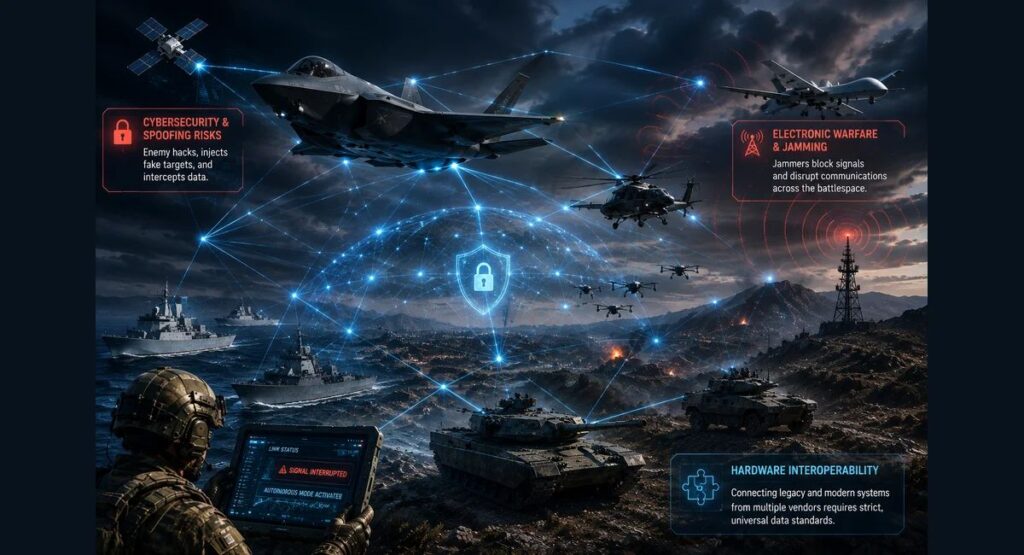
While the sky grid offers clear strategic advantages, building and maintaining an interconnected battle network comes with major technical hurdles.
Cybersecurity and Spoofing Risks
Because the sky grid relies heavily on software and wireless signals, cybersecurity is a top priority. Enemies will actively attempt to hack into data streams, insert fake targets, or intercept classified communications. Maintaining end-to-end encryption across hundreds of mobile combat nodes requires constant security updates.
Electronic Warfare and Jamming
Adversaries use powerful electronic jammers to block radio and satellite frequencies. If the wireless signals connecting jets to drones are severed, those nodes must be able to fall back on autonomous local AI routines until connectivity is restored.
Hardware Interoperability
Militaries often buy weapons, vehicles, and software from different manufacturers across different decades. Getting an armored tank built in 2010 to communicate seamlessly with a drone built in 2025 and a fighter jet built in 2020 requires strict, universal data standards.
The Future: What Lies Beyond the Grid?
As we look toward sixth-generation defense capabilities, the line between air and ground operations will continue to blur. Future iterations of the sky grid will incorporate even more advanced technologies:
Quantum Encryption
Utilizing quantum key distribution to make military data streams virtually impossible to intercept or decrypt.
Fully Autonomous Swarms
Hundreds of small micro-drones communicating locally to blanket an operational zone with real-time sensor coverage.
Direct Satellite-to-Vehicle Integration
Low Earth Orbit (LEO) satellite constellations offer low-latency, global coverage directly to tactical ground vehicles without needing bulky satellite dishes.
Conclusion
Stealth technology changed the way fighter jets survived in contested skies, but the Fifth-Generation Sky Grid is changing how entire wars are fought. By weaving stealth aircraft, autonomous drones, and heavy armor into a single real-time digital mesh, defense networks have evolved past isolated super-weapons.
In this new era of defense technology, victory does not belong simply to the platform with the quietest radar cross-section or the thickest armor. It belongs to the side that can collect, process, and act on data the fastest.