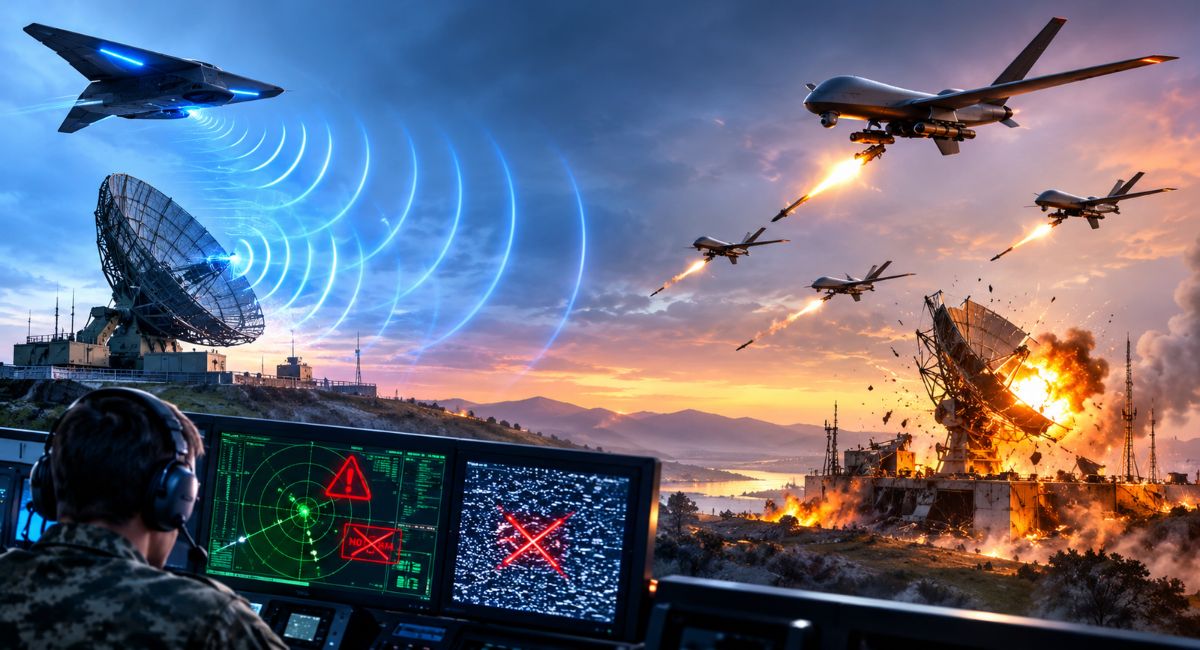
Imagine looking at a massive, multi-million-dollar security network designed to track every single movement across the sky, only to watch it turn completely blind in a matter of seconds. For decades, radar was the ultimate guardian of airspace. If something flew, a radar dish spun, picked up the radio waves, and plotted its coordinates.
Today, that paradigm is shifting dramatically. Modern warfare has entered an era where traditional defense systems are routinely outsmarted, blinded, and systematically dismantled. The combination of next-generation electronic jamming and precision-guided, targeted drone strikes has completely changed how airspace is controlled and defended.
For beginners looking to understand this high-tech shift, this article explains how modern radar works, how next-generation jamming blinds it, and why the tandem use of drones is rewriting military strategy.
Understanding the Eyes of the Sky: How Traditional Radar Networks Work
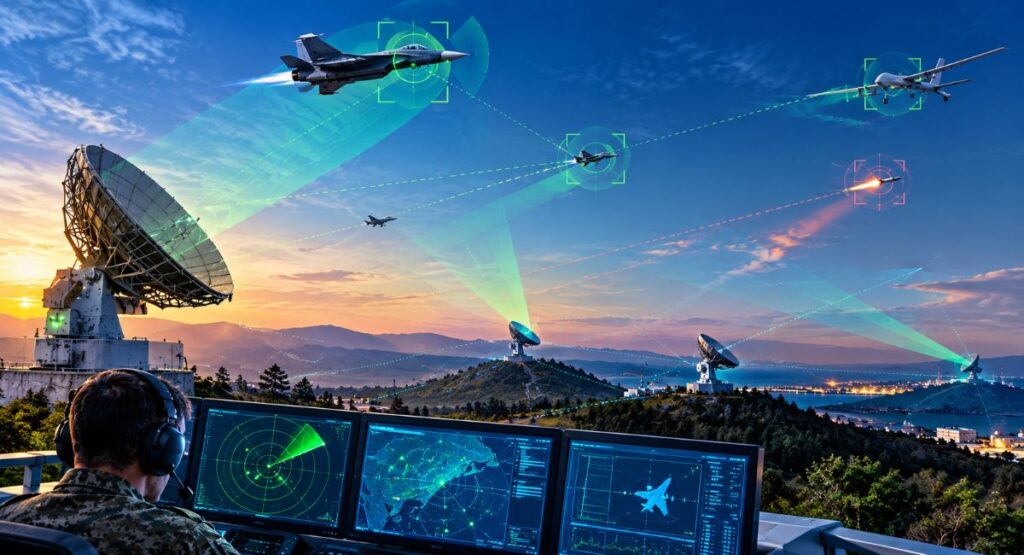
To understand how modern radar networks are being blinded, we first need to look at how they see. At its core, a radar system is relatively straightforward. It operates on a simple principle: echo location.
- The Transmission: A radar antenna sends out a pulse of radio frequency (RF) energy into the sky.
- The Reflection: That energy travels outward until it hits an object like an aircraft, a missile, or a cloud. When it hits the object, some of that energy bounces back as an echo.
- The Processing: The radar receiver catches the returning echo, measures how long it took to return, and calculates the object’s distance, speed, and direction.
Traditional networks tie multiple radar stations together. If one station has its view blocked by a mountain or the curvature of the Earth, another station picks up the slack. For a long time, this created a comprehensive, overlapping web of coverage that made it nearly impossible for anything to fly completely unnoticed.
The Evolution of Interference: What is Next-Gen Jamming?
Electronic jamming is not a brand-new concept; militaries have been using it since World War II by dropping strips of aluminum foil (called chaff) to confuse radar screens. However, next-generation jamming is light-years ahead of those rudimentary methods.
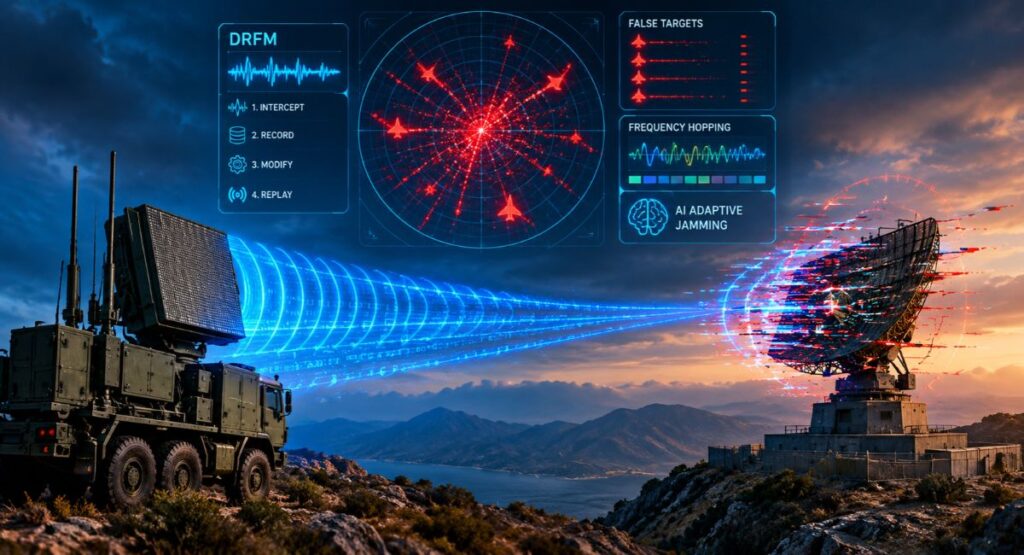
Modern systems use Cognitive Electronic Warfare (EW) and advanced digital techniques to outthink the radar rather than just shouting over it.
1. Digital Radio Frequency Memory (DRFM)
Advanced jammers use a technology called DRFM. Instead of just blasting random white noise to block a signal, a DRFM jammer intercepts the incoming radar pulse, records it, digitally alters it, and bounces it back instantly.
Result:
The radar system receives thousands of false echoes. To the operators tracking the screens, it looks like there are dozens of incoming aircraft, or that a real target is suddenly moving at supersonic speeds in three different directions at once. The radar operator is trapped in a maze of digital ghost images.
2. Frequency Agility and Cognitive Jamming
Older radars operated on fixed frequencies, making them easy to target. Modern radars fight back by constantly hopping from one frequency to another. Next-gen jammers counter this using Artificial Intelligence (AI). These smart jammers scan the environment, learn the radar’s hopping pattern in real time, and adapt their output to disrupt the specific frequency the radar is currently using.
In short, next-generation jamming turns a radar network’s own technology against it, flooding its processors with confusing data until it effectively suffers a digital blackout.
The One-Two Punch: How Targeted Drone Strikes Complete the Blindness
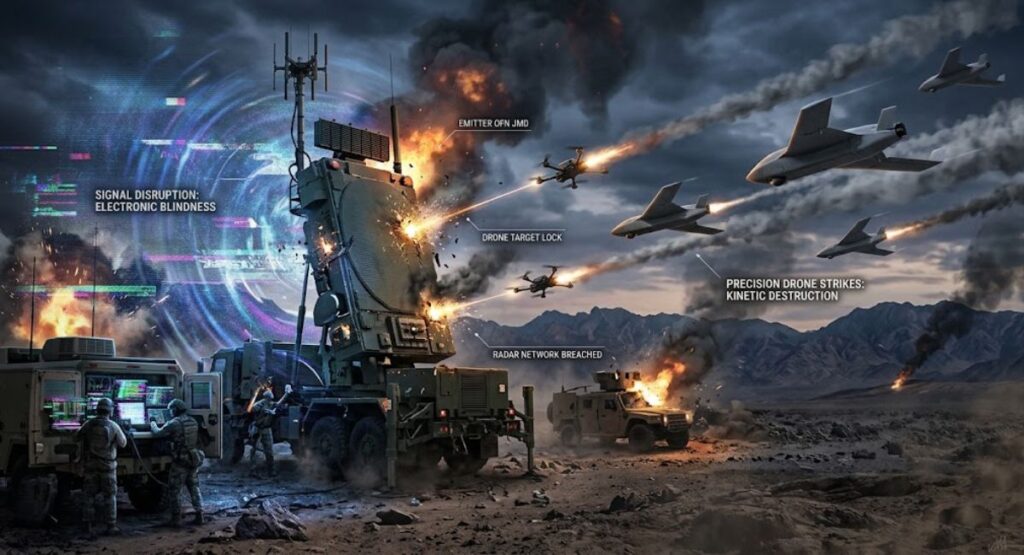
Jamming alone is powerful, but it is only half of the equation. Once a radar network is jammed, confused, or operating at reduced capacity, it becomes vulnerable to physical destruction through targeted drone strikes.
The Suppression Strategy
Radar sites are massive, heavy, and stationary. They require large antennas, heavy power generators, and fixed command posts. Because of their stationary nature, these installations become highly vulnerable target positions once their locations are discovered by hostile forces. By using next-gen jammers to blind the wider network first, attacking forces can safely guide loitering munitions, first-person view (FPV) drones, or autonomous strike UAVs directly toward the radar installations.
- Cost Inefficiency: A single high-end air defense radar can cost tens or hundreds of millions of dollars. A precision loitering drone or kamikaze UAV can cost a fraction of that.
- The Loop of Destruction: The jammer disrupts the radar’s ability to detect the incoming drone. By the time the radar operators realize something is wrong, the autonomous drone has locked onto the emitter’s signal and executed a terminal dive.
When the radar station is destroyed, a massive hole opens up in the defense network. Neighboring radars try to compensate, stretching their coverage thin, which creates more blind spots for subsequent waves of attacks.
Why This Changes Everything: The Shift in Modern Defense
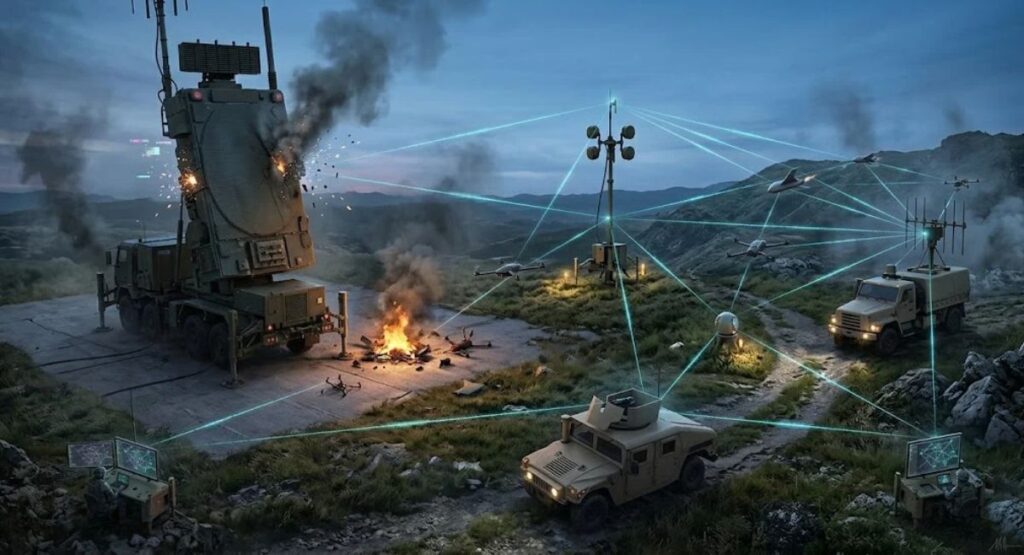
The synergy between smart jamming and targeted drone operations has forced military strategists worldwide to rethink how they protect airspace. We are seeing a rapid shift away from massive, centralized radar stations toward decentralized, mobile, and passive detection networks.
- Passive Detection
Because active radars are easy to spot and jam (since they give away their location by constantly transmitting signals), modern defense is leaning into passive systems. These include advanced acoustic sensors, infrared tracking, and radio-frequency receivers that listen to enemy communications without broadcasting anything themselves.
- Network Resilience
Instead of relying on a few massive radar nodes, modern systems use distributed swarms of smaller, interconnected sensors. If one node is taken out by a drone strike, the network instantly self-heals by routing data through neighboring nodes.
Conclusion
The reliance on massive, rotating radar systems to shield skyways is swiftly fading into history. High-tech electronic disruption combined with precision drone attacks has highlighted critical flaws in conventional, centralized air defense architectures. Today, intelligent algorithms and cost-effective unmanned systems can effectively bypass and disable multi-million-dollar military hardware. As defense technology pushes further into AI-driven automation and adaptive signal warfare, success will depend on a single priority: protecting modern sensor networks while remaining invisible to enemy detection.