When OpenAI released ChatGPT, the world experienced a massive turning point in digital technology. Overnight, computers learned to summarize documents, write code, compose emails, and converse like humans. It was software mastering software, a revolution contained entirely within digital screens.
However, a fundamental limitation remained. A chatbot can draft a gourmet recipe, stir a pot, or serve the meal. It can write a blueprint for a home, but it cannot lift bricks or turn a screwdriver.
To bridge this gap, artificial intelligence must transition from text and images into physical reality. This next evolutionary frontier is called Physical AI, which understands, interacts with, and navigates the physical world.
Building robots that can operate safely alongside humans is extraordinarily difficult. Teaching machines in physical environments takes massive amounts of time, requires heavy capital investment, and carries significant safety risks. If a 150-pound metal robot makes a mistake while learning to walk, it can shatter its own frame or damage surrounding equipment.
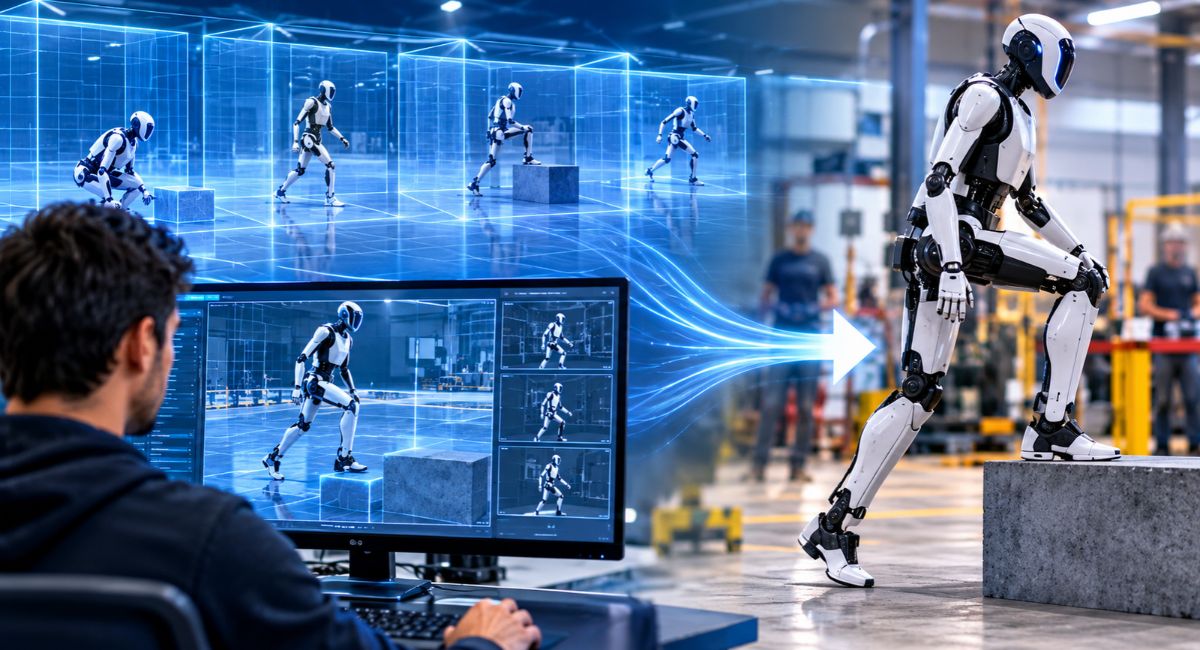
The breakthrough powering this new era relies on Virtual Training Arena’s ultra-realistic, GPU-powered digital environments where humanoid robots train in parallel before ever setting foot in the physical world.
What Is Physical AI and How Does It Differ from Traditional AI?
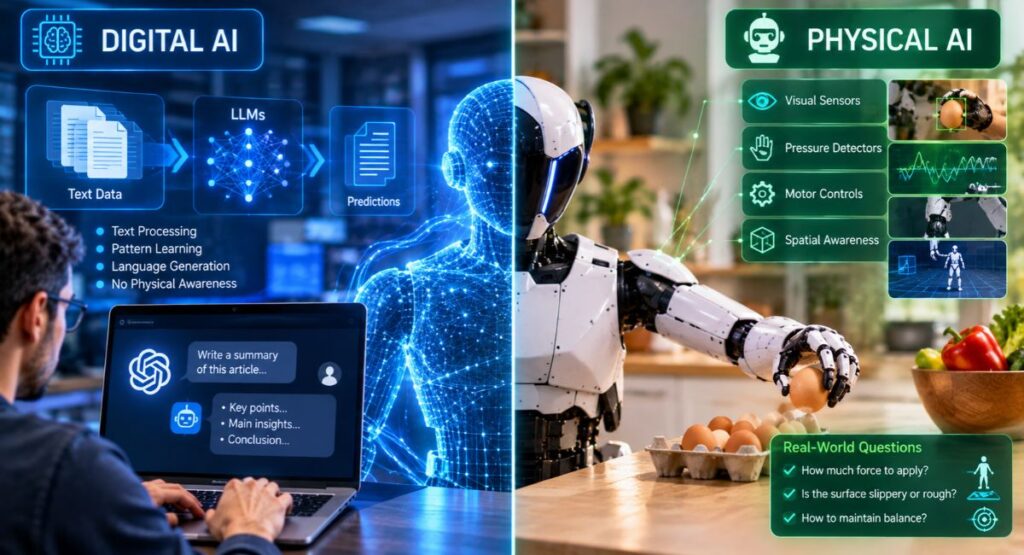
To understand this shift, it helps to separate software-based AI from embodied physical systems.
Digital AI
Digital AI operates inside databases and text streams. Models like LLMs (Large Language Models) consume text, learn patterns, and generate predictions. They have no concept of mass, balance, surface friction, or inertia.
Physical AI
Physical AI combines digital intelligence with spatial hardware, often referred to as embodied AI. It equips machines with physical bodies, visual sensors, pressure detectors, and motor controls. A physical AI system must continuously process sensory data to answer spatial questions:
- How much force should my fingers apply to grab an egg without crushing it?
- Is this surface slick or carpeted?
- How do I adjust my center of gravity if someone nudges my shoulder?
While digital AI predicts the next word in a sentence, physical AI predicts the next safe motion in physical space.
The Physical Wall: Why Training Humanoids in the Real World Is Broken
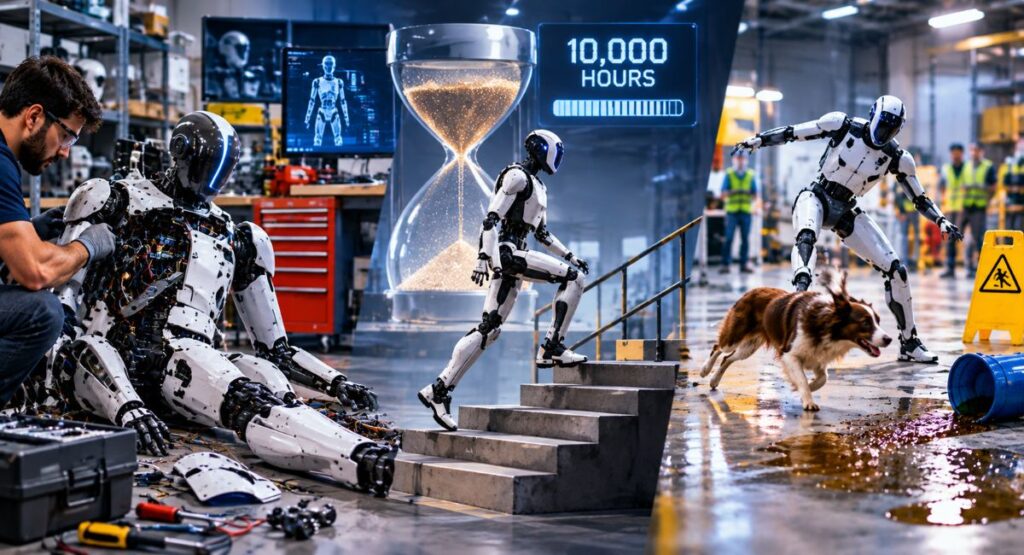
Training a humanoid robot in a physical room presents three major bottlenecks:
1. The Cost of Hardware and Repairs
Humanoid robots are complex machines packed with precision actuators, custom motors, carbon-fiber limbs, and high-resolution cameras. In early development, learning algorithms make thousands of errors per hour. Repeatedly dropping a robot leads to costly repairs, burned-out gearboxes, and project delays.
2. Time Realities
In the physical world, time cannot be fast-forwarded. If a robot requires 10,000 hours of physical practice to master walking down stairs, collecting those hours in real time takes over a year of nonstop operation.
3. Edge Case Dangers
An edge case is an unexpected or rare event like a dog running under a robot’s feet or liquid spilled on a warehouse floor. Intentionally setting up dangerous scenarios to train a physical robot risks hurting nearby personnel and destroying hardware.
Enter Virtual Training Arenas: The Digital Proving Grounds
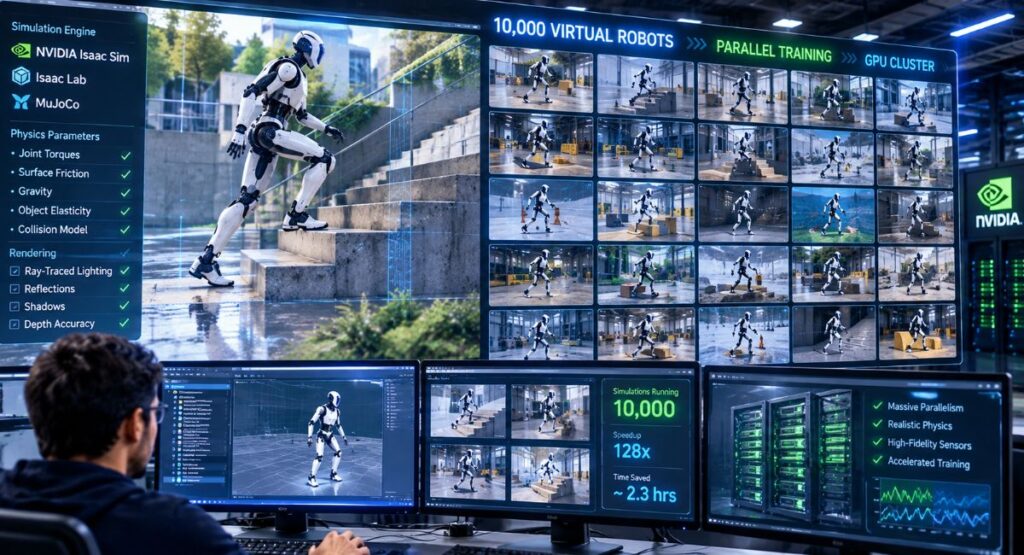
To solve the physical bottleneck, engineers built Virtual Training Arenas, advanced physical simulation spaces. Platforms like NVIDIA Isaac Sim, Isaac Lab, and MuJoCo serve as high-fidelity virtual proving grounds for AI development.
A virtual training arena is not a standard video game engine. It is an exact mathematical mirror of physical reality.
Key Characteristics of Virtual Training Arenas:
- Ray-Traced Visual Fidelity: Photorealistic rendering allows camera sensors on simulated robots to perceive reflections, shadows, and depth accurately.
- Exact Physics Engines: Simulators model dynamic variables like joint torques, surface friction, gravity, and object elasticity.
- Parallel GPU Compute: Instead of training one robot in one physical room, developers simulate 10,000 virtual robots simultaneously across GPU clusters.
By running thousands of virtual instances at accelerated speeds, a team can compress years of physical robot experience into a few hours.
Core Technologies Accelerating the Virtual Arena Pipeline
Several technical breakthroughs allow virtual training arenas to scale physical AI so rapidly:
1. Synthetic Data Generation (SDG)
To learn vision tasks, AI requires millions of labeled images. In a virtual arena, software automatically changes lighting, textures, camera angles, and object positions. This generates perfectly annotated synthetic data without human labeling.
2. Reinforcement Learning (RL)
In virtual arenas, humanoid robots learn through continuous rewards and penalties. For example, if a virtual robot steps securely onto a step, it gains points; if it falls, it loses points. By iterating through billions of attempts, the AI discovers optimal balance strategies autonomously.
3. Foundation Models for Embodied AI
Just as LLMs process text, foundation models built for physical AI such as NVIDIA Project GR00T or Google’s RT series process multimodal inputs (video, text instruction, joint state) and translate them into motor actions.
Overcoming the Sim-to-Real Gap
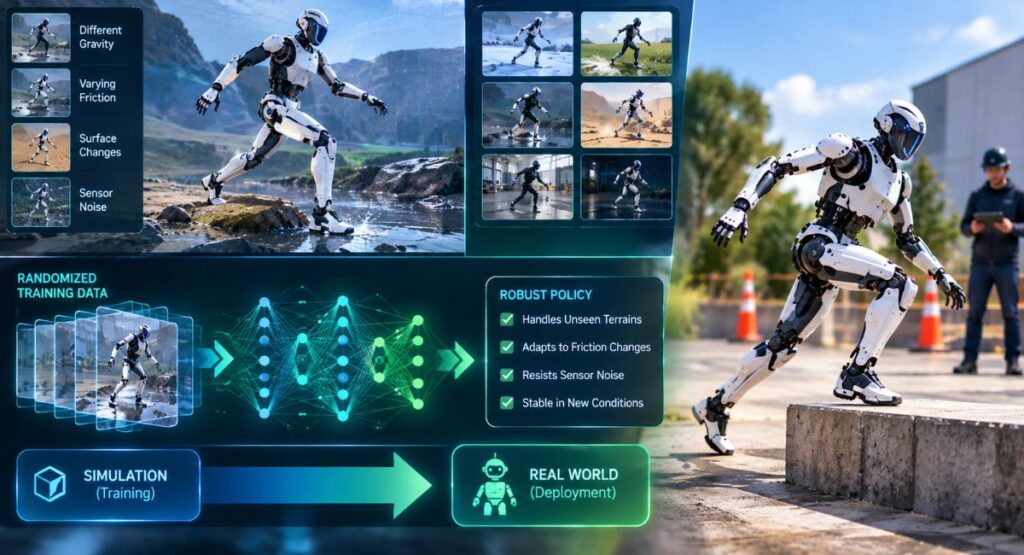
A primary challenge in robotics simulation is the Sim-to-Real gap, the discrepancy between virtual simulation physics and real-world execution.
If a digital simulation models air resistance or friction incorrectly, a robot trained in simulation may instantly fall when deployed onto concrete.
How Engineers Cross the Gap:
- Domain Randomization: During training, developers intentionally randomize physics variables within the simulation. They alter gravity settings slightly, make floor surfaces slippery or tacky, and introduce sensor noise. This forces the robot’s neural network to develop resilient movement strategies that adapt to unexpected conditions.
- Zero-Shot Transfer: When domain randomization is done effectively, a robot trained exclusively in a virtual arena can be loaded onto physical hardware and immediately complete real-world tasks without extra adjustments.
Real-World Applications: Where Physical AI Humanoids Are Heading
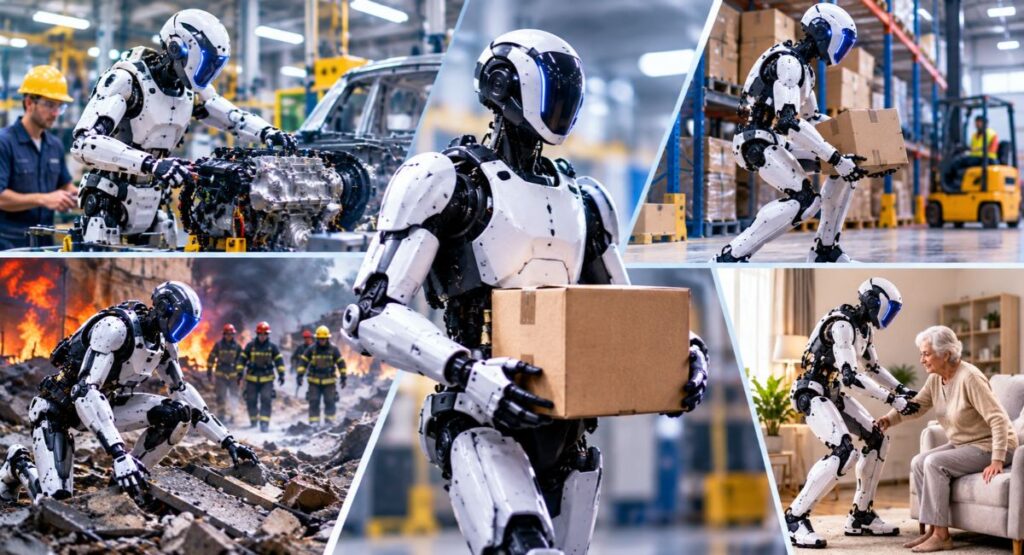
As virtual training arenas shorten development cycles, humanoid robots are moving out of research labs and into operational environments.
| Sector | Practical Application | Impact |
| Manufacturing & Auto Plants | Assembling parts, carrying heavy engine components, inspecting tight vehicle chassis. | Reduces workplace injuries and fills labor gaps in dangerous environments. |
| Logistics & Warehouses | Sorting irregular packages, unstacking pallets, navigating crowded aisles. | Optimizes supply chain speeds and handles high-turnover shifts. |
| Disaster Response | Entering burning structures, turning off hazardous gas valves, searching through rubble. | Replaces human responders in high-risk zones. |
| Elderly Care & Homes | Assists with mobility, retrieves household items, and supports daily routines. | Provides physical aid in aging demographics. |
Key Challenges Facing the Physical AI Era
While virtual training accelerates development, several structural hurdles remain:
- Actuator Hardware Limitations
Software models can execute complex movements virtually, but real-world hardware requires compact, high-torque motors that can run for hours without overheating.
- Power & Battery Efficiency
Bipedal locomotion and continuous vision processing consume significant power. Modern humanoids usually require recharge cycles after 2 to 4 hours of continuous work.
- Safety & Regulatory Protocols
Deploying a 150-pound autonomous metal machine around human workers requires strict safety guarantees, emergency fail-safes, and clear industry standards.
The Evolution of AI
| Generation | Primary Focus | Learning Method | Core Medium |
| Web & Search Era | Data Indexing | PageRank & Algorithms | Web Pages & Links |
| ChatGPT Era | Language & Code | Transformer LLMs | Text Prompts & Tokens |
| Physical AI Era | Motion & Spatial Reality | Simulation & Virtual Arenas | Physics, Sensors & Actuators |
Conclusion
The ChatGPT moment proved that artificial intelligence can master digital communication. However, the next technological frontier lies beyond the screen.
By building Virtual Training Arenas, researchers are unlocking a safe, hyper-scalable pipeline for training physical AI. Millions of virtual robots can fail, adapt, and master complex manual tasks inside simulated environments every single day. When these models leave the virtual arena and enter real-world hardware, they will transform manufacturing, logistics, and daily human productivity forever.