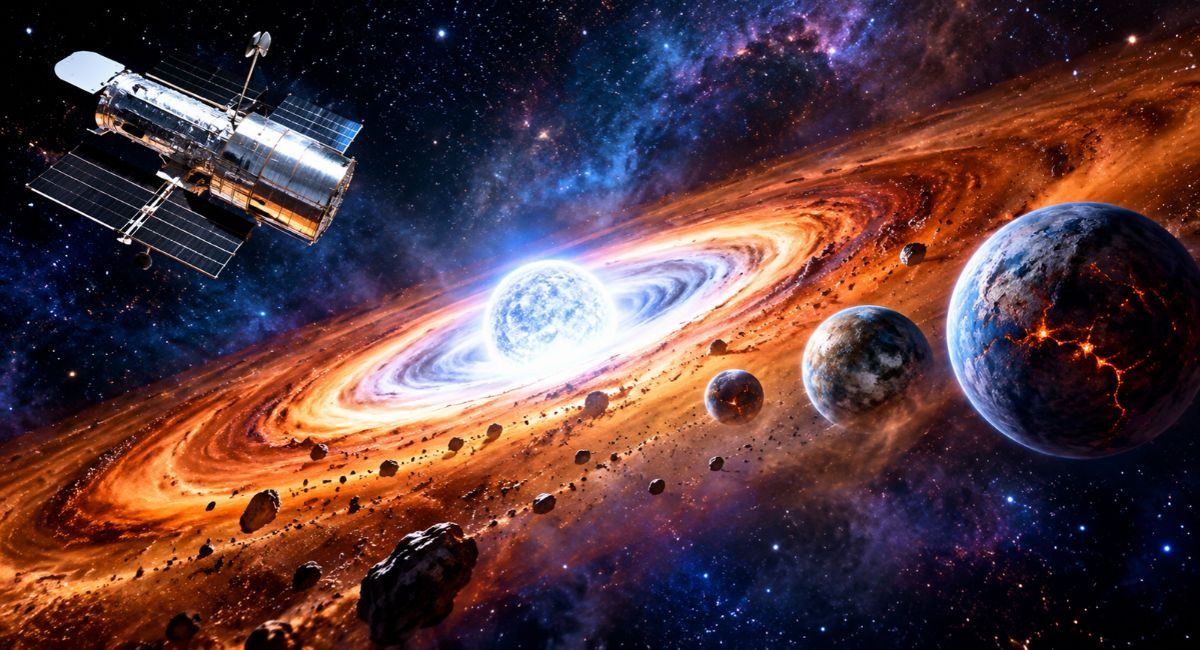
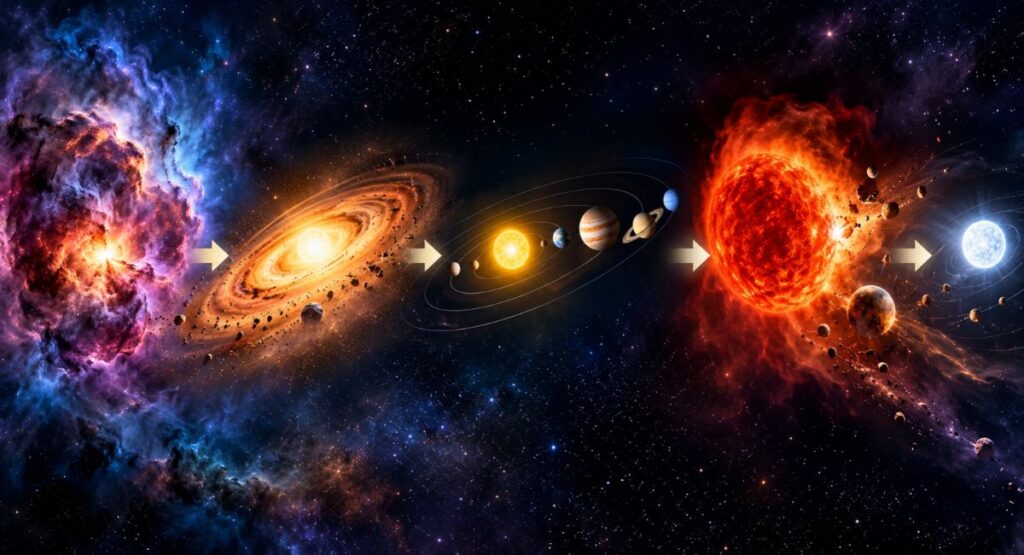
Space has a way of surprising us when we least expect it. For generations, scientists believed they understood the lifecycle of stars and planets. A star is born from a vast cloud of gas and dust; planets form from the leftover scraps in a disk around it; and billions of years later, the star dies, taking its planetary system down with it in a fiery or slow-fade finale.
But what if death isn’t the absolute end? What if a dead star could experience a miraculous second act, giving birth to an entirely new kind of world from beyond the grave?
Thanks to a brilliant re-examination of archival data from the NASA/ESA Hubble Space Telescope, astronomers have uncovered clues pointing to a phenomenal reality. Dead stars, specifically compact remnants known as white dwarfs, might be forging a completely new class of deep space worlds.
The Traditional Story of Star and Planet Birth
To understand why this new discovery is turning modern astronomy on its head, we first need to look at how the universe usually operates.
In our cosmic neighborhood, the timeline of creation is well-documented:
- The Stellar Nursery
A giant cloud of molecular gas and hydrogen collapses under its own gravity, igniting a brand-new star.
- The Protoplanetary Disk
Whatever material is left spinning around the infant star flattens into a disk. Over millions of years, dust grains collide, stick together, and grow into pebbles, rocks, and eventually full-scale planets like Earth and Jupiter.
- The First-Generation Rule
These planets are strictly first-generation. They are born alongside their host star and share its chemical DNA.
For the longest time, science assumed that when a star like our Sun runs out of nuclear fuel, it swells into a red giant, sheds its outer layers into space, and leaves behind a glowing, dead ember called a white dwarf. Planets orbiting too close during this phase are swallowed or incinerated, leaving a desolate, lonely graveyard.
Solving a Cosmic Cold Case: The Mystery of HS 0209+0832
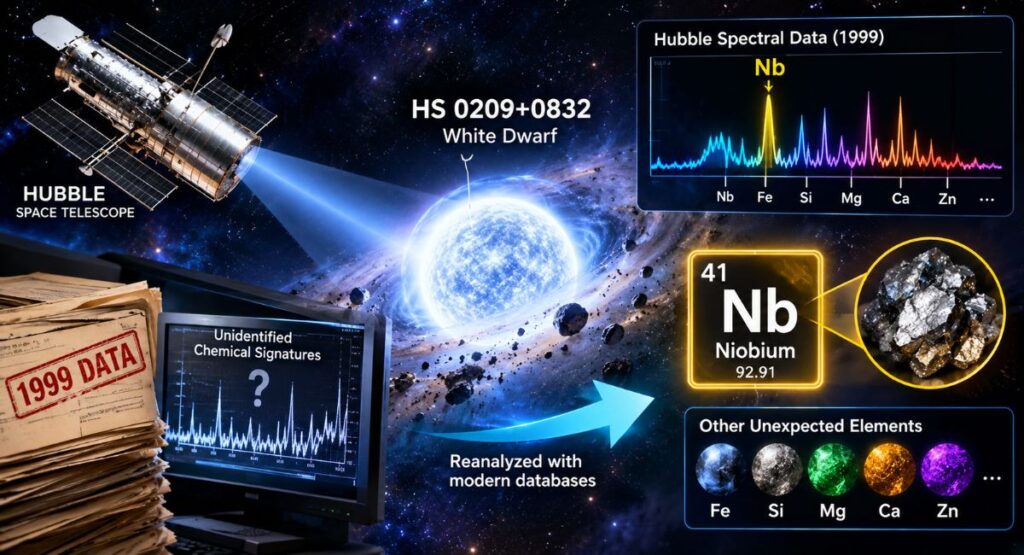
The plot thickens with a stellar remnant cataloged as HS 0209+0832. Back in 1999, the Hubble Space Telescope pointed its sensitive instruments at this white dwarf. Back then, the data revealed a baffling puzzle: Hubble picked up roughly 100 strange chemical signatures that astronomers could not identify. They sat in the archives like an unsolved cold case, baffling researchers for decades.
Recently, a team of scientists revisited these old observations using modern chemical databases. It was like looking at an ancient text with a newly discovered translation key.
The pieces fit. The mysterious chemical fingerprints belonged to niobium (Nb), a rare heavy metal, alongside other unexpected elements. But why would a dead white dwarf be littered with heavy chemical signatures?
Enter the Zombie Stars: What is a White Dwarf?
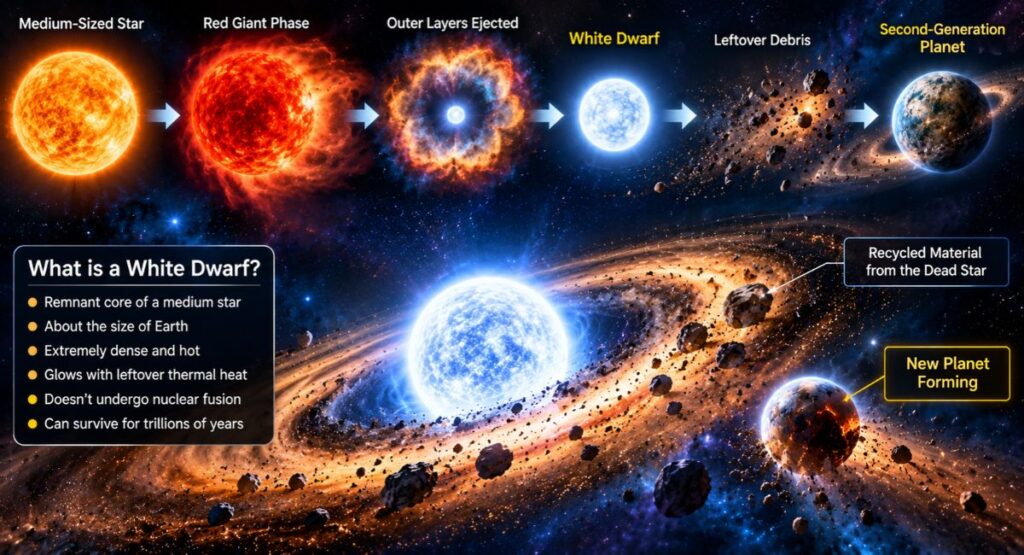
When medium-sized stars die, they don’t explode into brilliant supernovas. Instead, they gently puff off their outer layers into the cosmos, leaving behind a dense, Earth-sized core packed with matter. This core is a white dwarf.
Though they are often called dead because they no longer undergo nuclear fusion, they aren’t completely inactive. They glow with leftover thermal heat for trillions of years, stubbornly refusing to fade into total darkness. Because of this eerie, long-lasting persistence, astronomers often affectionately think of them as the zombies of the stellar graveyard.
The new Hubble analysis suggests that the debris left behind when the star died didn’t just drift uselessly into the void. Instead, under the right conditions, that recycled material could coalesce, pool together, and form something entirely unprecedented: a second-generation planet.
Backed by Multiple Missions: The TESS Connection
Science thrives on verification. A single odd chemical signature in Hubble data is fascinating, but scientists needed more evidence to prove that a zombie star could actually host a brand-new world.
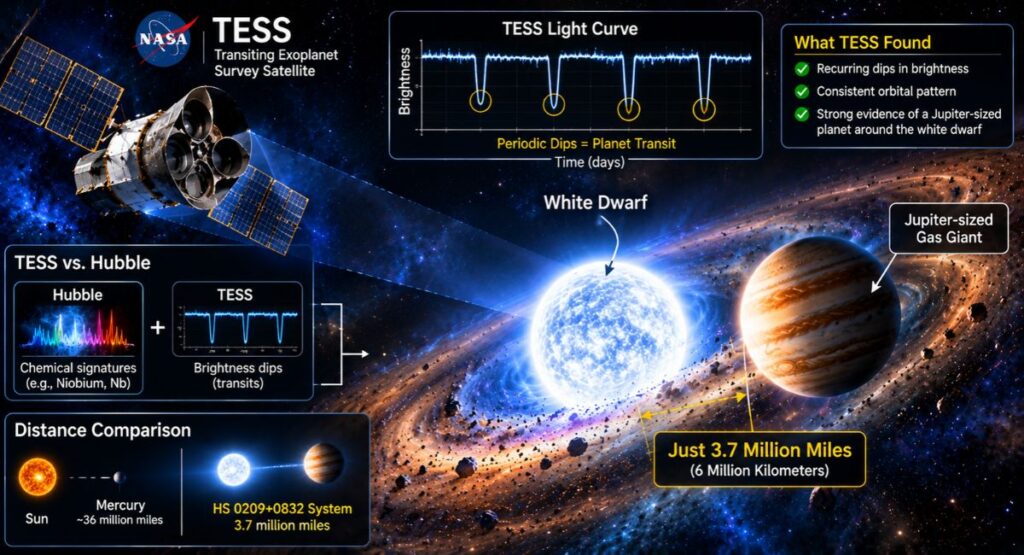
Enter NASA’s TESS (Transiting Exoplanet Survey Satellite). TESS monitors stellar brightness, looking for tiny dips in light when a planet crosses in front of its host star.
When researchers analyzed TESS data for this system, they found recurring, subtle brightness changes. These patterns strongly suggested a Jupiter-sized gas giant orbiting the white dwarf. Even more shocking is its location: this potential world orbits the dead star at a blistering 3.7 million miles (about 6 million kilometers), far closer than Mercury is to our Sun.
How Do You Build a Planet from the Dead?
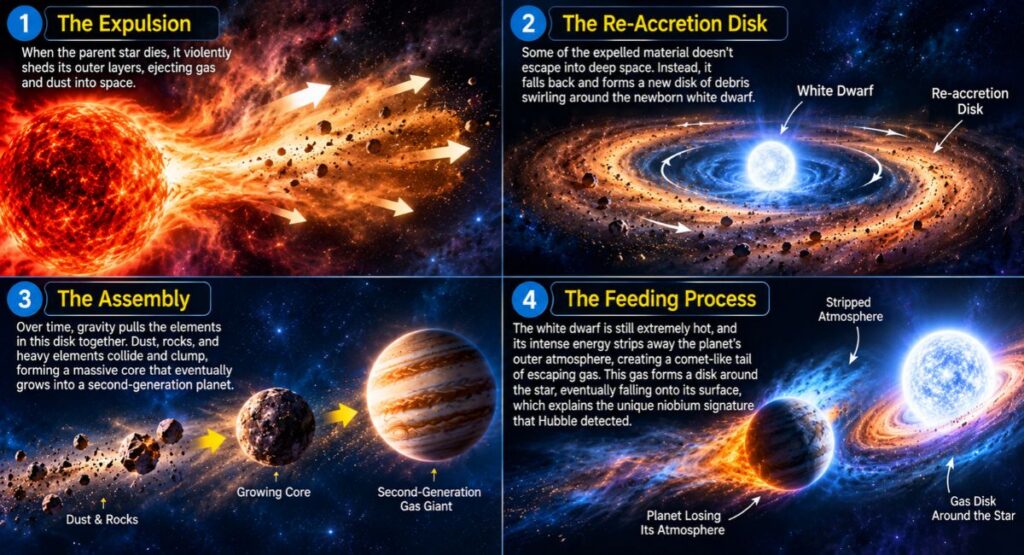
The idea of building a planet after a star has already died sounds like science fiction, but the physics is surprisingly grounded. Here is how astronomers believe it happens:
- The Expulsion: When the parent star dies, it ejects gas and dust outward.
- The Re-Accretion Disk: Some of this material doesn’t escape into deep space. Instead, it forms a new disk of debris swirling around the newborn white dwarf.
- The Assembly: Over time, gravity pulls the elements in this disk together. Heavy elements, gas, and dust clump into a massive core, eventually swelling into a second-generation gas giant.
- The Feeding Process: Because this white dwarf is still scorching hot, its intense energy acts like a blowtorch on the nearby planet. It slowly strips away the planet’s outer atmosphere, creating a comet-like tail of escaping gas. This gas forms a disk around the star, eventually falling onto its surface, which explains the unique niobium signature that Hubble detected in the first place.
Could These Worlds Support Life?
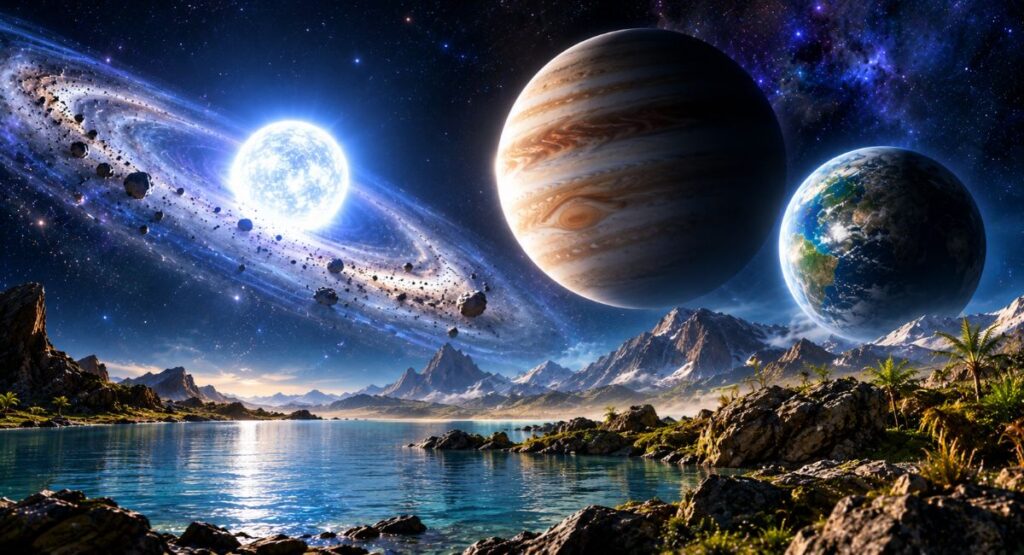
It is natural to wonder whether these bizarre, second-generation worlds could ever be home to alien life.
Right now, the candidate spotted near HS 0209+0832 is a massive gas giant, much like Jupiter, meaning it lacks a solid surface for walking or building habitats. Furthermore, it is currently baking way too close to the hot stellar core to be comfortable.
However, researchers point out a fascinating long-term outlook. As the white dwarf cools down over millions of years, its searing temperature drops and stabilizes. If a rocky world were to form or migrate into the white dwarf’s stable habitable zone during this cooling phase, it could theoretically maintain a steady climate for millions, or even billions, of years.
It turns out that a dead star’s neighborhood might eventually become a surprisingly cozy place to settle down.
Why This Discovery Changes Everything
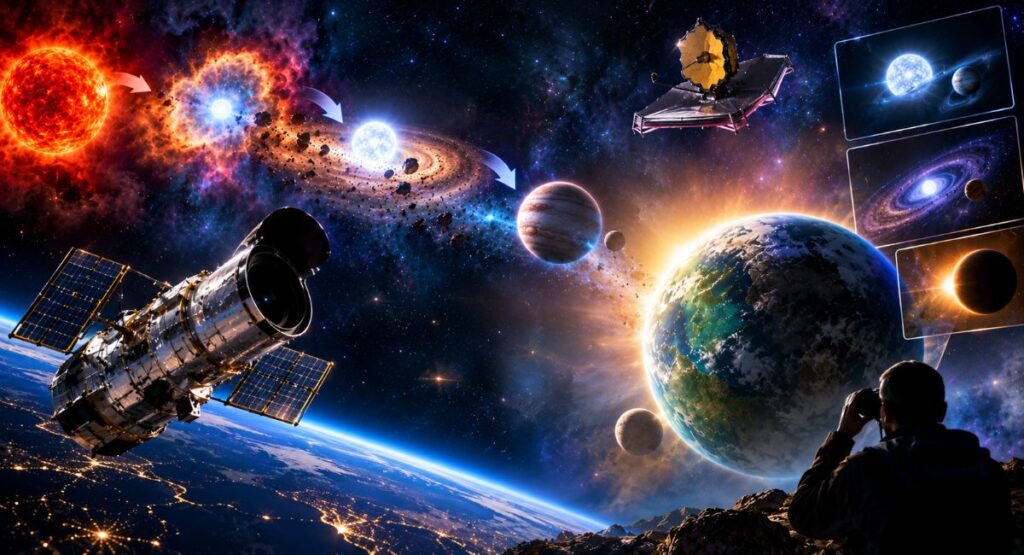
The implications of this Hubble discovery stretch far beyond a single star system. For years, astronomy textbooks taught a very rigid, linear lifecycle for planetary systems.
This finding shatters that rigid mindset. It proves that the universe is far more dynamic, cyclical, and endlessly creative than we imagined. Death in space does not mean the end of creation; rather, it can be the raw material for a brand-new beginning.
By proving that second-generation planets can exist, Hubble has opened up an entirely new frontier in space exploration. Astronomers now have a brand-new scavenger hunt: to look back at old archival data, team up with modern space telescopes like TESS, and search for more signs of life and planets rising from the ashes of dead stars.
Conclusion
The universe is a master recycler. What starts as a brilliant star ends in a quiet, glowing white dwarf, only for the ashes of that destruction to knit themselves back together into a brand-new deep space world.
Hubble’s re-examined data reminds us that science is an ongoing journey of rewriting what we think we know. As technology improves and we look deeper into the cosmic archives, we are reminded that even in the stellar graveyard, the universe finds a way to surprise us with new life.