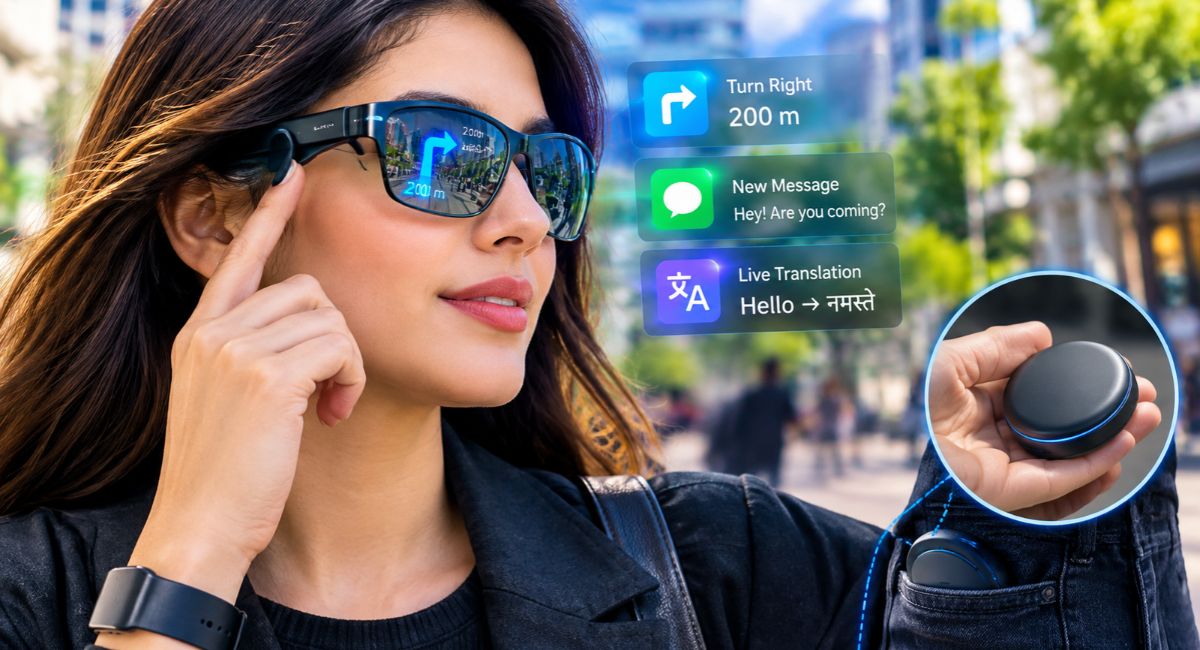
Picture putting on a pair of sleek, stylish glasses that project digital navigation arrows, instant message alerts, and live language translation directly into your field of view. The frames feel as light as standard sunglasses; there are no bulky batteries pressing into your nose, no heavy cooling fans buzzing in your ears, and no hot microchips warming up your temples.
To anyone watching, you are simply wearing fashionable eyewear. But behind the scenes, a clever engineering decision makes this seamless experience possible: the heavy electronic workload has been removed from your face entirely and shifted into a compact, pocket-sized companion device.
In augmented reality (AR) and wearable technology, this system layout is known as a split-computer architecture, and the external companion module is commonly called a pocket-puck.
By splitting hardware duties between an optical display headset and an external pocket module, wearable designers have tackled the biggest technical hurdles facing modern smart glasses: reducing weight, extending battery life, and preventing heat buildup. However, offloading hardware to a pocket brings its own set of trade-offs. In this article, explore how split-compute smart glasses work, why the pocket-puck dilemma exists, and what this tech means for the future of everyday wearables.
What Exactly Is Split-Compute Technology?
To understand why the pocket-puck strategy has gained so much traction, it helps to look at how first-generation smart eyewear was constructed.
Early smart glasses attempted an all-in-one design, cramming every single hardware component directly into the frame legs and rim:
- Rechargeable lithium-ion batteries
- Micro-display projectors and optical prisms
- Wireless antennas (Wi-Fi, Bluetooth, cellular)
- Main central processing units (CPUs) and graphics processors (GPUs)
Packing all those high-power parts onto a human head leads to immediate comfort and safety problems. High-capacity batteries add noticeable physical weight, powerful chips generate heat right against sensitive facial tissue, and users quickly reject bulky, heavy facegear for daily public wear.
The Split-Compute Solution
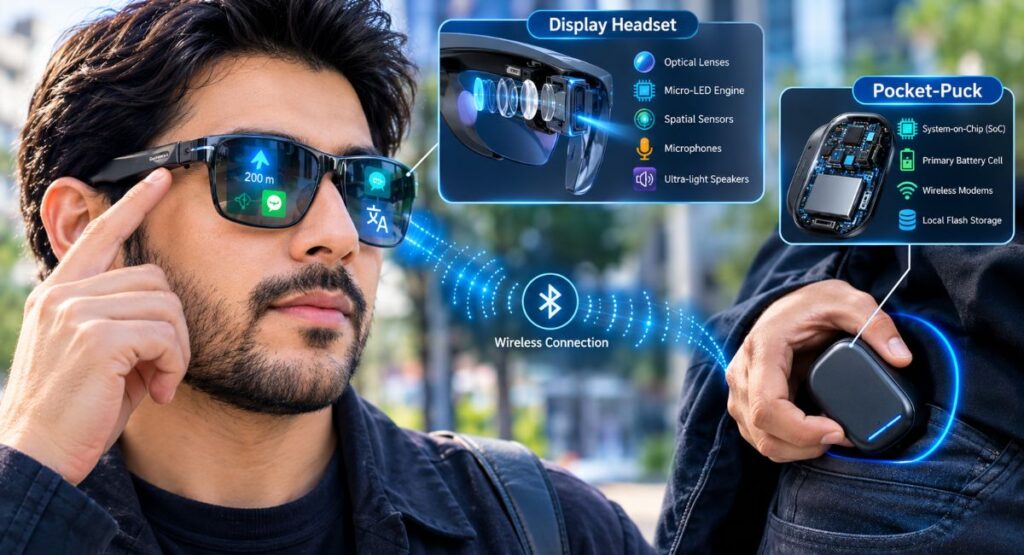
Split-compute design solves the physical weight problem by dividing the system into two complementary units:
- The Display Headset: Contains only essential optical lenses, micro-LED engines, spatial positioning sensors, microphones, and ultra-light audio speakers. Freed from heavy processors and big power packs, the frames remain light, comfortable, and well-balanced.
- The Pocket-Puck: An external companion module roughly the size of a small smartphone or power bank that rests in your jacket or pants pocket. It houses the heavy-duty system-on-chip (SoC), primary battery cell, wireless modems, and local flash storage.
Connecting these two hardware pieces wirelessly gives users smartphone-grade processing performance while maintaining the natural feel of standard glasses. However, this split moves the engineering battleground to managing energy draw and thermal output across two distinct hardware locations.
The Battery Challenge: Balancing Dual Power Stations
Battery technology advances at a much slower rate than microchip performance. While computer processors shrink and grow exponentially faster every few years, battery chemistry improves only in small, incremental steps. In a split-compute setup, designers must carefully manage power across two separate battery systems.
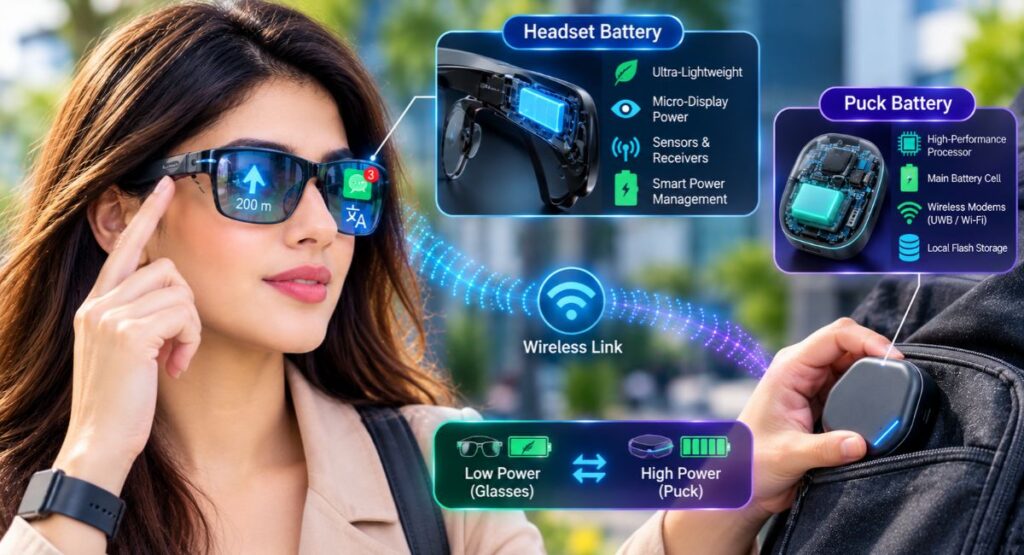
1. Headset Battery: Ultra-Lightweight vs. Active Power Time
Even with primary processing offloaded to the pocket module, the glasses frames still require an internal battery cell to run micro-display engines, spatial sensors, and data receivers.
- The Problem: Adding a bigger battery makes the frames slide down your nose and causes ear fatigue. Reducing battery size too far leaves you with a headset that dies after short periods of use.
- The Engineering Fix: Manufacturers embed high-density lithium-silicon micro-cells inside the temple arms and pair them with smart software that dims display pixels whenever your eyes are not actively looking at a display panel.
2. Puck Battery: Sustaining High-Performance Computing
The pocket-puck carries the main energy burden. It executes complex software code, renders 3D graphics, interprets incoming sensor streams, and streams constant data back to the headset over short-range wireless channels.
- The Problem: Consumers expect all-day usability (10 to 14 hours) from personal electronics. However, streaming dense video feeds over high-bandwidth links like ultra-wideband (UWB) or Wi-Fi drains energy faster than normal phone background tasks.
- The Engineering Fix: Dynamic power distribution. When you are doing basic tasks like checking the time or playing audio, the puck enters an ultra-low-power state, letting the headset handle lightweight duties locally.
Thermal Management: Handling Heat in Tight Spaces
While battery life can be extended through smart software tweaks and low-power modes, thermal dynamics follow strict physical laws. High-speed computing chips naturally produce thermal energy whenever they perform complex calculations.
Why Cooling a Pocket Device Is Tricky
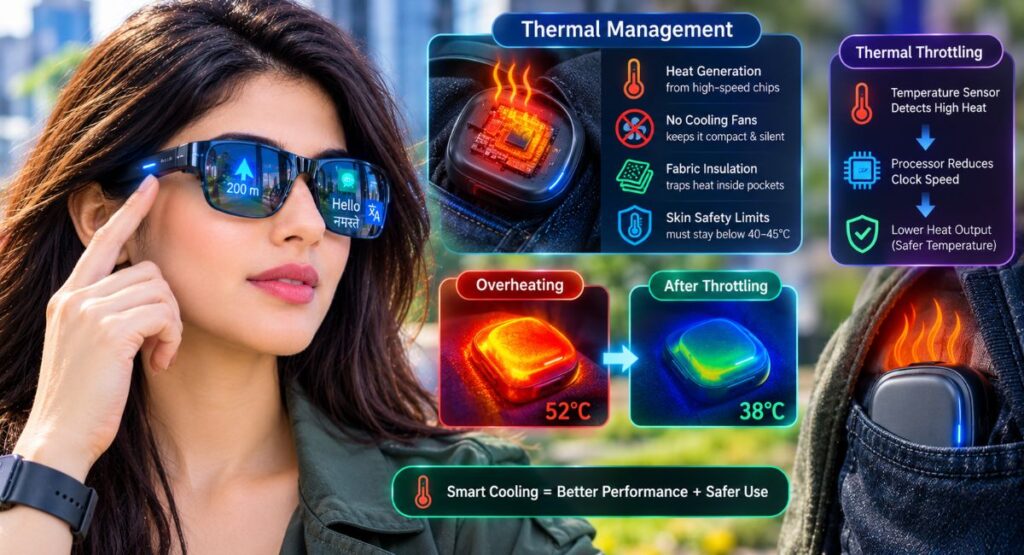
When a pocket-puck runs intense tasks like spatial mapping or real-time AI translation, internal temperatures rise quickly due to three distinct physical constraints:
- No Cooling Fans: To keep pocket-pucks compact, silent, and weather-resistant, engineers avoid noisy internal fans. Mechanical fans draw extra power, collect dust, and take up valuable space inside the casing.
- Fabric Insulation: A clothing pocket acts like a natural blanket. Surrounded by denim, cotton, or jacket linings, a warm electronic device has almost no surrounding airflow to vent off trapped heat.
- Skin Temperature Safety Rules: Safety guidelines state that any electronic device resting close to a person’s body must stay below specific surface temperature limits (usually 40°C to 45°C) to prevent skin discomfort or thermal injury.
Understanding Thermal Throttling
When an internal temperature sensor detects dangerous heat levels, built-in safety software initiates thermal throttling. The main processor deliberately reduces its operating clock speed to cool itself down.
For someone wearing the glasses, this protective slowdown translates into dropped screen frames, visual stuttering, or slight delays during demanding augmented reality tasks.
Innovative Solutions Solving the Pocket-Puck Dilemma
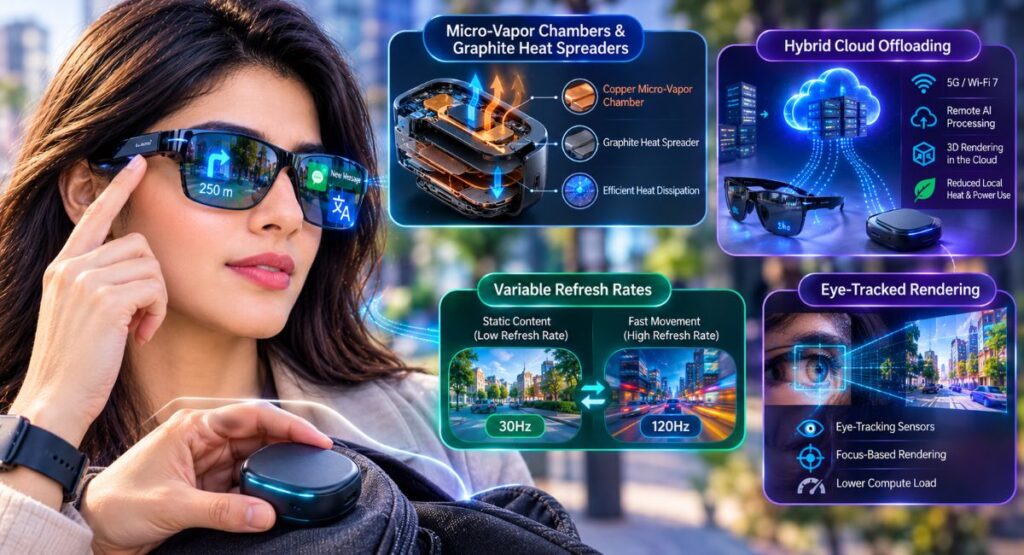
Engineers are using advanced hardware cooling systems and clever rendering software to keep split-compute setups cool, efficient, and responsive.
Micro-Vapor Chambers and Graphite Heat Spreaders
Without active cooling fans, pocket devices rely on clever passive cooling techniques. Modern pocket-pucks feature paper-thin copper micro-vapor chambers containing tiny drops of liquid. When the processor heats up, the liquid evaporates, moves heat to the outer shell, condenses back into liquid, and repeats the cooling loop. Multi-layered graphite sheets sit alongside these chambers to spread thermal energy across the outer surface, eliminating single hot spots against your clothing.
Hybrid Cloud Offloading
Rather than forcing the pocket-puck to process every heavy task locally, modern systems send intensive computing, such as complex voice recognition or detailed 3D environment rendering, to distant cloud servers over fast 5G or Wi-Fi 7 networks. This significantly lowers local chip processing, keeping the pocket module cooler and preserving power.
Variable Refresh Rates and Eye-Tracked Rendering
Optimized software cuts energy draw dramatically. Modern micro-displays drop their refresh rate automatically when you view static text or basic icons, instantly ramping back up only during rapid movement. Additionally, eye-tracking sensors enable specialized rendering pipelines that draw great graphic detail only at the precise point where your eyes are looking, cutting compute workloads across the remaining display area.
What This Means for Everyday Wearable Users
As split-compute smart glasses enter mainstream consumer markets, keeping these hardware realities in mind helps set clear expectations:
Practical Initial Features
Early product lineups will concentrate on swift text notifications, step-by-step directions, and instant voice assistance rather than multi-hour graphic gaming.
New Daily Essentials
Just as wireless earbud cases became standard pocket gear, compact pocket-pucks will become a normal item in your everyday carry collection alongside your phone and wallet.
Comfort Comes First
Hardware brands recognize that light, comfortable facegear matters more than sheer power. Keeping the headset cool and effortless to wear remains the absolute top priority.
Conclusion
The pocket-puck dilemma is a classic challenge in modern consumer hardware: delivering high-performance computing and reliable battery runtime in a shape that stays cool, comfortable, and easy to carry. By splitting responsibilities between a featherlight display headset and a dedicated pocket module, engineers have established a functional framework for the future of everyday augmented reality.
Even though managing heat and battery capacity remain tough ongoing challenges, steady progress in chip efficiency, passive thermal materials, and cloud computing continues to bridge the gap. As these technologies evolve, split-compute smart glasses will transition from an intriguing niche innovation to an essential tool for daily life.