
The cryptocurrency world stands at a major crossroads. For over a decade, most everyday crypto investors followed a simple path: open an account on a centralized exchange (like Coinbase or Binance), deposit cash, buy tokens, and leave them in the exchange’s account. It felt as easy and familiar as online banking.
However, high-profile exchange collapses, surprise account freezes, and shifting global rules have exposed the hidden flaw in that approach. When you keep your crypto on a centralized platform, you don’t actually hold your money; the platform does.
This reality has triggered a major movement known as The Sovereignty Shift. Over the next two years, the battle for crypto’s future won’t be fought between individual meme coins or competing blockchain networks. Instead, it will be fought between two powerful, rapidly growing models:
Self-Custody Decentralized Exchanges (DEXs): Platforms where you retain full control over your private keys and trade directly from your wallet.
Regulated Tokenized Venues: Highly compliant platforms where real-world assets (like stocks, real estate, and government bonds) are traded on-chain under official legal frameworks.
Understanding this tug-of-war is essential for protecting your investments and taking advantage of the best opportunities in modern Web3. Let’s break down what this shift means, why it’s happening, and how to navigate it as a beginner.
What Is Sovereignty in Crypto (and Why Does It Matter)?

In traditional finance, financial sovereignty means complete, uninterrupted control over your money. In crypto, this concept is captured by a famous industry motto: Not your keys, not your coins.
Understanding Private Keys vs. Custodial Accounts
When you store money in a traditional bank account or a centralized crypto exchange, you are using a custodial service. The exchange controls the master passwords (private keys) to the blockchain wallets. You simply log in with a username and password. If the exchange goes bankrupt, gets hacked, or freezes withdrawals, you lose access.
Self-custody flips this script. You hold the private keys, usually managed through a software wallet (like MetaMask or Phantom) or a hardware cold-storage device (like Ledger or Trezor). Nobody can freeze your account, take your funds, or limit your transfers. You act as your own bank.
Front 1: The Rise of Self-Custody DEXs
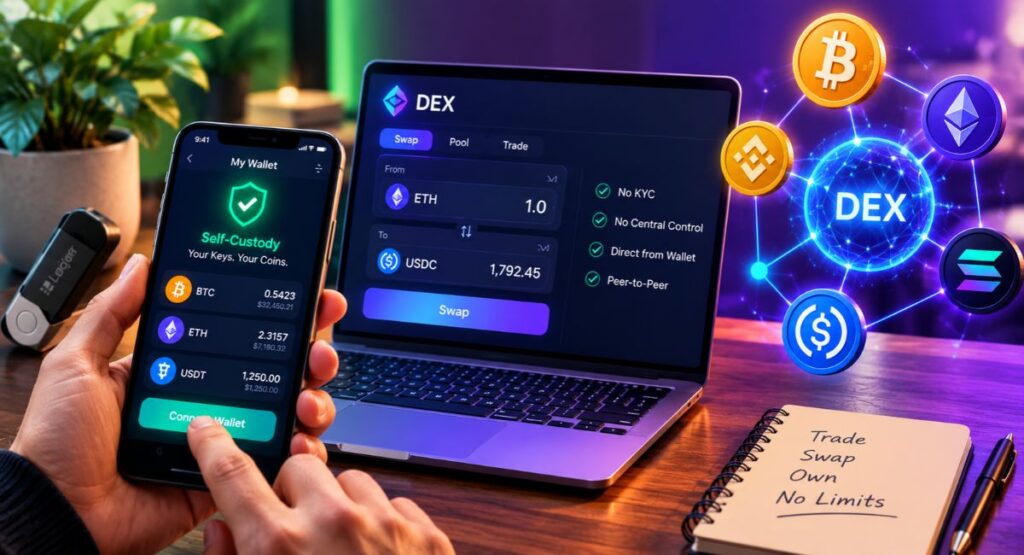
Decentralized exchanges (DEXs) are peer-to-peer platforms where users trade crypto directly with each other using automated smart contracts. Unlike traditional exchanges, a DEX never takes possession of your funds.
Why Self-Custody DEXs Are Gaining Momentum
- When you execute a swap on a DEX, the funds move directly from your wallet to the destination address in a single automated step.
- Anyone with an internet connection and a self-custody wallet can access a DEX without relying on regional banking approvals.
- You do not need to share sensitive personal identity information or bank details just to trade two digital tokens.
The Usability Gap Is Closing
Historically, DEXs were difficult for beginners to navigate. They required users to manage gas fees manually, understand complex wallet approvals, and worry about losing their seed phrases.
Innovations like Account Abstraction (Smart Contract Wallets) are changing that. Modern self-custody wallets now offer simple social logins, automated fee-paying, and account recovery features. This makes trading on a DEX nearly as seamless as using a mobile banking app, without surrendering ownership.
Front 2: The Emergence of Regulated Tokenized Venues
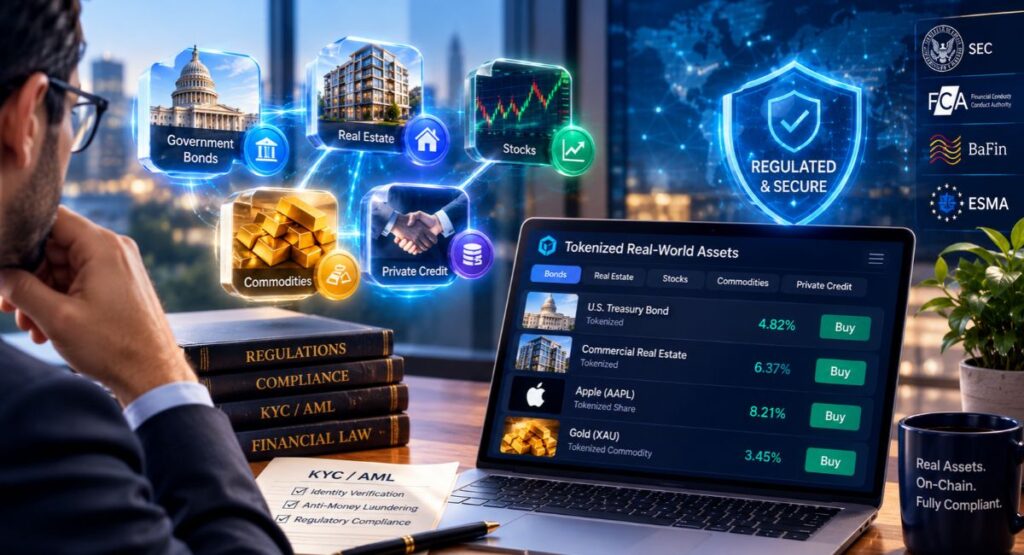
While self-custody DEXs empower individual ownership, mainstream institutional finance is moving toward a different model: Regulated Tokenized Venues.
What Are Tokenized Real-World Assets (RWAs)?
Tokenization is the process of bringing physical or traditional financial assets onto a blockchain network. Examples include:
- Government Treasury bonds
- Real estate shares
- Stocks and corporate commodities
- Private credit and investment funds
Instead of trading slow paper certificates or waiting days for stock market settlements, tokenized platforms let investors trade fractionalized ownership of real-world assets around the clock.
Why Institutions Demand Regulated Venues
Major banks, investment advisors, and institutional funds manage billions of dollars. By law, they cannot trade on anonymous, non-compliant exchanges. They require:
- KYC/AML Compliance: Verification of identity for all trading counterparties.
- Legal Protections: Oversight by recognized global financial regulators.
- Qualified Custody Infrastructure: Standardized, insured storage models for underlying physical assets.
As a result, a massive ecosystem of regulated, tokenized venues is launching. These venues combine blockchain’s efficiency and speed with the strict regulatory safeguards of traditional stock markets.
Comparing the Two Fronts: Decentralized vs. Regulated
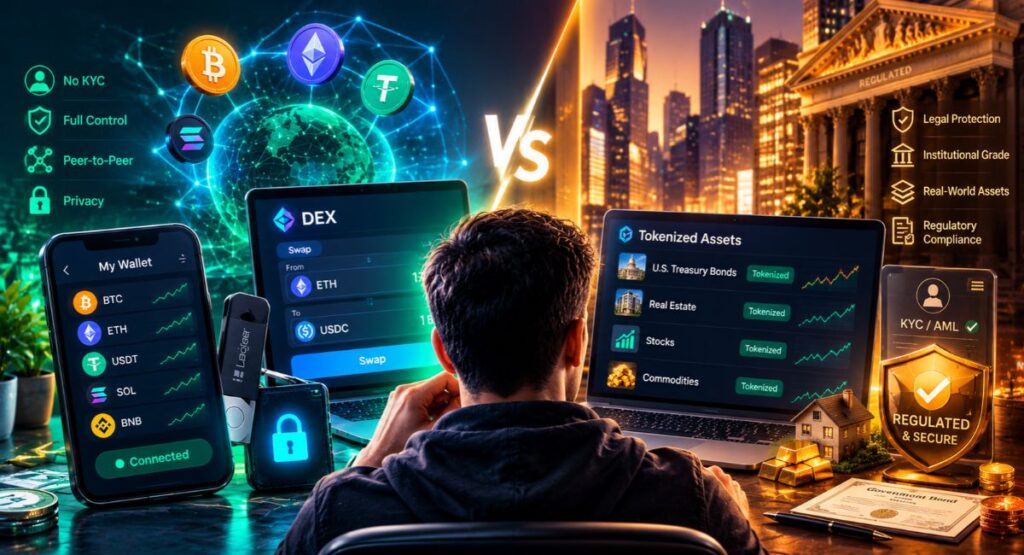
To understand where the crypto market is headed, it helps to compare how these two approaches operate side-by-side:
| Feature | Self-Custody DEXs | Regulated Tokenized Venues |
| Asset Control | Fully held by the user (Private Keys) | Held by qualified custodians/trusts |
| Primary Assets | Native tokens, stablecoins, DeFi assets | Bonds, real estate, stocks, tokenized fiat |
| Target Audience | Individual retail users, Web3 natives | Institutions, accredited investors, funds |
| Identity Requirements | Wallet connection only | Full identity verification (KYC/AML) |
| Main Advantage | Total financial freedom and privacy | Legal protections and real-world assets |
| Primary Risk | User error (losing private keys/seed phrases) | Regulatory updates and centralized freezes |
Key Drivers Behind the 2-Year Battleground
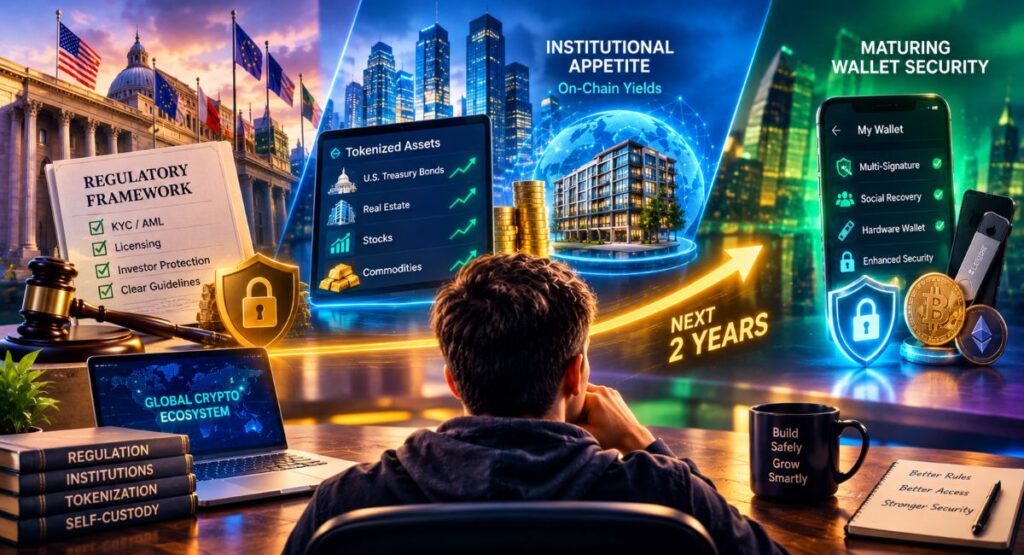
Why is this shift happening right now? Three main catalysts are shaping the next two years:
Regulatory Clarity and Shifting Frameworks
Financial authorities worldwide are establishing clear rules for digital asset custody. Clear guidelines allow institutional managers to bring client capital into tokenized markets without regulatory ambiguity. At the same time, individual rights around self-custodial wallets are gaining legal recognition, solidifying both ecosystems.
Institutional Appetite for On-Chain Yields
Traditional finance operates on legacy technology that takes days to settle trades. Tokenizing treasury bills, real estate, and credit markets lets institutions move capital instantly, automate dividend payments with smart contracts, and reduce operating overhead.
Maturing Wallet Security for Individuals
Self-custody used to mean writing 12 random words on a piece of paper and praying you didn’t lose it. Advanced multi-signature setups, social recovery mechanisms, and hardware integrations have made self-custody far safer for everyday users.
What This Means for Everyday Crypto Investors
You don’t need to pick just one side in this evolution. Most market participants will interact with both models depending on their specific financial goals.
- Use Self-Custody DEXs for: Storing long-term crypto assets, participating in decentralized finance protocols, and retaining total privacy and control over your digital wealth.
- Use Regulated Tokenized Venues for: Diversifying your digital portfolio into real-world yields (like tokenized government bonds or real estate) with legal protection and institutional safety nets.
Practical Steps to Protect and Grow Your Assets
- Start Small with Self-Custody: Download a reputable self-custody wallet, practice small transfers, and back up your recovery seed phrase offline in a secure location. Never share your seed phrase with anyone.
- Double-Check Network Details: When swapping on a DEX, verify that you are connected to the official platform address and trading on the correct blockchain network.
- Explore Regulated RWA Assets: Keep an eye on institutional tokenization platforms offering real-world yield opportunities backed by verifiable collateral.
- Maintain a Balanced Strategy: Avoid keeping all your assets on a single centralized platform. Combining self-custody storage with regulated investments provides a healthy mix of freedom, privacy, and security.
Conclusion
The crypto landscape is evolving beyond simple speculative trading. Over the next two years, the industry will be defined by the Sovereignty Shift: a dual-track system where self-custody DEXs provide personal financial autonomy, while regulated tokenized venues unlock institutional capital and real-world assets. By learning how self-custody works today, you protect yourself from third-party exchange risks and position your portfolio to thrive in the future of modern finance.
Frequently Asked Questions (FAQs)
What is the primary difference between a centralized exchange (CEX) and a decentralized exchange (DEX)?
A CEX holds your private keys and manages your funds on an internal ledger. A DEX allows you to trade directly from your own self-custody wallet using automated smart contracts, ensuring you maintain full control of your assets at all times.
Can I lose my funds when using a self-custody wallet?
Yes, but usually only through user error. If you lose your recovery seed phrase or share it with a scammer, you cannot reset your password. Protecting your private key offline is critical to secure self-custody.
What are tokenized real-world assets (RWAs)?
Tokenized RWAs are digital blockchain representations of physical or traditional financial assets, such as real estate, stocks, commodities, or government bonds. They allow fractional ownership and 24/7 trading on-chain.
Why are regulated tokenized venues important for institutions?
Institutions must comply with identity verification (KYC) and custody standards. Regulated venues provide a legally compliant environment that allows institutional capital to access the efficiency of blockchain technology.
Will regulated venues replace self-custody DEXs completely?
No. They serve two distinct market needs. Self-custody DEXs serve individuals seeking privacy, censorship resistance, and personal control, while regulated venues serve institutional entities and traditional investors who need legal frameworks.