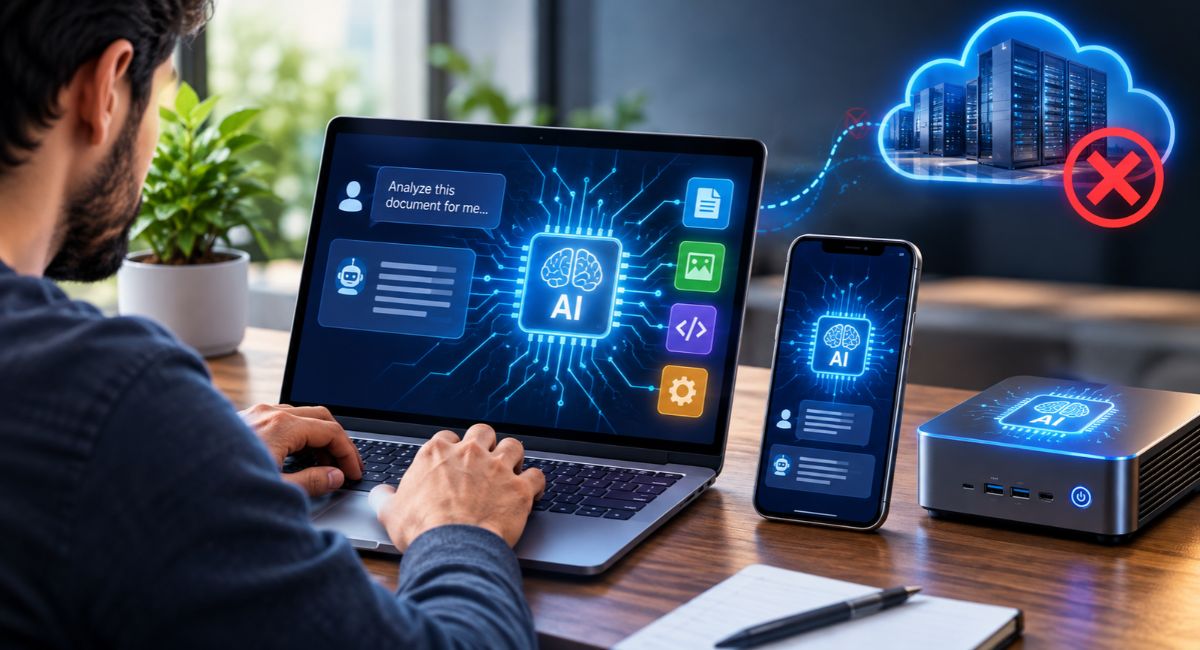
Artificial intelligence has exploded in recent years. Today, millions of people interact with cloud-hosted platforms like ChatGPT, Claude, or Gemini every day. In the traditional cloud model, you send every query over the internet to massive data centers housing thousands of high-performance GPUs. The server processes your request, generates a response, and routes it back across the web to your screen.
While this centralized, server-heavy infrastructure enabled the first wave of generative technology, a quiet structural revolution is unfolding across the software landscape. Intelligence is migrating away from distant cloud facilities and landing directly onto everyday personal hardware such as laptops, smartphones, edge gateways, and desktop workstations.
This technical transition centers around on-device machine learning, which forms the operational backbone for local AI agents. Instead of relying on constant web connectivity, remote APIs, and recurring token charges, these intelligent applications run natively on the physical hardware sitting right in front of you.
In this article, we will break down what local agents are, why software engineers are fundamentally rethinking system architecture, how modern hardware handles heavy machine learning tasks, and what this shift means for the future of digital privacy and application development.
What Is a Local AI Agent?
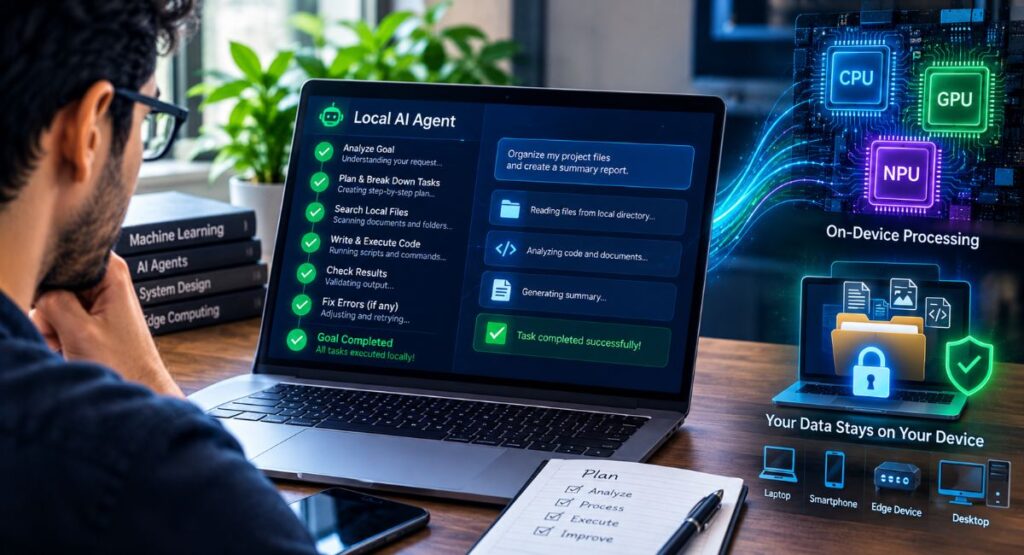
To appreciate this technical shift, it is essential to distinguish between a standard large language model (LLM) and an autonomous software agent.
A conventional language model is primarily reactive. You provide a text prompt, and the model generates a corresponding text or image output based on pattern recognition. An agent, by contrast, is designed for goal-driven, multi-step execution. Rather than merely answering a question, an agent breaks a high-level goal down into sequential sub-tasks, writes and executes code, inspects local directory structures, evaluates its own outputs, corrects runtime errors, and interacts directly with other software applications.
When an agent operates locally, it runs these multi-step loops entirely on your device using native compute resources: the Central Processing Unit (CPU), Graphics Processing Unit (GPU), or dedicated Neural Processing Unit (NPU).
Because execution happens locally, your documents, system state, and conversation histories never leave your device. Task execution, file indexing, and decision-making remain completely confined within your physical hardware.
The Paradigm Shift: Cloud-Centric vs. Edge Execution
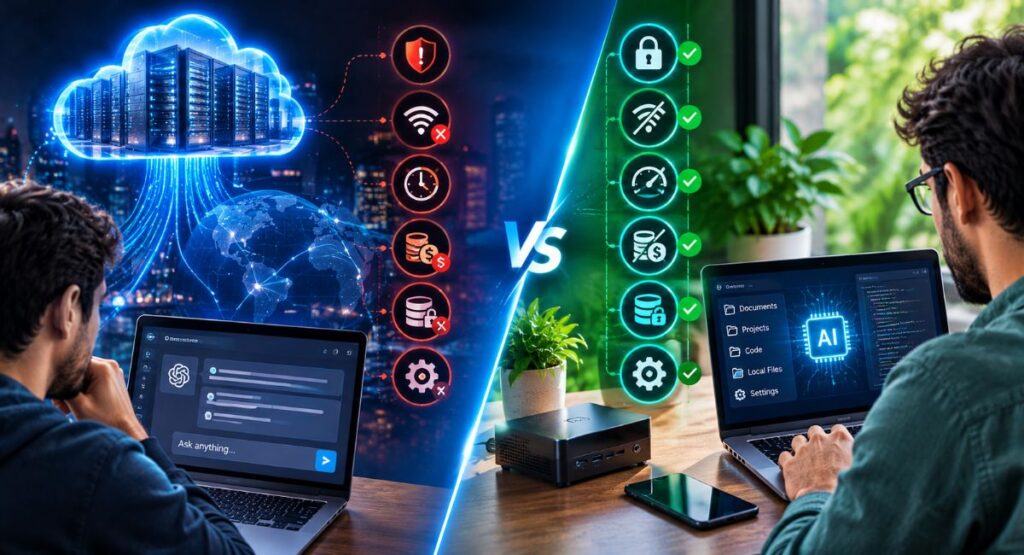
For more than a decade, standard software engineering taught that advanced intelligence required massive cloud infrastructure. However, real-world constraints ranging from data breaches to high operational overhead have forced engineers to re-evaluate this assumption.
Below is a detailed structural comparison between centralized cloud platforms and local execution models:
| Core Metric | Centralized Cloud Infrastructure | Local Edge Execution |
| Data Privacy & Security | Data travels to third-party data centers | Sensitive information remains on user hardware |
| Network Reliance | Requires an uninterrupted internet connection | Fully functional 100% offline |
| Response Latency | High variability (network hops + queue time) | Deterministic, sub-second execution speeds |
| Cost Dynamics | Metered API usage fees per token/request | Zero token fees after initial hardware acquisition |
| Data Ownership | Governed by cloud provider terms & privacy policies | Complete user data sovereignty and governance |
| Customization Capability | Constrained by standardized API parameters | Fully customizable runtime environment and tools |
Major Drivers Accelerating On-Device Intelligence
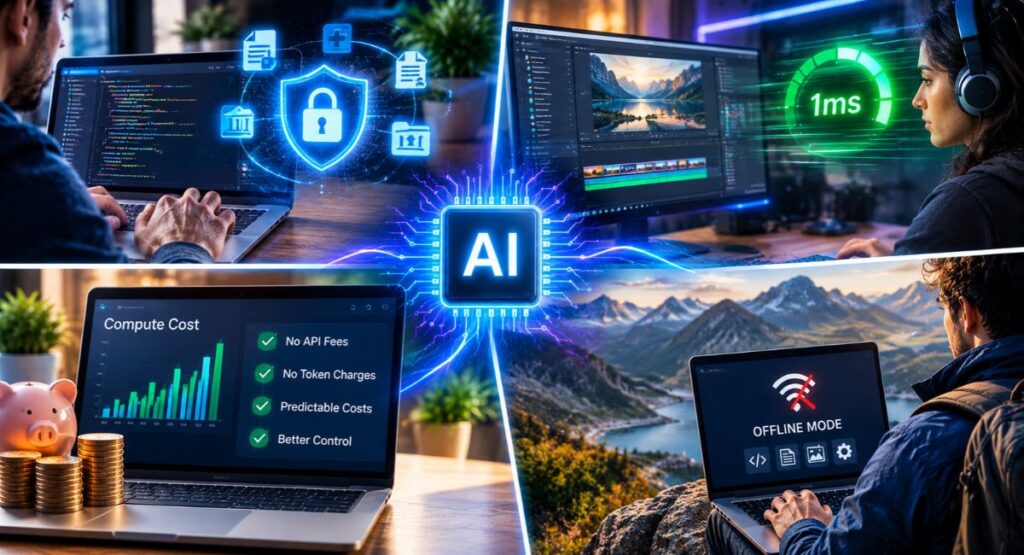
The transition toward decentralized computing is not merely an academic trend; it is driven by pressing operational challenges that cloud-only architectures struggle to solve.
1. Absolute Privacy and Regulatory Compliance
Data security remains the single largest driver behind local hardware execution. Corporations, healthcare providers, legal firms, and individual developers regularly work with confidential information such as internal code repositories, personal medical records, or proprietary financial strategies.
Transmitting these sensitive assets to external cloud API endpoints creates serious regulatory risks under frameworks like GDPR, HIPAA, and CCPA. Running models locally removes external network exposure entirely, guaranteeing that confidential inputs stay securely within the user’s controlled storage environment.
2. Zero Network Latency and Real-Time Responsiveness
Network transmission takes time. While a two-second delay is acceptable when generating a long essay, real-time interactive tasks cannot tolerate network lag.
Consider applications like inline code autocompletion inside an IDE, automated video editing software, robotic control loops, or dynamic audio processing. For these workflows to feel fluid and natural, response times must be measured in milliseconds. By eliminating outbound HTTP requests, edge execution provides immediate feedback.
3. Predictable Economics and Cost Control
Cloud API fees scale linearly with usage. When developers build autonomous agents that perform dozens or hundreds of internal reasoning loops behind the scenes for a single task, the underlying token costs add up fast.
For startups and enterprise software providers, relying entirely on remote APIs can lead to unpredictable, skyrocketing monthly bills. Shifting the computational workload directly onto end-user hardware transfers compute execution away from central servers, keeping software operational costs manageable and predictable.
4. Continuous Offline Functionality
Modern business productivity should not break the moment an internet connection drops. Whether you are working on a flight, traveling through remote regions, or experiencing a local broadband outage, edge-native software continues to run reliably without demanding an active network connection.
Technical Innovations Enabling Local Execution
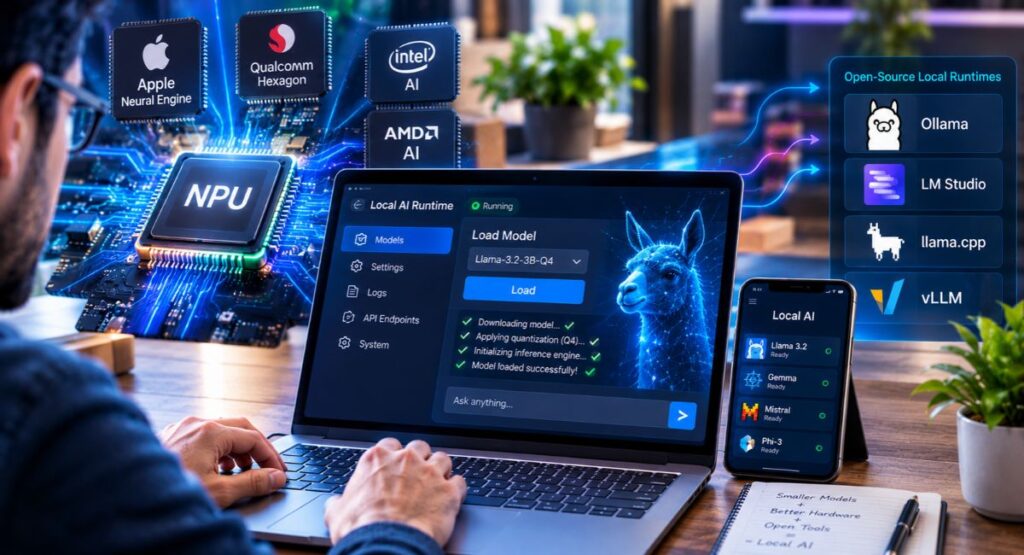
How is it possible for a consumer laptop or smartphone to run complex AI models that previously required enterprise server racks? Three major engineering breakthroughs have made this possible:
1. Efficient Small Language Models (SLMs)
In the past, high performance was synonymous with massive model sizes featuring hundreds of billions of parameters. Today, research focuses heavily on Small Language Models (SLMs) designed specifically for efficiency.
Through mathematical optimizations such as quantization, which reduces the numerical precision of model weights (e.g., converting 16-bit floating-point numbers into 4-bit or 8-bit integers), file sizes drop dramatically with minimal loss in reasoning accuracy. Combined with structural pruning and knowledge distillation, 3-billion to 8-billion parameter models can run comfortably inside a modest memory footprint.
2. Dedicated Silicon Acceleration (NPUs)
Silicon manufacturers have transformed consumer hardware by adding specialized processing units designed specifically for matrix algebra and neural networks:
- Apple Neural Engine (ANE): Integrated into modern M-series and A-series chips.
- Qualcomm Hexagon NPU: Embedded inside Snapdragon processors powering mobile devices and ARM laptops.
- Intel & AMD AI Processors: Dedicated neural blocks built into modern x86 CPU architectures.
These NPUs process machine learning instructions with remarkable power efficiency, leaving the main CPU and GPU free for regular system tasks while preserving battery life.
3. Open-Source Local Runtimes
The open-source ecosystem has created fast, lightweight inference tools that make model execution simple. Tools like Ollama, LM Studio, llama.cpp, and vLLM abstract away complex low-level code, allowing users to download open weights (such as Llama, Gemma, or Mistral) and serve them locally via clean, standardized local endpoints.
How Edge Intelligence Is Reshaping System Architecture
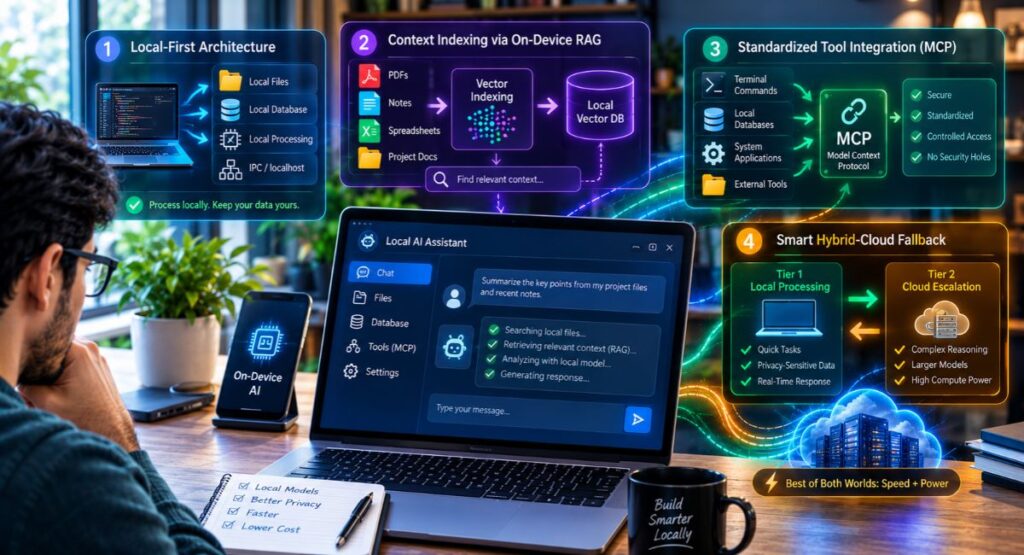
Software architecture dictates how software components manage data, communicate, and process business logic. The rise of local execution is driving a migration from traditional Client-Server Architecture toward a Local-First, Hybrid Architecture.
Here are the key principles shaping this structural transition
1. Transitioning to Local-First Software Design
In classical web design, the frontend application operates as a thin layer whose main purpose is to package user input and send it across the web to a backend server.
In a Local-First Architecture, the application treats local storage and local processing power as the primary engine. Applications process inputs, manipulate files, and update local databases directly on the user’s system. Communication occurs locally through ultra-fast Inter-Process Communication (IPC) mechanisms or local loopback networks (localhost) rather than external HTTP endpoints.
2. Context Indexing via On-Device RAG
For an agent to provide relevant assistance, it requires contextual awareness of the user’s specific environment. Retrieval-Augmented Generation (RAG) achieves this by converting text documents into mathematical vectors and indexing them inside a local vector database stored on your disk.
For example, a local document assistant can index your personal PDF files, project notes, and spreadsheets. When you ask a question, the assistant retrieves relevant context chunks from your hard drive without transmitting your personal records over the internet.
3. Standardized Tool Integration (MCP)
Agents need a safe, structured way to interact with software environments such as executing terminal commands, querying local databases, or controlling system applications.
Open protocols like the Model Context Protocol (MCP) provide a standardized communication standard between agents and local software systems. MCP allows applications to expose safely constrained tools to local agents without opening security holes.
4. Smart Hybrid-Cloud Fallback Architecture
Choosing local processing does not mean cloud servers disappear altogether. Modern system designers routinely implement hybrid patterns:
- Tier 1 (Local Processing): High-volume, privacy-sensitive, or rapid-response tasks are handled entirely by the local runtime.
- Tier 2 (Cloud Escalation): If a query requires complex reasoning beyond local hardware capabilities, the system seamlessly escalates that specific request to a high-capacity cloud model.
This multi-tier approach combines the speed, privacy, and cost benefits of local processing with the raw reasoning depth of large cloud clusters when necessary.
Real-World Applications in Use Today
On-device machine learning is already reshaping productivity tools across multiple sectors:
1. Software Engineering & Development
Command-line agents like Claude Code, Cline, and local IDE plugins analyze code repositories, run automated test suites, refactor codebases, and fix build errors, all running directly in the developer’s local terminal.
2. Personal Knowledge Management & Notes
Desktop note-taking tools index personal notes, web clips, and task lists locally. Users can summarize complex research projects and query their personal knowledge graphs completely offline without sending private thoughts to third-party servers.
3. Healthcare, Legal, and Financial Systems
Applications managing medical patient records, financial audits, or legal contracts utilize local models to draft document summaries, analyze legal clauses, and audit paperwork entirely on-premises, fulfilling strict data confidentiality mandates.
4. Industrial IoT and Edge Automation
In manufacturing environments, sensors mounted on factory machinery process operating metrics on edge hardware. Local monitoring agents detect anomalous equipment behavior and trigger emergency stops in milliseconds without waiting for cloud validation.
Conclusion
The software industry is witnessing a clear structural transition toward localized, edge-native computing. By bringing machine learning directly to consumer hardware, software architects are creating applications that are faster, more private, and far more cost-effective.
As hardware manufacturers continue to enhance NPU performance and open-source developers create increasingly efficient small models, on-device intelligence will become a standard foundation of modern application development. The future of software is not just connected; it is local, private, and always available.