For years, wireless earbuds have focused on doing a few core jobs exceptionally well: playing high-fidelity music, blocking out background noise with Active Noise Cancellation (ANC), and capturing your voice clearly during phone calls. But if you thought audio gear was reaching its natural design peak, think again.
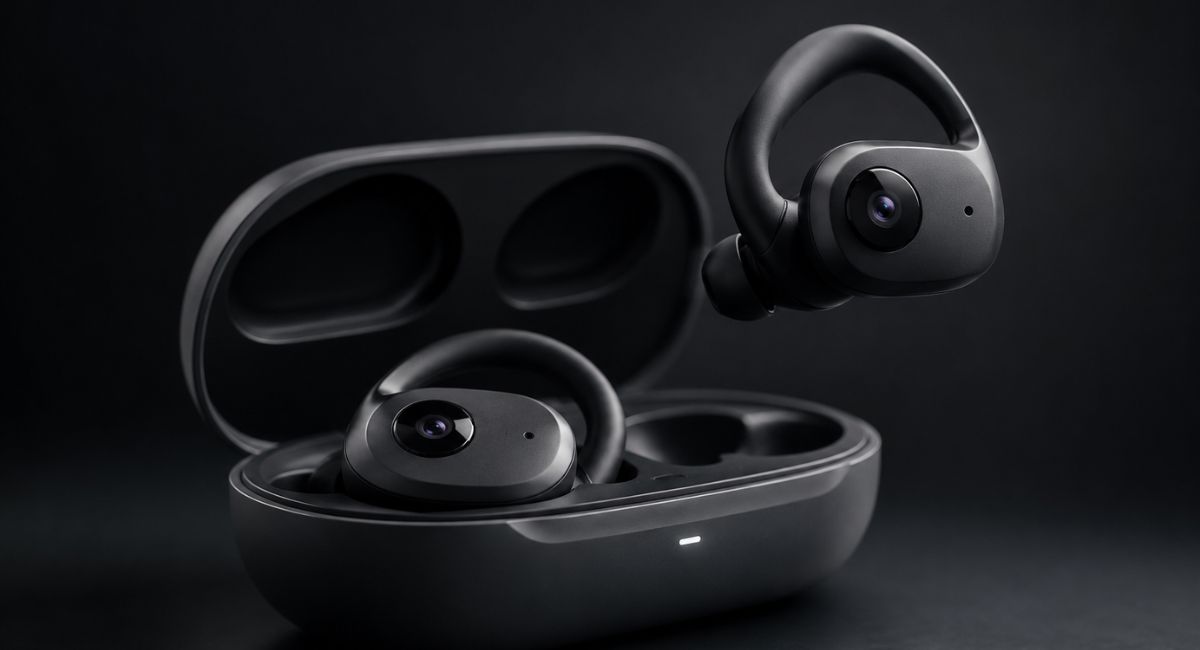
The tech industry is preparing for its next major evolutionary leap. With audio brands like Cleer demonstrating early prototype concepts featuring built-in micro-cameras, a brand-new category of smart wearables is taking shape.
Why would anyone want tiny cameras attached to their ears? Is this just a gimmick to hype up trade shows, or are we witnessing the birth of the ultimate Artificial Intelligence (AI) companion?
This article breaks down why tech hardware makers are embedding optical sensors into earbuds, how these devices work, the real-world benefits they bring, and what this means for consumer privacy.
The Big Shift: From Pure Audio to Multimodal AI
To understand why a camera belongs in an earbud, you first have to look at where personal computing is heading. We are moving away from traditional screen-based interaction (smartphones, laptops) toward ambient computing technology that operates seamlessly in the background without requiring you to look down at a display.
What Is Multimodal AI?
Early AI voice assistants (like Siri or Google Assistant) relied solely on voice commands and text data. Modern AI models are multimodal, meaning they can read text, process spoken audio, and analyze real-time video simultaneously.
When you equip an audio device with a camera, you give the underlying AI a pair of eyes. Instead of describing what you are looking at to an assistant, the assistant simply sees what you see from your exact head-level perspective.
Why Earbuds Are the Ultimate Real Estate for Cameras
Tech companies have tried putting cameras on consumers before. Smart glasses like Ray-Ban Meta glasses proved that users enjoy lightweight, wearable capture devices. However, earbuds hold several distinct physical and practical advantages over smart glasses or lapel pins.
Earbuds Are Already Ubiquitous
Millions of people keep wireless earbuds in their ears for hours every day while working, commuting, or exercising. Brands do not need to convince consumers to adopt a weird new accessory; they are simply upgrading an item people already carry.
The Power of Head-Tracking Perspective
Because earbuds sit firmly on the sides of your head, their cameras naturally point toward your field of view. When you turn your head to look at an object, a building, or a sign, the camera rotates with you. This creates a natural point-of-view (POV) perspective that handheld smartphones simply cannot replicate hands-free.
Power & Component Consolidation
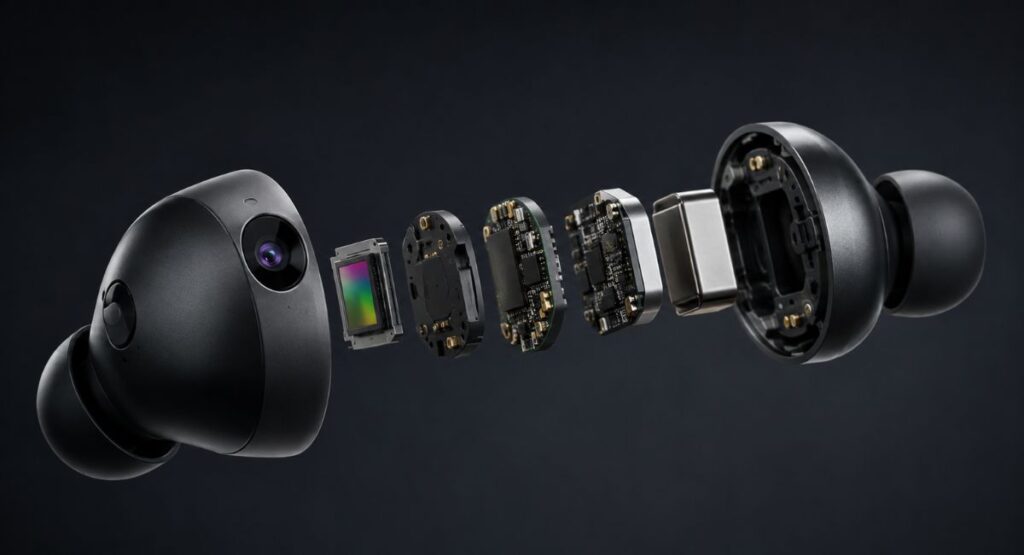
Modern true wireless earbuds already pack Bluetooth chips, battery cells, touch sensors, and digital signal processors (DSPs) into tiny shells. Adding tiny image sensors similar to the microscopic camera modules used in modern endoscopes or ultra-thin smartphones is the logical next step for hardware engineers looking to add value.
Practical Use Cases: What Can Camera-Equipped Earbuds Actually Do?
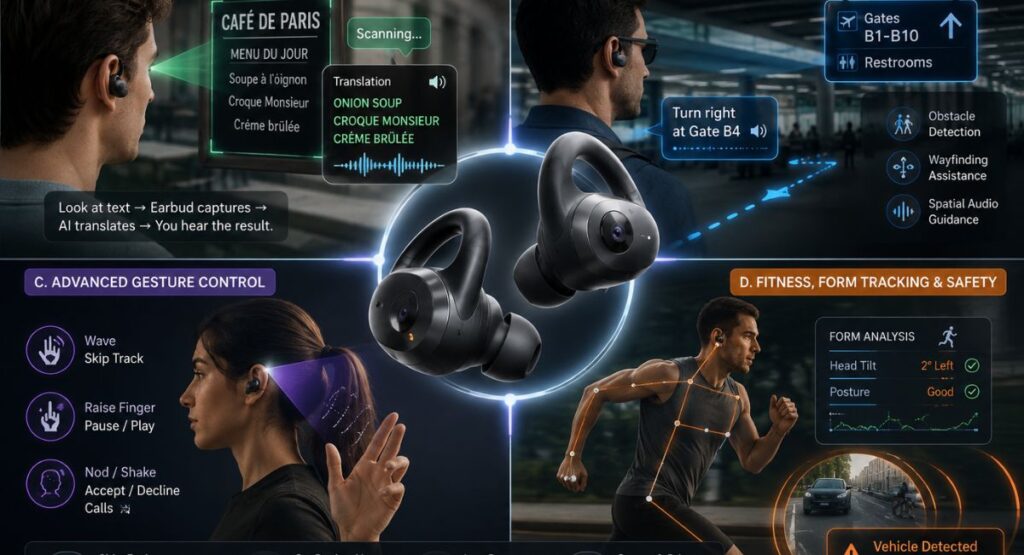
Placing optical sensors in your ears isn’t about taking low-quality selfies or recording secretly. The real goal is contextual awareness. Here is how camera earbuds will change everyday life for general consumers.
A. Real-Time Visual Translation and Sign Reading
Imagine walking through a foreign city where street signs, menus, and transit maps are written in a language you don’t read. Instead of pulling out your smartphone, unlocking it, and holding up an app:
- You look directly at the foreign text.
- The earbud’s micro-camera captures the image.
- The built-in AI processes the text and instantly translates it.
- The audio driver speaks the translation directly into your ear.
B. Intelligent Navigation and Accessibility
For visually impaired individuals or travelers navigating complex indoor environments (like airports or subway stations), camera-equipped earbuds offer a revolutionary safety net:
- Obstacle Detection
Alerts you to curb edges, low-hanging branches, or oncoming bicycles via spatial audio prompts.
- Wayfinding
Directs you through terminal gates by scanning overhead signs and giving subtle voice directions (Turn right at Gate B4).
C. Advanced Gesture Control
Current earbuds rely on touch controls tapping, pinching, or sliding along the stem which can feel clunky or shift the fit in your ear canal. Cameras enable gesture recognition:
- Wave your hand in front of your ear to skip a track.
- Raise a finger to pause playback.
- Nod or shake your head naturally to accept or decline incoming phone calls.
D. Fitness, Form Tracking, and Safety
For runners and outdoor enthusiasts, side-facing or wide-angle cameras add an extra layer of awareness:
- Form Analysis
Combined with motion sensors, optical tracking can monitor your head tilt and posture during a workout.
- Rear/Side Safety Alerts
Wide-angle lenses can detect vehicles approaching rapidly from behind or in your blind spots, sending a quick audio warning to keep you safe.
Comparing Wearable AI Devices
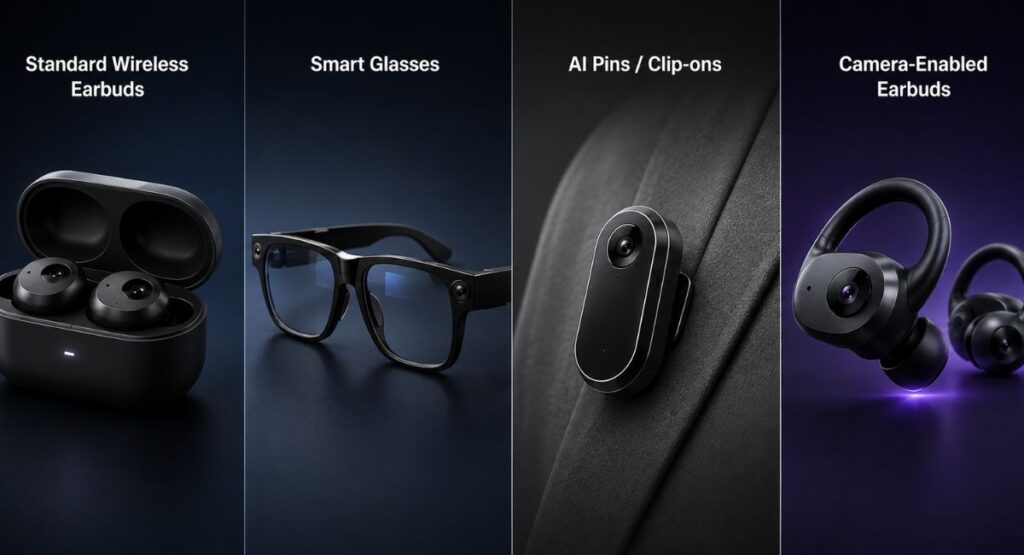
To see how camera-enabled earbuds fit into the larger wearable market, consider this feature breakdown:
| Wearable Category | Primary Input | Primary Output | Main Advantage | Key Drawback |
| Standard Wireless Earbuds | Audio (Mics) | Audio (Speakers) | All-day comfort, small footprint | Zero visual context |
| Smart Glasses | Audio + Vision | Audio + Micro-Displays | Great forward field of view | Weight, prescription constraints |
| AI Pins / Clip-ons | Audio + Vision | Audio / Small Projection | Hands-free placement | Shifts on clothing, unnatural angle |
| Camera-Enabled Earbuds | Audio + Vision | Audio (Speakers) | Zero eyewear clutter, natural head tracking | Battery constraints, heat management |
The Big Hurdles: What Manufacturers Must Solve
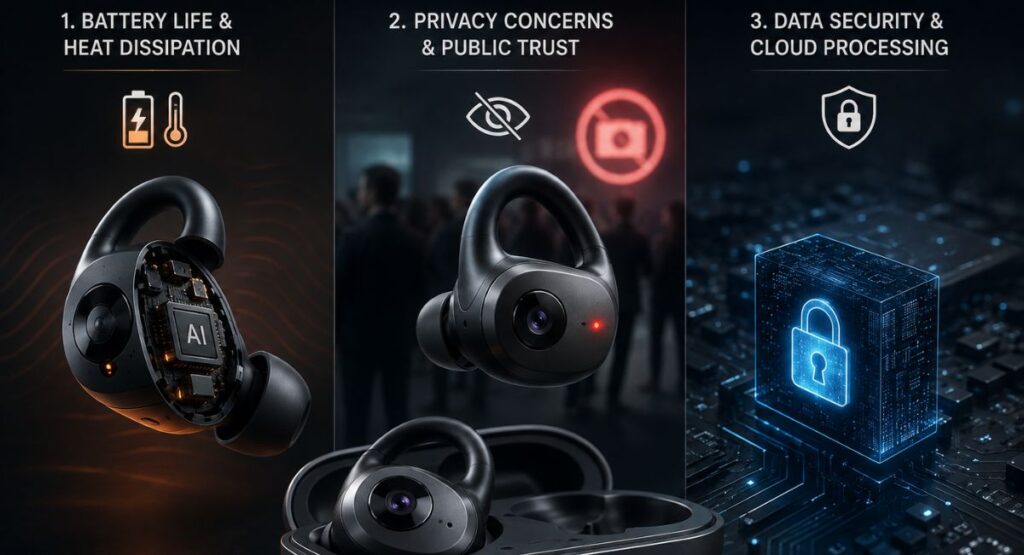
While early prototypes from innovators like Cleer show immense promise, mainstream adoption relies on overcoming three massive technical and social engineering challenges.
1. Battery Life and Heat Dissipation
Capturing image frames and streaming video data requires significantly more power than decoding an audio signal. Earbud batteries are small (typically ranging from 40mAh to 70mAh per earbud). Engineering chips that process visual AI tasks locally without draining the battery in 30 minutes or overheating inside your ear canal is the primary technical obstacle.
2. Privacy Concerns and Public Trust
The idea of hidden or inconspicuous cameras on wearable devices naturally makes people uneasy. Tech manufacturers must design clear visual indicators such as bright, tamper-proof LED tally lights that illuminate whenever the camera sensor is actively recording or analyzing data to ensure surrounding individuals know when an optical chip is operating.
3. Data Security and Cloud Processing
Sending raw visual data to cloud servers raises valid cybersecurity questions. To protect user privacy, hardware makers are leaning toward on-device processing (Edge AI), where visual data is analyzed locally on the earbud’s neural processor and immediately discarded rather than stored permanently on cloud databases.
What This Means for the Future of Consumer Tech
Cleer’s exploratory concepts are proof that the earbud is evolving from a passive speaker into an active sensory node. As microprocessors grow more efficient and multimodal AI models become lighter, the boundary between audio gear and smart wearables will dissolve entirely.
Within the next few years, buying a pair of flagship earbuds won’t just be about sound signatures or noise isolation. It will be about choosing a smart assistant that hears what you hear, sees what you see, and helps you navigate the physical world completely hands-free.
Conclusion
The integration of micro-cameras into true wireless earbuds marks a major turning point in personal technology. What sounds like science fiction today is rapidly becoming the next logical design step for industry leaders. By pairing high-definition sound with real-time computer vision, brands like Cleer are showing us that our favorite audio accessories are ready to become our most valuable everyday AI guides.