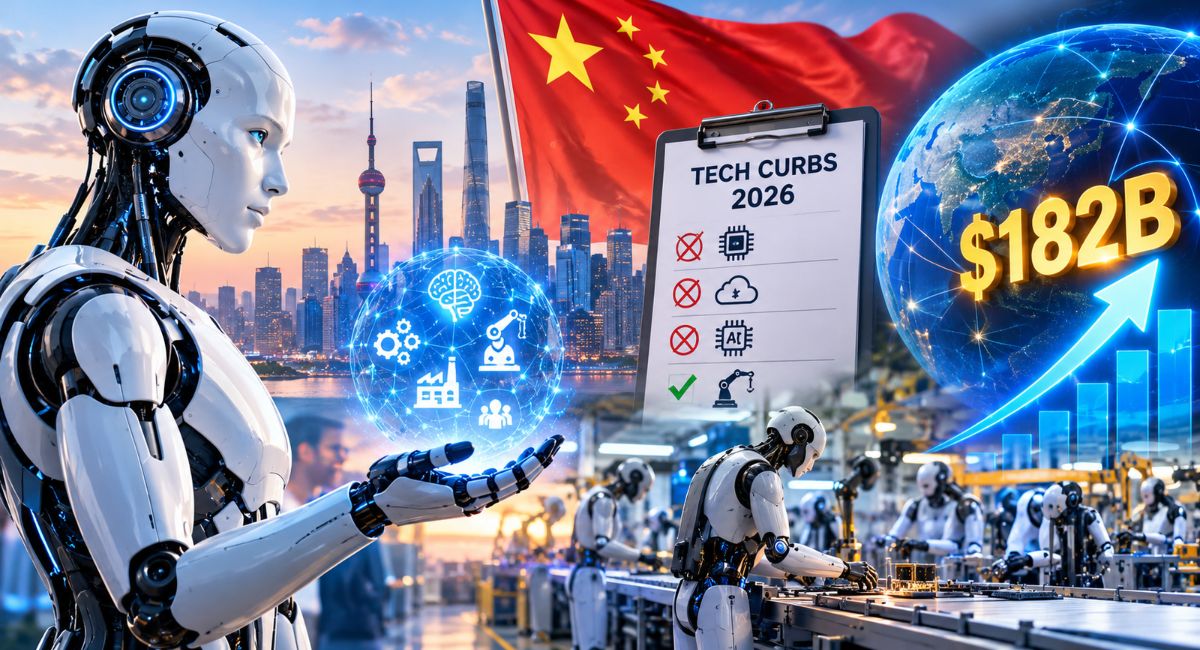
Artificial intelligence has reached a decisive milestone. For years, our interactions with machine learning were limited to digital interfaces like text boxes, search algorithms, and mobile virtual assistants. While these tools transformed how we process information, they remained entirely digital and passive, unable to interact directly with the physical world around us. Today, that dynamic has fundamentally shifted. We are entering the era of Agentic AI: intelligent hardware systems that can reason, plan multi-step goals, adapt to changing environments, and autonomously perform complex physical tasks. At the same time, China’s 2026 tech policy curbs are redirecting capital from speculative software ventures to real-world hardware integration. This regulatory pivot, combined with a projected $182 billion global market shift toward humanoid robotics, is rewriting global supply chains and industrial automation. In this article, we explore what Agentic AI is, how new tech curbs are shaping hardware innovation, and what this massive physical transition means for the future.
Understanding Agentic AI: The Evolution from Software to Hardware
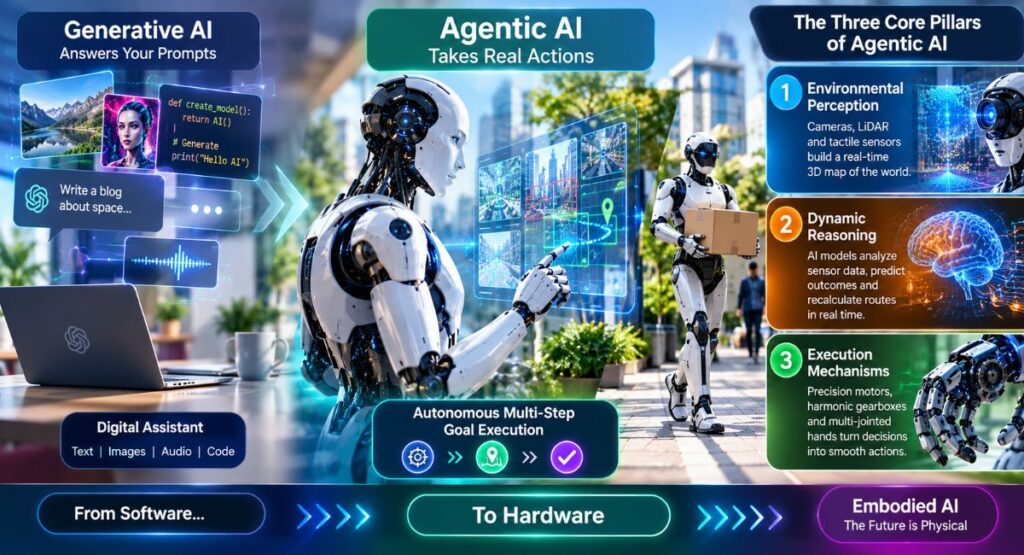
To understand where global technology is heading, it helps to look at how artificial intelligence has evolved in recent years. Early AI models focused on classification and pattern recognition, such as sorting email spam or recommending movies. Next came Generative AI, which brought natural language understanding, text generation, and automated code writing.
While Generative AI acts like a knowledgeable digital assistant that answers questions, Agentic AI acts like an autonomous manager capable of carrying out physical and digital operations without requiring constant step-by-step human prompts.
| Key Aspect | Generative AI Models | Agentic AI Systems |
| Primary Output | Text, images, audio, and code drafts | Real-world physical or digital actions |
| Operational Mode | Prompt-and-response loop | Autonomous multi-step goal execution |
| Data Environment | Static text and visual datasets | Dynamic real-world sensor streams |
| Core Hardware Integration | Cloud data centers and web browsers | Robotics, joint actuators, and onboard chips |
The Three Core Pillars of Agentic AI
To operate seamlessly, self-directing AI frameworks depend on three unified components:
- Environmental Perception: Using visual cameras, LiDAR depth sensors, and force-feedback tactile fingertips, the AI builds a real-time, three-dimensional map of its surrounding environment.
- Dynamic Reasoning: Advanced foundation models process sensor data, evaluate potential outcomes, recalculate routes, and make real-time decisions to bypass physical obstacles safely.
- Execution Mechanisms: Precision motors, harmonic gearboxes, and multi-jointed mechanical hands turn digital decisions into smooth physical movements.
When these three components are packaged into a bipedal body designed to navigate human spaces, the result is Embodied AI, the foundational software behind modern humanoid robots.
China’s 2026 Tech Curbs: A Strategic Shift Toward Physical Hardware
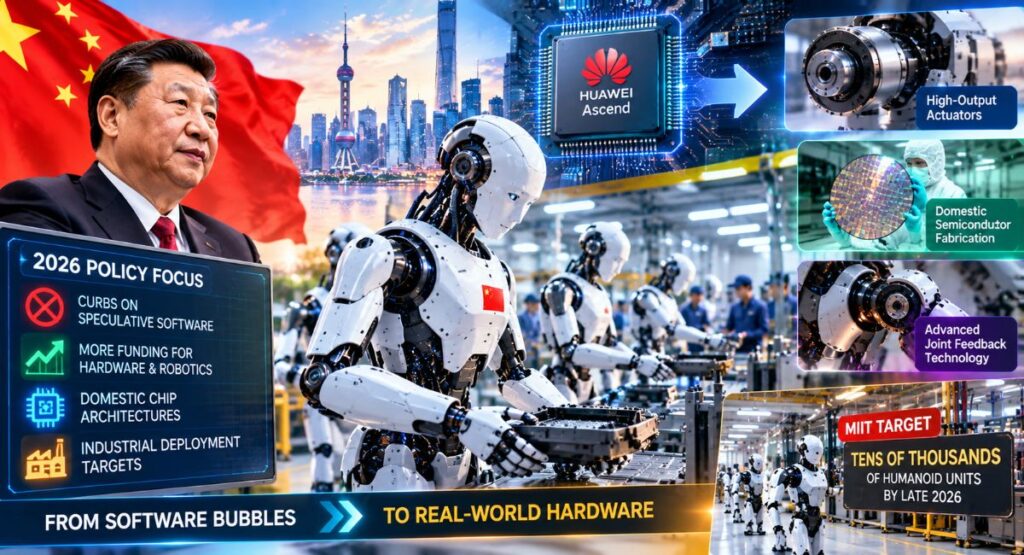
While foreign technology hubs have invested heavily in large-scale cloud-based software applications, China’s recent policy directives reflect a clear pivot toward domestic hardware manufacturing, industrial independence, and real-world utility.
Eliminating Speculative Capital Bubbles
In early 2026, regulatory policy updates introduced targeted curbs to discourage speculative investments in unproven software apps and copycat consumer services. State grants and venture investments are currently channeled into fundamental hardware priorities, including high-output actuators, domestic semiconductor fabrication, and advanced joint feedback technology.
Transitioning to Domestic Chip Architectures
Export limitations on foreign processors accelerated the adoption of local hardware alternatives across manufacturing hubs. Neural processing platforms like the Huawei Ascend series are increasingly integrated directly into physical robotic frames. This shift has helped create a self-contained domestic ecosystem spanning hardware design, component sourcing, local training, and physical deployment.
Government Mandates for Industrial Deployment
The Ministry of Industry and Information Technology (MIIT) set clear targets to introduce tens of thousands of humanoid units into commercial operations by late 2026. Rather than displaying prototype units in closed lab settings, factories are actively incentivized to integrate humanoid helpers onto active production lines.
The $182 Billion Humanoid Market Shift
The global market projection reaching $182 billion highlights a massive transformation in commercial robotics. But why are companies choosing human-shaped bipedal hardware instead of traditional, single-purpose factory machinery? The answer comes down to compatibility with facilities.
Traditional manufacturing setups depend heavily on fixed safety enclosures and capital-intensive plant restructuring. Conversely, advanced bipedal robotics easily adapt to environments engineered around human biology.
Because modern commercial plants, fulfillment centers, and energy infrastructure are tailored to human physical dimensions, humanoid platforms offer a plug-and-play solution. Machines built with articulated gripping mechanisms and real-time balancing systems can easily ascend standard stairwells, manipulate security doorways, operate specialized equipment, and collaborate with human personnel without triggering expensive facility structural revamps.
Industrial Supply Chains and Localized Production Scale
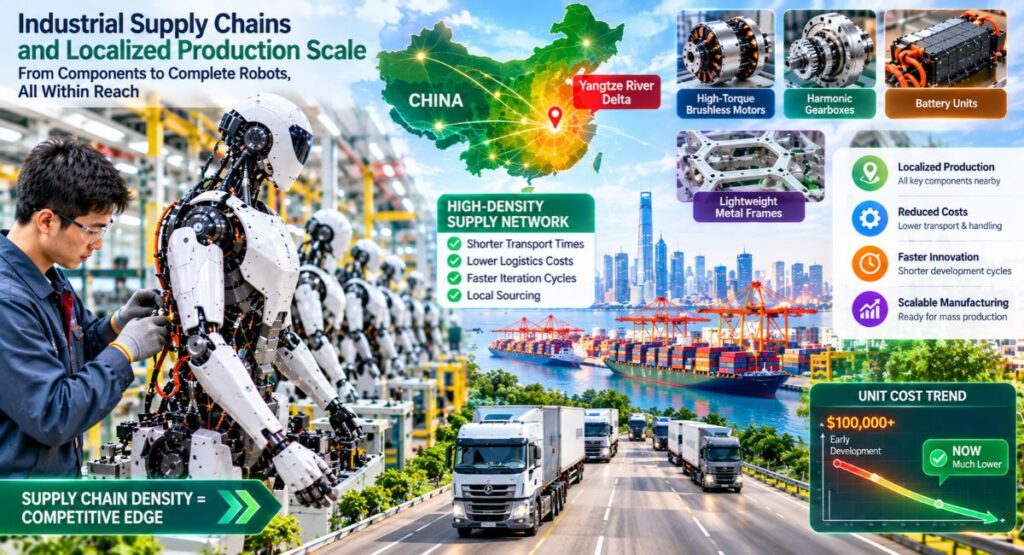
This rapid hardware rollout depends less on AI software development and more on manufacturing scale and logistics density.
High-Density Supply Networks
Clusters in Eastern China, specifically across the Yangtze River Delta, have established an unmatched supply network for humanoid hardware. Within a short geographic radius, engineering teams can source high-torque brushless motors, harmonic gearboxes, battery units, and lightweight metal frames.
This high density significantly reduces component transport times and hardware iteration costs. What previously cost over $100,000 per experimental unit in early development cycles is quickly dropping toward accessible price points, making widespread adoption commercially viable for medium and large businesses alike.
Real-World Applications Across Key Industries
Humanoid agents are actively taking on practical roles in production, logistics, and hazardous work environments:
1. Automotive Manufacturing
Major automakers are deploying humanoid helpers on production floors to pick up structural metal components, assist with assembly line placement, and run automated quality control checks alongside human workers.
2. High-Risk Facility Inspections
In power generation plants, electrical substations, and chemical processing sites, humanoid robots walk through hazardous zones to monitor thermal readings and check high-voltage switches, reducing direct risks to human inspectors.
3. Warehouse Logistics & Order Fulfillment
Logistics hubs are using flexible humanoid platforms to unpack mixed cargo pallets, sort packages into delivery bins, and organize retail products directly on standard shelving units.
The Global Impact on Work, Careers, and Future Hiring
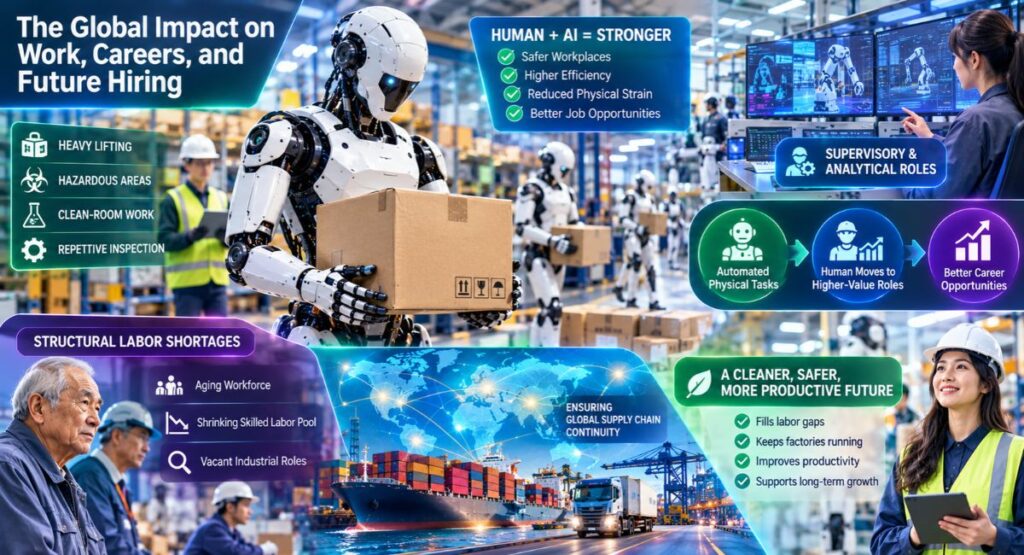
Whenever automation accelerates, questions naturally arise regarding job stability and workplace changes. How will Agentic AI and humanoid robotics alter the overall employment landscape?
Focus on Hazardous and Repetitive Tasks
In the near term, physical AI deployment focuses heavily on tasks involving high physical strain, severe safety risks, or high repetition:
- Transporting heavy material components continuously across long shifts
- Working in sterile clean-room environments or around hazardous materials
- Conducting repetitive quality inspection rounds in noisy facility areas
By delegating these demanding physical tasks to automated hardware, companies allow human workers to move into supervisory, analytical, and operational management positions.
Addressing Structural Labor Shortages
Many industrial economies are facing demographic headwinds, including an aging workforce and shrinking skilled labor pools. Millions of manufacturing and industrial roles remain vacant globally every year. Autonomous physical agents offer a reliable way to maintain supply chain continuity while keeping production facilities operating efficiently.
Technical Challenges and Roadmap Ahead
While physical AI has advanced rapidly, several engineering and operational hurdles remain to be solved before universal deployment becomes a reality:
Data Collection Limits
Digital AI trains on vast amounts of online text and images. Embodied AI, however, requires massive volumes of physical sensor data measuring force interactions, balance dynamics, surface friction, and object slippage during actual motion.
Power Density & Operating Time
Current battery technology limits continuous physical work cycles to roughly 2 to 4 hours under heavy load, requiring faster charging solutions or hot-swappable battery modules.
Cross-Border Regulatory Standards
Differences in regional safety certifications, trade policies, and data security mandates create operational hurdles for international market expansion.
Strategic Checklist for Business Leaders
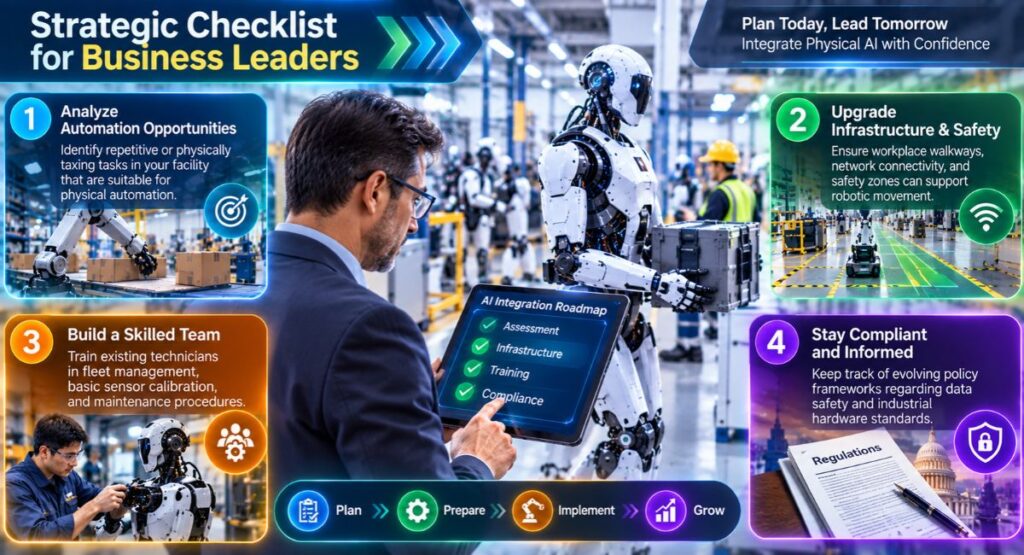
To help organizations prepare for the integration of physical AI and agentic systems, consider the following roadmap:
- Identify repetitive or physically taxing tasks in your facility that are suitable for physical automation.
- Ensure workplace walkways, network connectivity, and safety zones can support robotic movement.
- Train existing technicians in fleet management, basic sensor calibration, and maintenance procedures.
- Keep track of evolving policy frameworks regarding data safety and industrial hardware standards.
Conclusion
The convergence of Agentic AI, focused policy curbs, and rapid hardware scaling represents a major turning point in modern technology. The focus has shifted from purely conversational software tools to intelligent physical hardware capable of executing real work alongside human teams.
China’s 2026 tech curbs illustrate a clear global shift: moving past speculative tech trends to concentrate on measurable real-world performance. As the $182 billion humanoid sector expands, businesses and individuals who can deploy, manage, and collaborate with these autonomous systems will be best positioned to lead the emerging industrial landscape.