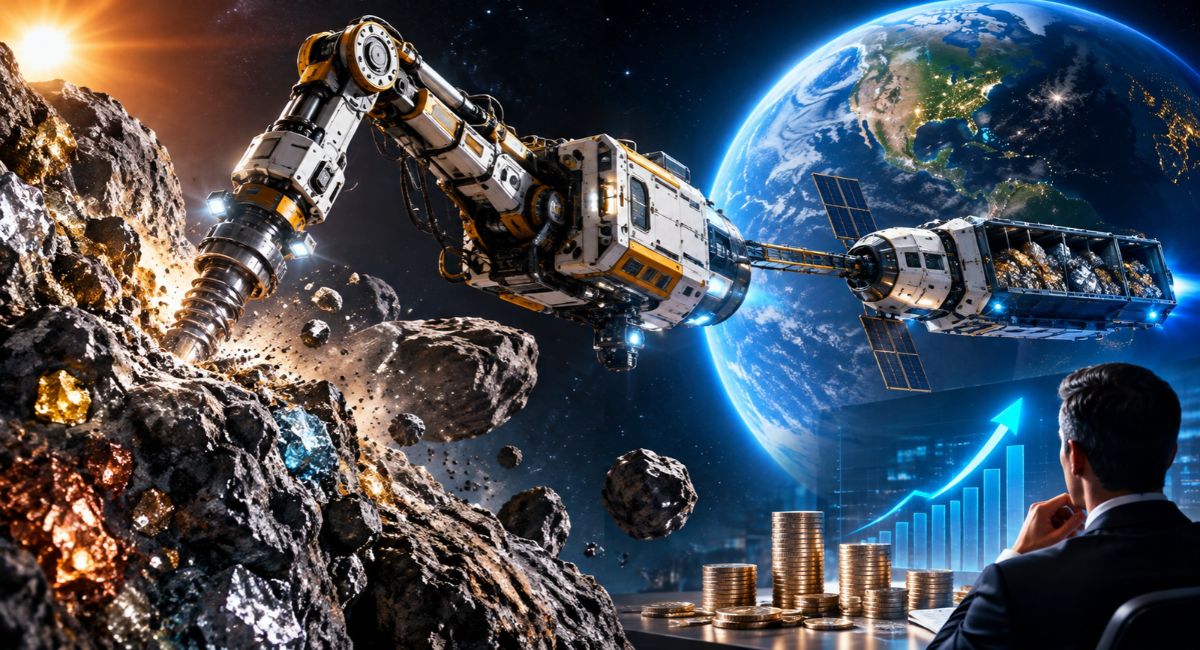
For centuries, human progress has been tied directly to the ground beneath our feet. We dug into the Earth for coal, iron, copper, and precious metals to power our civilizations, build our cities, and fuel our technological revolutions. But as we move deeper into the twenty-first century, a stark reality is becoming impossible to ignore: Earth is finite.
The high-tech minerals that power electric vehicles, smartphones, and green energy grids are becoming scarcer and more expensive to extract. Enter a brand-new frontier that sounds like science fiction but is rapidly turning into reality: space mining.
While public attention often focuses on civilian space tourism or rocket launches, a massive economic shift is happening behind the scenes. Private capital, venture capitalists, and visionary entrepreneurs are pouring billions into private space-resource companies. They aren’t looking to plant flags or take scenic pictures; they are chasing an estimated multi-trillion-dollar cosmic economy.
This article covers the mechanics, the players, and the massive potential of the next generation of space mining.
Why Earth Is Running Out of Time and Resources
To understand why investors are looking up at the stars, we first have to look down at our own planet. The global need for essential industrial minerals is expanding at an unprecedented rate. Every smartphone, laptop, wind turbine, and electric car battery requires specific elements like lithium, cobalt, nickel, and platinum-group metals.
The Finite Nature of Terrestrial Elements
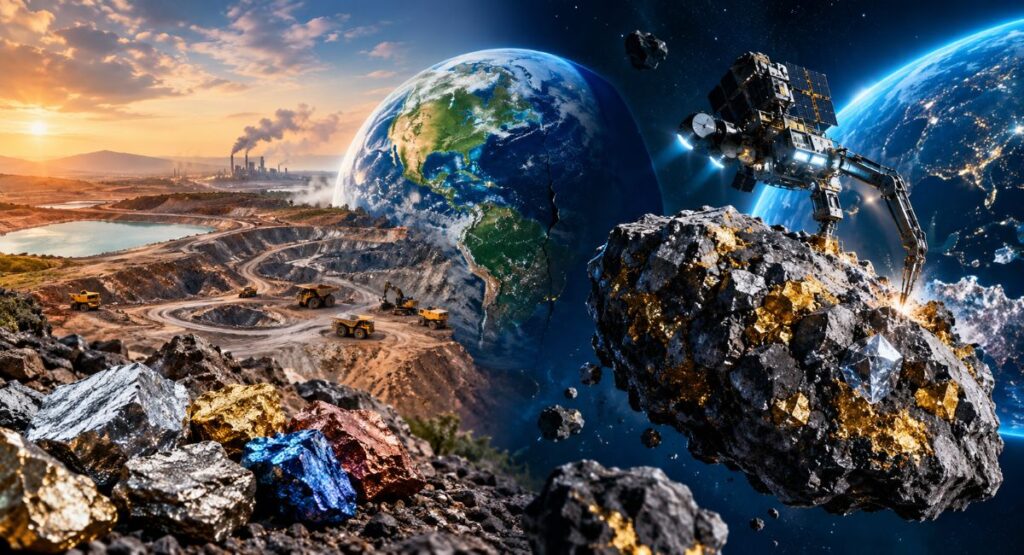
Earth is a closed ecosystem. The total amount of gold, platinum, and rare earth elements trapped inside our crust is fixed. As we mine the richest deposits, we are forced to dig deeper, use more toxic chemicals, and disturb more pristine ecosystems to get lower-grade ores. This dynamic creates a ticking clock for modern industrial manufacturing.
Rising Extraction Costs and Environmental Realities
Traditional mining is one of Earth’s most environmentally destructive industries. It scars landscapes, pollutes watersheds, and consumes massive amounts of water and energy. As environmental regulations tighten and easy-to-reach deposits disappear, the financial and ecological price of terrestrial mining climbs higher every year. For long-term investors, the math simply stops working. The solution? Look off-world, where entire mountains of precious metals float freely in the vacuum of space.
Enter the Space Economy: What Is Space Mining, Anyway?
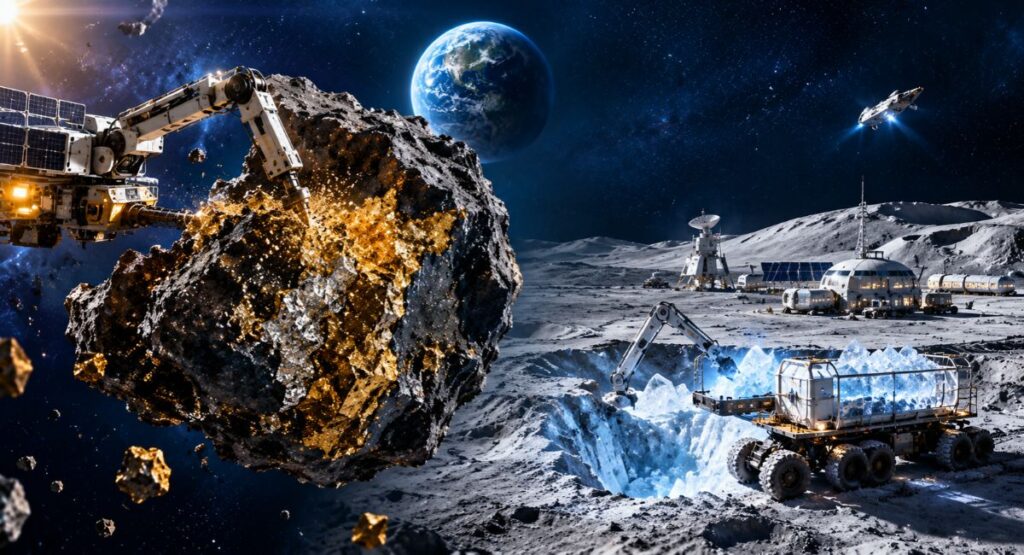
Space mining refers to the extraction of valuable raw materials from celestial bodies, such as near-Earth asteroids, the Moon, and even Mars. Instead of dragging heavy machinery across hundreds of miles of fragile ecosystems on Earth, future industries plan to harvest resources where they already float or rest.
1: Near-Earth Asteroids (The Metallic Goldmines)
Asteroids are essentially ancient building blocks left over from the formation of our solar system. Many of these space rocks contain staggering concentrations of iron, nickel, cobalt, and platinum-group metals. A single medium-sized asteroid can contain more platinum than humanity has ever mined. Harvesting even one of these objects could completely shift global commodity markets.
2: The Moon (Water Ice and Helium-3)
The Moon is much closer to home and serves as a vital stepping stone for deep space exploration. More importantly, the lunar poles contain trapped water ice. Water isn’t just for drinking; it can be split into hydrogen and oxygen to manufacture rocket propellant directly in space. The Moon also holds deposits of helium-3, a rare isotope on Earth that could potentially fuel clean nuclear fusion energy in the future.
The Shift from Government Science to Private Capital
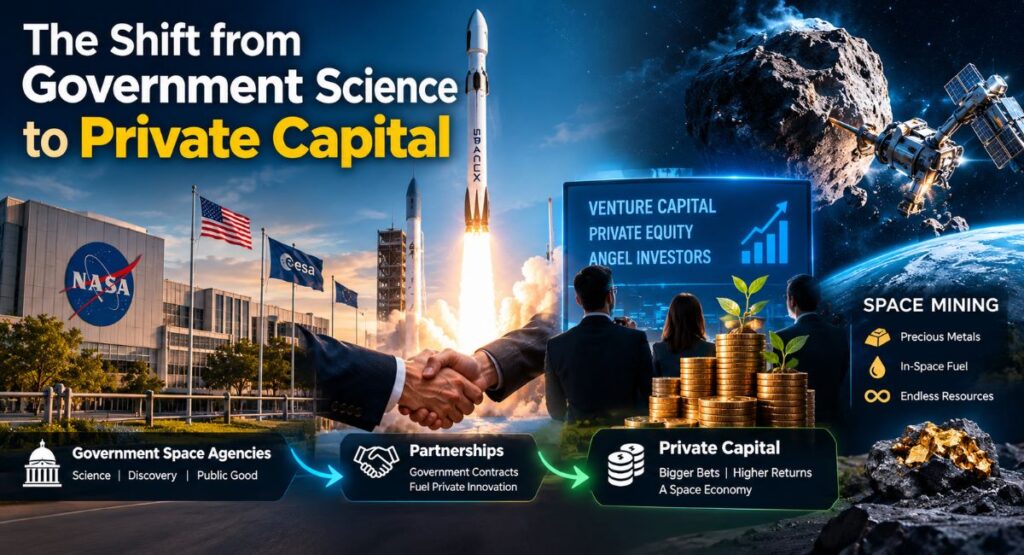
Historically, space exploration was the exclusive domain of superpowers like NASA, ESA, and other national space agencies. Government budgets are constrained by political cycles, public approval, and taxpayer priorities. They focus heavily on scientific discovery rather than commercial profitability.
That dynamic changed completely with the arrival of commercial spaceflight companies like SpaceX, which drastically reduced the cost of launching payloads into orbit. Once launch costs plummeted, private investors realized that doing business in space was no longer a pipe dream.
Why NASA and Space Agencies Partner with Startups
National space agencies quickly realized they couldn’t afford to build every piece of infrastructure alone. Instead of running every mission themselves, agencies like NASA now award multi-million-dollar development and procurement contracts to private startups. By acting as reliable early customers, governments provide a financial safety net that encourages private venture capital firms to step in with even larger investments.
Venture Capital and Private Equity Stepping In
Venture capitalists are always hunting for asymmetric upside industries with the potential to scale exponentially. Space mining fits this profile perfectly. While the initial capital expenditure is high, the payoff of unlocking an endless supply of precious metals and in-space fuel is astronomical. Private equity firms and angel investors are quietly funneling funds into early-stage aerospace startups, betting that the first companies to map and harvest space resources will become the tech giants of the twenty-second century.
The Pioneers: Real Companies Building the Future Today
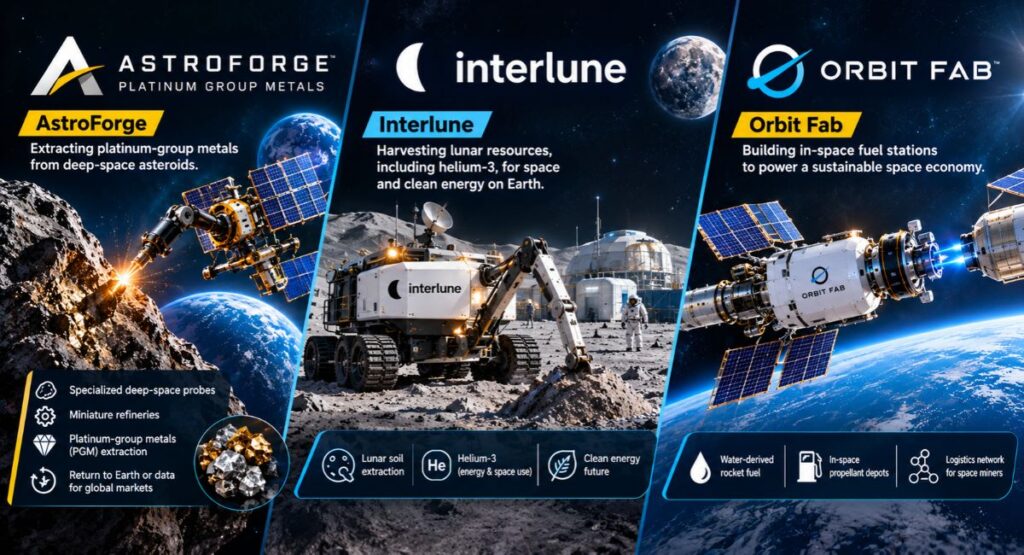
You might think space mining is a concept reserved for the year 2100, but several innovative startups are already building and testing hardware right now.
AstroForge and Platinum Group Metals
AstroForge is a venture-backed startup focusing specifically on extracting platinum-group metals from deep-space asteroids. Traditional mining on Earth makes these metals difficult and expensive to recover, but AstroForge is designing specialized deep-space probes and miniature refineries to intercept asteroids, extract valuable minerals, and return them or data about them back to Earth markets.
Interline and Lunar Resource Extraction
Co-founded by space industry veterans, Interlune is targeting the Moon. Their primary goal is to harvest natural resources from lunar soil, most notably helium-3, to support both space operations and clean energy initiatives on Earth. By treating the Moon as an industrial worksite, Interlune aims to commercialize lunar resources for everyday use.
Orbit Fab and In-Space Refueling Depots
You cannot drive a car across the country without gas stations, and you cannot build a sustainable space economy without propellant depots. Orbit Fab is tackling this exact problem by building in-space fuel stations. By supplying water-derived rocket fuel directly in orbit, they are creating the crucial customer base and logistics network that space miners need to move their products around efficiently.
How Space Mining Actually Works (Step-by-Step for Beginners)
If you are new to aerospace concepts, the idea of mining an asteroid sounds impossibly complex. In practice, space mining follows a clear, logical three-phase pipeline.
1: Prospecting and Mapping via Satellites
Before you can mine anything, you need to find the right target. Companies deploy advanced hyperspectral imaging satellites and space telescopes to scan near-Earth asteroids and the lunar surface. These instruments analyze the chemical and mineral makeup of objects from afar, identifying which space rocks contain high concentrations of valuable metals or water ice.
2: Capture, Extraction, and Processing
Once a target is identified, a spacecraft travels to the asteroid or landing site. Depending on the company’s strategy, the spacecraft might use mechanical capture bags, anchoring systems, or thermal processing units to break down the rock. Because hauling heavy raw rock back to Earth is wildly expensive, much of the initial processing and refining is designed to happen right there in microgravity.
3: Bringing Resources Home or Using Them in Orbit
Not everything mined in space needs to come back to Earth. In fact, the most immediate market for space resources is in space. Water extracted from the Moon or asteroids is converted into rocket fuel for satellites and future crewed missions. Only high-value, lightweight commodities like platinum or rare earth elements make economic sense to ship back down to terrestrial markets.
The Major Challenges Standing in the Way
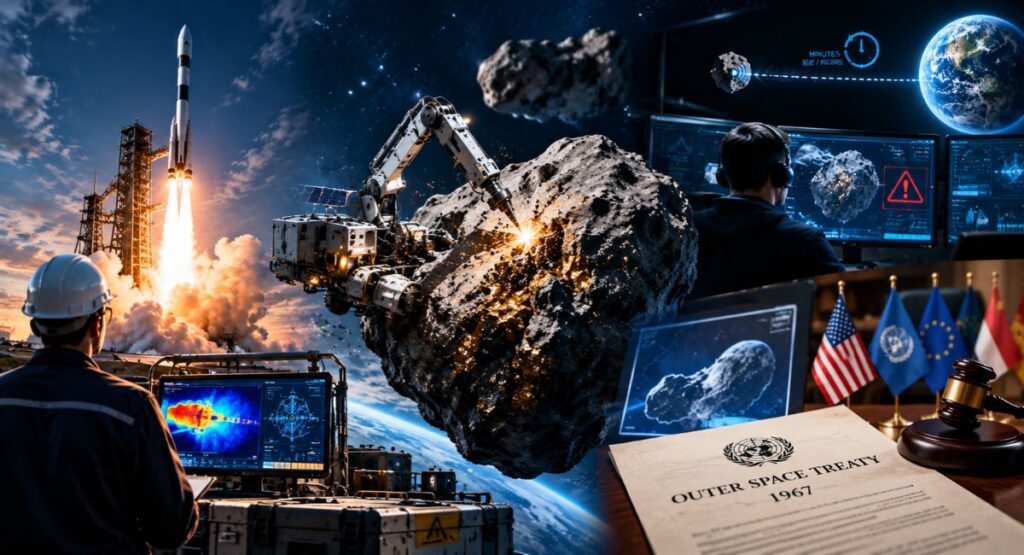
Despite the staggering multi-trillion-dollar potential, space mining is not without major hurdles. Investors and engineers must overcome significant obstacles before commercial extraction becomes routine.
Astronomical Launch and Development Costs
Building hardware that can survive the brutal environment of space is expensive. Equipment must withstand extreme temperature swings, intense cosmic radiation, and micrometeorite impacts. Even with reusable rockets lowering transport costs, a single failed mission can wipe out millions of dollars in private investment.
Technical and Environmental Hurdles in Deep Space
Operating autonomous machinery with a communication time delay of several minutes or hours is remarkably difficult. If a robotic excavator gets stuck on an asteroid millions of miles away, engineers cannot simply press an undo button. Autonomous artificial intelligence and robust robotics must reach unprecedented levels of reliability.
The Wild West of Space Law and Ownership Rights
Who actually owns an asteroid? Under the 1967 Outer Space Treaty, nations cannot claim sovereignty over celestial bodies. However, subsequent legislation in countries like the United States has granted private companies the legal right to own and sell resources they extract from space. Navigating international space law and preventing territorial disputes remains a delicate legal puzzle for policymakers.
Conclusion
The transition from terrestrial mining to space resource utilization represents one of the most profound shifts in human history. What was once confined to the pages of science fiction novels is now being actively engineered by private startups backed by visionary capital. As technology matures, launch costs drop, and pioneers prove out their extraction models, the multi-trillion-dollar economy of the cosmos is slowly coming into focus. Space mining is no longer a question of if, but when.