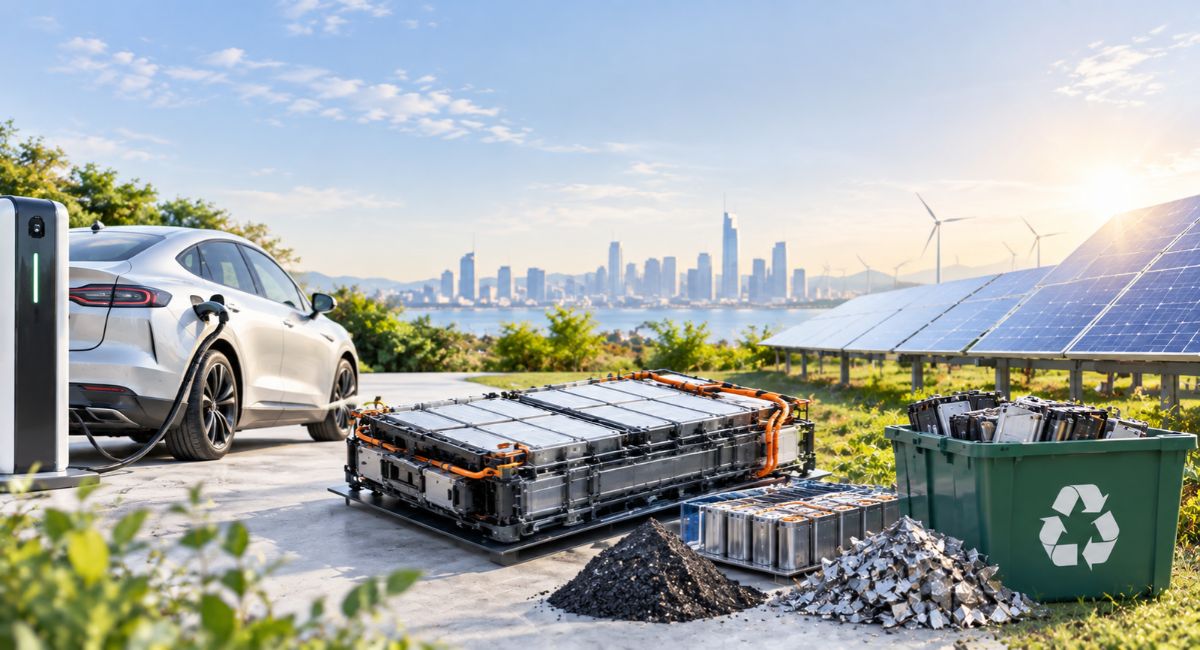
The global blueprint for clean power generation is undergoing a massive structural overhaul. Over the past decade, adopting sustainable energy practices appeared relatively straightforward: property owners mounted standard dark-blue silicon arrays on residential roofs, while environmentally conscious drivers swapped internal combustion engines for electric vehicles (EVs). Although these early adoptions reduced immediate tailpipe emissions and local fossil-fuel dependence, they also exposed a fundamental paradox at the heart of green manufacturing.
The hardware powering the clean energy transition remained fundamentally tied to resource-heavy, linear industrial lifecycles. Traditional solar panels and first-generation EV batteries required intensive raw mineral extraction, consumed substantial energy during refinement, and generated toxic electronic waste upon retirement.
To build an energy framework that can sustain humanity across generations, global industry must look far beyond simply installing alternative energy devices. The modern imperative demands a fully circular energy infrastructure an ecosystem where power generation hardware continuously renews itself without exhausting Earth’s finite materials.
Two interdependent breakthroughs drive this technological evolution: closed-loop electric vehicle battery recovery systems and next-generation photovoltaic solar technologies. Operating in unison, these two fields are effectively solving the twin pillars of green energy’s historical bottlenecks: long-term material scarcity and harvest efficiency limits.
1: The Hidden Vulnerabilities of Legacy Green Infrastructure
To understand why closed-loop networks and advanced solar materials represent such a monumental leap forward, one must examine the operational flaws in conventional renewable energy systems.
Historically, global manufacturing has followed a single-direction trajectory: extract raw ore, fabricate equipment, use the hardware, and dump the waste. Early renewable power setups could not escape this linear dependency, creating two major environmental challenges:
Ecological Degradation from Mineral Mining
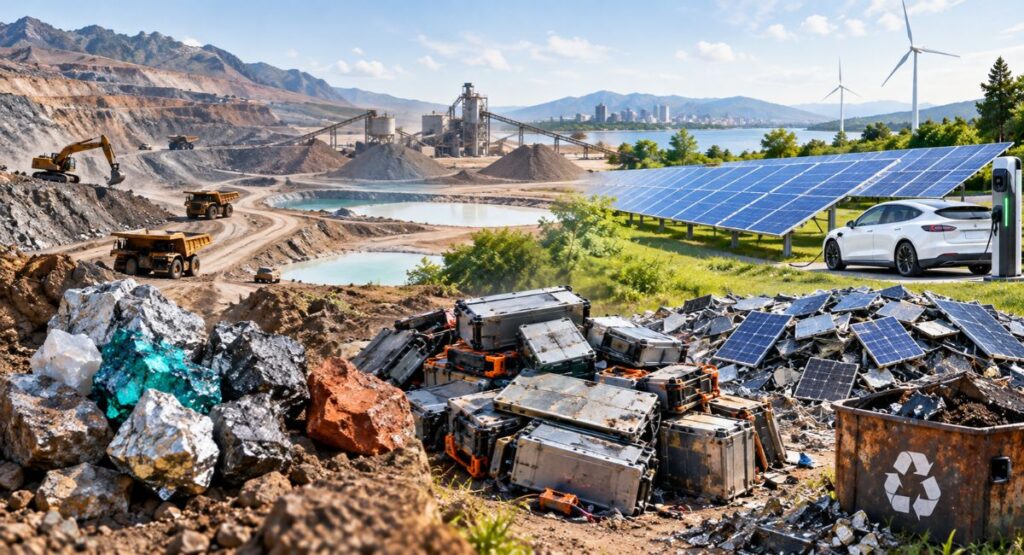
Building first-generation lithium-ion batteries and conventional silicon solar wafers requires vast volumes of critical elements, including cobalt, lithium, nickel, manganese, and refined silicon. Extracting these raw minerals requires intensive mining that often degrades local topsoil, contaminates regional groundwater, and displaces fragile biodiversity. Furthermore, global supply lines for these raw minerals remain tightly concentrated, making green technology vulnerable to geopolitical instability and severe cost inflation.
The Approaching Electronic Waste Crisis
First-generation solar arrays and early EV battery modules are rapidly approaching the end of their operational lifespans. Standard waste-processing systems are ill-equipped to handle the high volumes of complex electrochemical assemblies. Without dedicated recovery networks, millions of metric tons of retired battery cells and glass-silicon modules risk clogging industrial landfills and, over time, threatening surrounding water tables with heavy metal contamination.
True sustainability requires permanently sealing these open supply chains. The goal has expanded beyond producing zero-emission electricity at the point of use; it now requires ensuring that every piece of hardware harvesting and storing that energy remains sustainable across its entire lifecycle.
2: Demystifying Closed-Loop EV Battery Reclamation
As electric transport adoption accelerates across global markets, managing retired power packs has evolved into a vital industrial priority. This challenge has driven the creation of closed-loop battery recovery architecture.
What Defines a True Closed-Loop System?
In conventional open-loop or downcycling setups, recycled materials suffer structural degradation, forcing them into lower-tier industrial applications like basic consumer electronics or building materials.
Conversely, a true closed-loop system reclaims spent battery elements and restores them to exact chemical purity standards. Through this process, recovered battery metals can immediately re-enter high-performance battery cell manufacturing lines, effectively creating a endless cycle of material utility.
The Technical Recovery Process Explained
Modern closed-loop recycling facilities move away from high-temperature smelting (pyrometallurgy), which burns off valuable elements like lithium and generates atmospheric emissions, and instead rely on advanced hydrometallurgical processing:
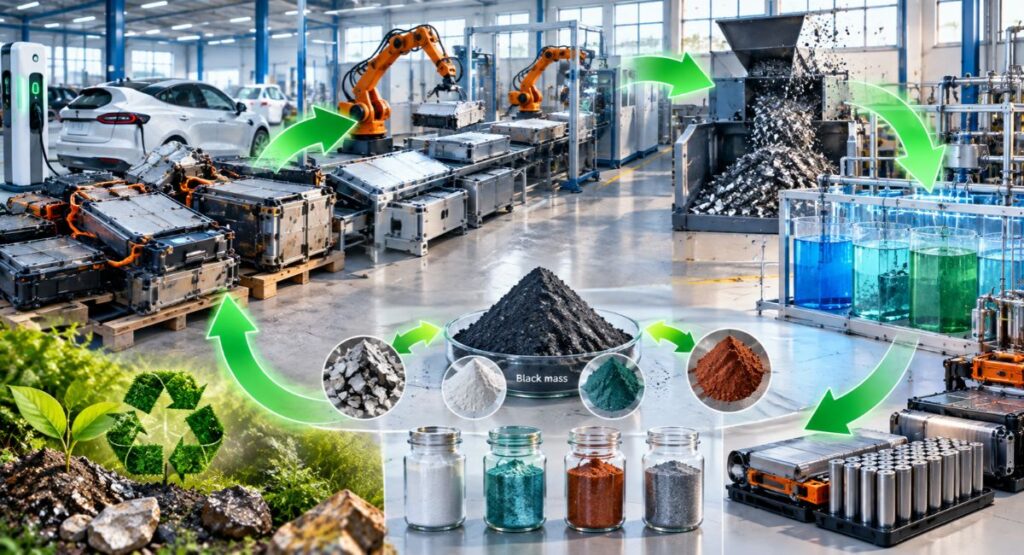
- Spent battery packs undergo diagnostic evaluation before automated robotics strip them down to individual battery modules and pouch cells.
- The isolated cells are shredded inside inert chemical environments to prevent thermal runaway. This process yields a concentrated metallic powder known as black mass, which contains high levels of lithium, nickel, cobalt, and manganese.
- Using low-temperature aqueous chemical solutions, processing plants selectively dissolve and extract individual metallic compounds.
- The extracted compounds are purified and converted directly into battery-grade cathode precursor materials, ready for instant integration into brand-new EV batteries.
The Broader Impacts of Closed-Loop Recovery
- Drastic Reduction in Mining Demand: By continuously looping existing battery elements through manufacturing facilities, processing plants can recover up to 95% to 98% of critical cathode metals, drastically reducing the need for raw ore extraction.
- Geopolitical Supply Sovereignty: Countries without natural subterranean mineral deposits can build self-sustaining supply chains by processing spent EV units on their own roads.
- Significant Carbon Footprint Reductions: Refining reclaimed battery-grade compounds uses up to 80% less energy than extracting, crushing, and purifying raw ore from global mines.
3: Next-Gen Solar Tech: Breaking Efficiency Ceilings
While closed-loop battery systems eliminate material waste and supply concerns on the storage side, generation hardware is undergoing a concurrent revolution. Standard single-junction silicon solar panels have served global energy markets well, but they are rapidly approaching their absolute theoretical limit for light-to-electricity conversion (known as the Shockley-Queisser limit). Next-generation solar technologies are shattering these physical efficiency ceilings.
The Game-Changing Potential of Perovskite Tandem Cells
The most promising development in modern photovoltaic research centers on perovskite crystalline materials. Perovskites possess a unique atomic crystal structure that absorbs light frequencies across different wavelengths than traditional silicon.
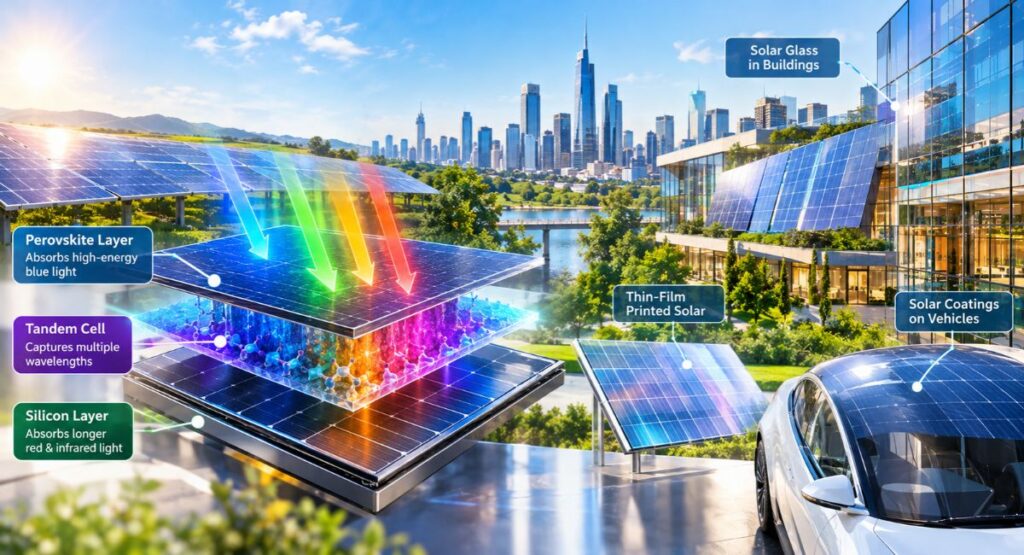
When material engineers apply a ultra-thin layer of perovskite directly onto a conventional silicon base, they create a tandem solar cell. This multi-layered layout harvests distinct regions of the solar light spectrum simultaneously:
- The Top Perovskite Layer: Efficiently absorbs high-energy, shorter-wavelength blue light.
- The Lower Silicon Layer: Allows longer red and infrared wavelengths to pass through the top layer and absorbs them at the base.
While standard single-junction silicon panels max out around 18% to 22% efficiency in field installations, perovskite-silicon tandem configurations consistently clear 30% to 33% efficiency in certified testing environments. This technological leap allows residential roofs, commercial facilities, and utility-scale solar farms to yield dramatically higher electrical output without expanding their physical footprint.
Expanding Solar Into Everyday Architecture
Next-generation solar developments extend far beyond rigid rooftop panels. Innovations in thin-film printed photovoltaics and transparent solar coatings enable light-harvesting layers to be integrated directly into architectural facades, commercial window glass, and vehicle surfaces. These advancements turn ordinary urban skyscrapers into quiet, continuous power generators without compromising aesthetic design.
4: The Convergence: Merging Storage Loops with Solar Generation
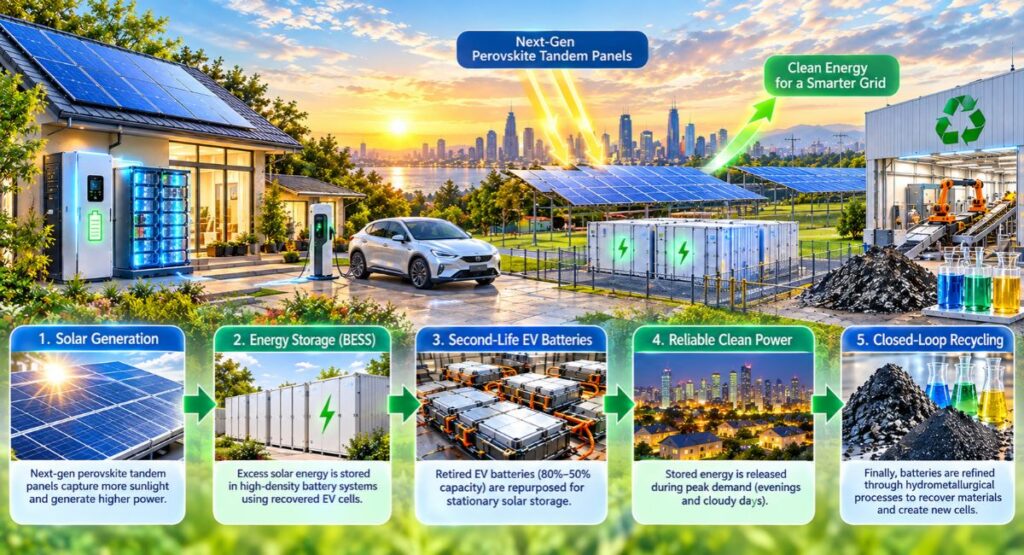
Individually, closed-loop battery recycling and perovskite tandem panels represent remarkable achievements in chemical engineering. However, their true societal value emerges when they function together as an integrated, self-sustaining renewable grid.
Eliminating Grid Intermittency
Solar power generation peaks at midday, when direct sunlight is strongest. However, consumer energy demand typically surges in the late afternoon and evening.
To bridge this gap, high-density Battery Energy Storage Systems (BESS) built from recovered, closed-loop battery cells absorb surplus daytime solar output. As daylight fades, these storage units dispatch clean power back to homes, commercial buildings, and local microgrids, ensuring round-the-clock power reliability.
The Role of Second-Life EV Batteries
Before an electric vehicle battery pack enters a closed-loop facility for complete chemical processing, it often undergoes an intermediary second-life operational phase:
| Battery Phase | Primary Capacity | Application Target |
| First Life | 100% – 80% | Electric Vehicle Transportation (High Acceleration Needs) |
| Second Life | 80% – 50% | Stationary Solar Energy Storage (Home & Grid Backup) |
| Closed-Loop Recycling | Material Reclamation | Hydrometallurgical Refining back into New EV Cells |
When an EV battery’s capacity drops below 80%, it may no longer deliver the rapid acceleration needed for daily vehicle driving. However, that remaining 80% capacity is ideal for stationary grid storage. Repurposing retired vehicle battery packs for residential or commercial solar backup extends their functional lifetime by 5 to 10 additional years before final closed-loop material recycling.
5: Overcoming Industrial Milestones and Scaling Challenges
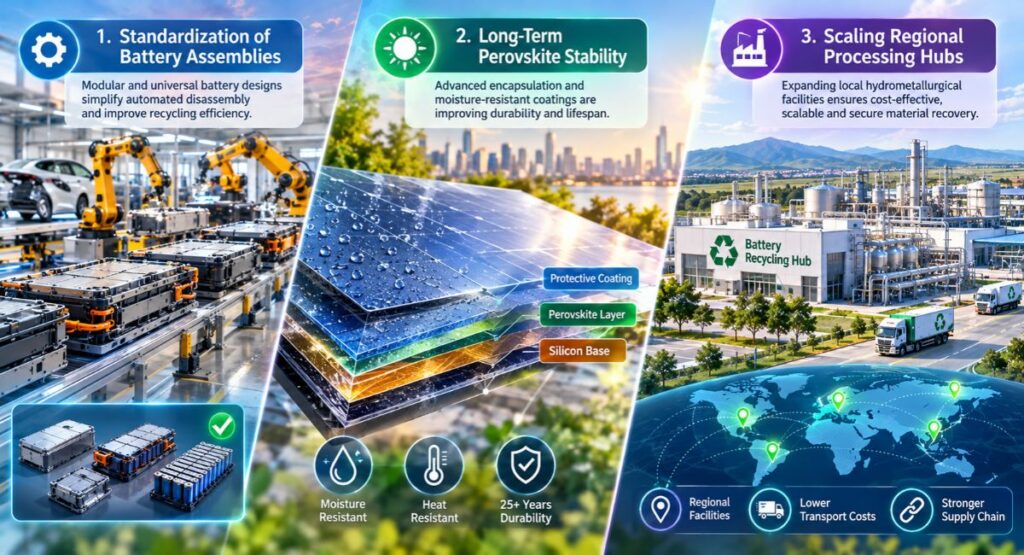
While the shift toward a circular energy ecosystem is accelerating globally, several key operational challenges are actively being addressed by engineers and policymakers:
Standardization of Battery Assemblies
Electric vehicle manufacturers currently utilize vastly different battery pack layouts and chemical formulations. Implementing standardized, modular battery designs will simplify automated robotic disassembly at recycling centers.
Long-Term Perovskite Stability
While perovskite cells offer unprecedented efficiency gains, early iterations degraded rapidly when exposed to atmospheric moisture and high heat. Ongoing research focuses on advanced microscopic encapsulation techniques to ensure perovskite panels match silicon’s 25-year outdoor durability.
Scaling Regional Processing Hubs
Constructing localized hydrometallurgical processing facilities requires substantial capital investment. Building this regional processing network ensures recycling throughput scales effectively as more early-generation EVs retire.
Conclusion
The global transition to sustainable power is evolving beyond basic alternative generation into a fully circular, highly efficient industrial framework. By pairing closed-loop battery material recovery with the efficiency gains of perovskite tandem solar systems, modern engineering is successfully and systematically addressing the historic flaws of early green technology.
This integrated approach ensures that our clean power infrastructure is not merely zero-emission at the point of use; it guarantees that the underlying supply chain remains sustainable, efficient, and resilient from raw material recovery to final generation. As these technologies scale, they will lay the groundwork for a truly zero-waste power grid that can support global energy needs for generations to come.