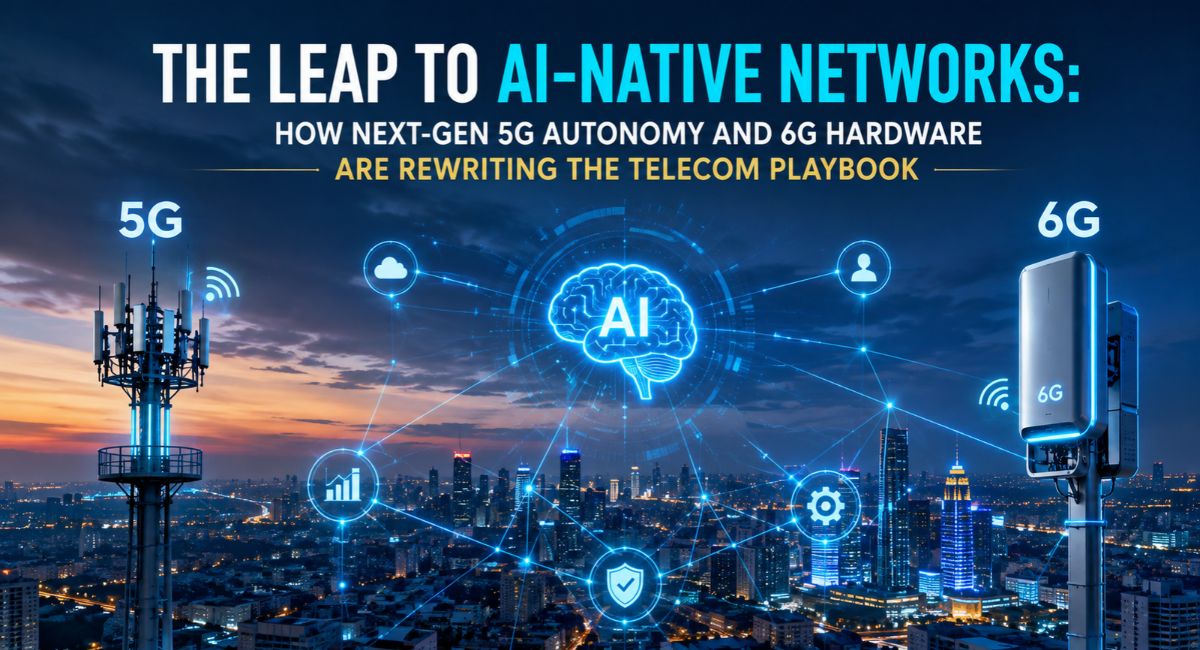
Have you ever thought about what keeps your smartphone connected seamlessly while you navigate a busy downtown street or travel aboard a high-speed transit train?
Behind every mobile screen, a vast web of infrastructure routes data streams, balances traffic loads, and restores lost signals around the clock.
Historically, keeping these networks running smoothly depended on human oversight. Network operators and ground technicians spent countless hours monitoring diagnostic dashboards, manually adjusting tower settings, or visiting physical site locations to perform maintenance.
This rapid expansion of connected devices has triggered a major paradigm shift across the communications industry: the transition toward fully autonomous, AI-integrated network architecture.
Rather than using artificial intelligence merely as a secondary extension, leading telecom providers are designing systems where machine intelligence acts as the central control hub. By combining automated 5G software algorithms with advanced 6G physical infrastructure, service providers are setting a benchmark for future digital communication. This article explains how autonomous networks function, why physical 6G upgrades are vital, and how these technological breakthroughs elevate your everyday online experience.
Defining AI-Integrated Network Architecture
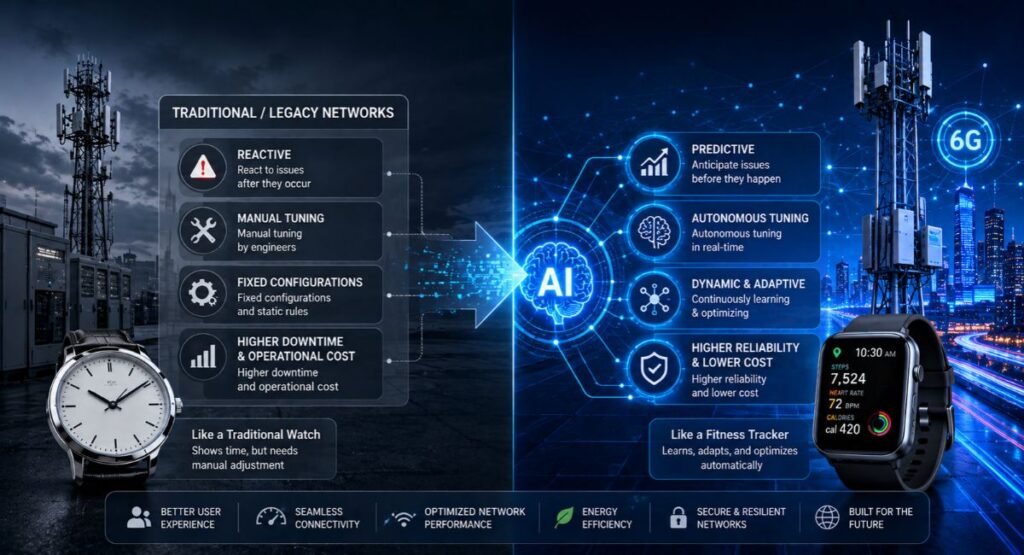
To grasp what sets an AI-integrated network apart, consider the difference between a basic wristwatch and an advanced fitness tracker.
A traditional wristwatch simply measures time based on static internal gears; if you cross into a new time zone, you must update the hands manually. In contrast, a modern fitness tracker automatically senses your location, monitors your activity metrics continuously, and adapts its display settings without requiring manual input.
Legacy cellular infrastructure functions much like that traditional wristwatch. Infrastructure teams set up fixed operational parameters and stepped in only after an outage occurred. Early 5G deployments often added basic predictive algorithms on top of pre-existing software structures as an extra feature layer.
An AI-integrated network, conversely, incorporates predictive intelligence directly into every structural layer. Machine learning guides each primary operational decision, from managing high-frequency radio transmissions to conserving tower power and identifying unusual network traffic.
Essential Differences: Traditional vs. Next-Gen Networks
- Legacy Systems: React to signal degradation or service drops only after users report problems.
- Next-Gen Systems: Anticipate localized traffic surges and hardware wear beforehand to prevent disruptions.
- Manual Tuning: Technical teams reconfigure signal directions and frequency allocations by hand.
- Autonomous Tuning: Software routines make thousands of subtle operational adjustments per minute automatically.
Exploring Next-Generation 5G Automation

While most mobile users associate 5G technology with faster video streaming on smartphones, the most transformative aspect of modern 5G lies in its operational self-management. Self-management allows a network to evaluate its performance, adjust resource allocation, and correct technical glitches without human intervention.
How Automated 5G Systems Operate in Practice
Automated 5G infrastructure relies on continuous data analysis to maintain optimal performance across diverse environments. Here is how these systems respond to everyday connectivity demands:
- Dynamic Traffic Reallocation: When massive crowds gather for music festivals or public rallies, network traffic spikes instantly. Automated 5G systems detect these sudden demand changes immediately, redirecting unused capacity from quiet residential districts to keep connections fast and responsive.
- Instant Fault Redirection: If a primary relay station encounters a power fault or hardware malfunction, intelligent routing software instantly diverts active data traffic through nearby secondary towers. Most connected users continue browsing without experiencing any service interruption.
- Automated Power Optimization: Running cellular towers continuously consumes substantial amounts of electrical energy. Predictive software routines track user activity trends, putting idle radio transmitters into low-power hibernation during late-night hours and waking them up instantly as morning activity resumes.
The Power of 6G Hardware: Supporting Heavy Computation
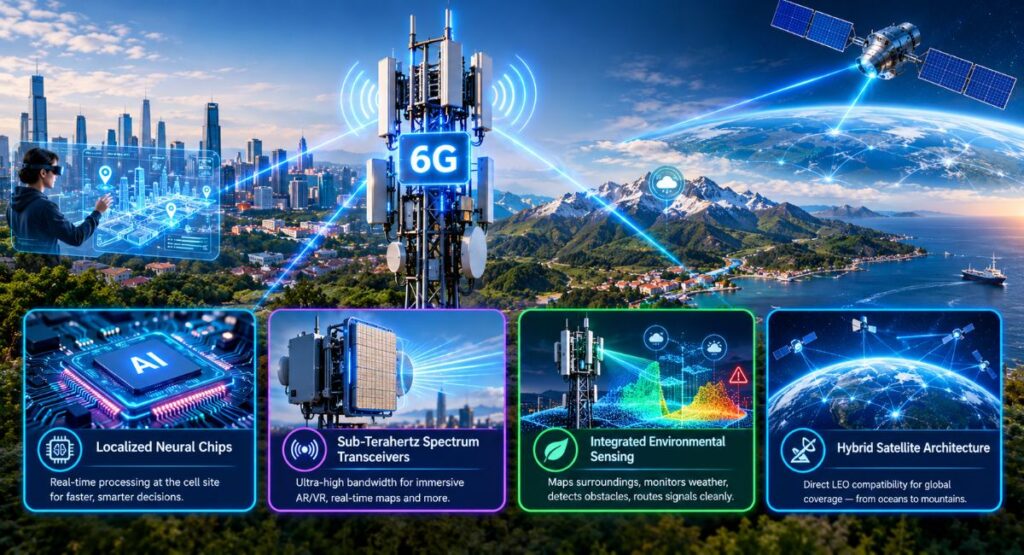
If automated 5G software acts as the cognitive engine of modern telecom, advanced 6G hardware supplies the necessary physical capabilities. While commercial 6G networks continue to take shape globally, the underlying physical components engineered for this era mark a monumental step forward in hardware capability.
Breakthrough Physical Advances in 6G
- Localized Neural Chips: Older cellular systems send raw operational data across long distances to centralized processing facilities for analysis. Next-generation 6G base stations house dedicated neural processing chips locally, enabling lightning-fast operational decisions right at the cell site.
- Sub-Terahertz Spectrum Transceivers: 6G utilizes extremely high-frequency radio spectrum capable of carrying unprecedented volumes of data per second. This physical throughput supports immersive applications like real-time interactive spatial maps and instant remote medical diagnostics.
- Integrated Environmental Sensing: Advanced 6G radio hardware can function similarly to high-resolution radar systems. Towers can map physical surroundings, monitor weather patterns, and detect structural obstacles, allowing signals to route cleanly around physical barriers.
- Hybrid Satellite Architecture: 6G hardware designs feature direct compatibility with low-Earth orbit (LEO) satellite constellations. This hybrid connectivity creates a unified signal blanket extending across remote oceans, rural valleys, and mountain ranges.
How Smart Networks Enhance Everyday Life

You do not need an engineering background to appreciate the practical rewards of intelligent cellular architecture. This technological transition brings tangible upgrades to daily digital experiences:
1. Safer Self-Driving Systems
Autonomous vehicles require constant, low-latency communication with nearby road infrastructure, traffic control systems, and neighboring cars to navigate safely. Ultra-responsive automated networks allow critical telemetry data to be exchanged instantly.
2. Low-Latency Virtual Workspaces and Gaming
High latency (data transmission delay) can cause visual lag in virtual reality tools and online interactive platforms. By calculating optimal data paths continuously, intelligent networks deliver fluid, lag-free performance for remote collaboration and gaming.
3. Reliable Disaster Response Communications
During severe storms or natural emergencies, conventional communication links can sustain damage or become congested with emergency calls. Self-healing network architecture automatically prioritizes life-saving emergency traffic and routes signal paths through surviving equipment instantly.
Overcoming Key Implementation Barriers
Despite these groundbreaking advantages, transitioning global communication systems toward full operational autonomy presents several real-world engineering hurdles:
Substantial Infrastructure Upgrades
Equipping millions of global cell sites with upgraded radio hardware, localized AI processing chips, and satellite-compatible arrays requires significant capital investments from service providers.
Computational Energy Management
Running complex machine learning algorithms directly at local tower sites demands substantial electrical power and thermal control. Engineers are actively designing lower-power processor architectures to keep operations sustainable.
Automated Security Protocols
As communication infrastructure becomes increasingly self-managing, protecting automated systems against unauthorized network intrusions and automated cyber exploits remains a top industry priority.
Conclusion
The transition toward fully automated 5G networks and advanced 6G hardware represents far more than an incremental speed upgrade. It establishes a fundamental redesign in how global communication networks manage, repair, and optimize themselves.
By pairing self-adjusting software logic with high-throughput physical hardware, telecommunications leaders are forging an adaptive, self-healing digital backbone for the modern world. As these technologies expand globally, they will power the future of connected communities, smart transit, and reliable communications worldwide.