
Large Language Models (LLMs) like ChatGPT, Claude, and Gemini have captured the world’s imagination. They draft emails in seconds, generate code, summarize long documents, and converse naturally. Because of these headline-grabbing capabilities, many business leaders naturally assumed that LLMs would solve every enterprise intelligence challenge.
However, a massive disconnect exists between consumer AI hype and enterprise operational reality. While LLMs excel at processing unstructured text and language, most critical business operations, such as supply chain forecasting, fraud detection, customer churn prediction, credit scoring, and inventory management, run on structured tabular data. These are the numbers, rows, columns, and relational databases that power modern business software like ERPs, CRMs, and SQL databases.
When forced to analyze massive, complex tabular datasets, general-purpose LLMs struggle with mathematical precision, hallucinations, high latency, and severe privacy limitations. This limitation has given rise to the next defining enterprise technology wave: Tabular AI and Tabular Foundation Models (TFMs). This complete article explores what Tabular AI is, why LLMs fall short on structured data, and why Tabular represents the dominant 10-year trend for enterprise data intelligence.
What is Tabular AI?

Tabular AI refers to artificial intelligence architectures, algorithms, and foundation models built to process, learn from, and predict on structured data.
Structured data is information organized into tables with rows and columns. Common examples include:
- Spreadsheets: Microsoft Excel files, Google Sheets, or CSV files.
- Relational Databases: SQL databases, PostgreSQL, and Snowflake data warehouses.
- Enterprise Software Records: Customer transaction histories, ERP supply chain logs, inventory ledgers, and financial records.
Unlike legacy machine learning models (like XGBoost or Decision Trees) that require weeks of custom feature engineering and manual pipeline setup for every new dataset, modern Tabular Foundation Models(TFMs) can consume raw, messy enterprise tables directly. They automatically discover relationships across numerical values, categorical tags, and timestamps to output highly accurate predictions in seconds.
Why LLMs Struggle with Structured Enterprise Data

To understand why Tabular AI is skyrocketing in adoption, it helps to look at why general text-focused LLMs fall short when handling tabular systems.
1. The Tokenization Problem
LLMs process information by breaking down text into small chunks called tokens. While tokenization works brilliantly for English sentences or programming code, it breaks down with complex mathematical figures and numbers. An LLM sees the number 184,295.50 not as a distinct numeric quantity with mathematical properties, but as a sequence of text characters. This leads to inaccurate calculations and unreliable statistical deductions.
2. High Hallucination Rates in Calculations
In creative writing or customer support summarization, small variations in wording are acceptable. However, in financial audits, risk scoring, or medical inventory planning, 100% accuracy is required. LLMs are probabilistic text generators; they predict the next word, not the exact mathematical outcome. When prompted to calculate complex predictive trends across thousands of table rows, LLMs frequently hallucinate incorrect totals or false correlations.
3. Context Window Limits and Cost High-Water Marks
Enterprise databases contain millions of rows and thousands of columns. Feeding millions of structured rows into a traditional LLM’s text context window is wildly inefficient, extremely expensive, and painfully slow. Tabular AI models, by contrast, are mathematically compressed to process millions of structured data points with tiny compute footprints and near-instant speed.
4. Noise, Missing Values, and Data Imbalance
Real-world enterprise spreadsheets are messy. They contain missing values, inconsistent date formats, outlier numbers, and imbalanced classifications. In head-to-head performance benchmarks measuring predictive performance on noisy, real-world corporate databases, specialized Tabular AI models consistently outperform generalized LLMs by significant margins (often scoring 90%+ accuracy compared to LLMs scoring below 40% on identical complex datasets).
The Evolution: From Traditional ML to Tabular Foundation Models (TFMs)
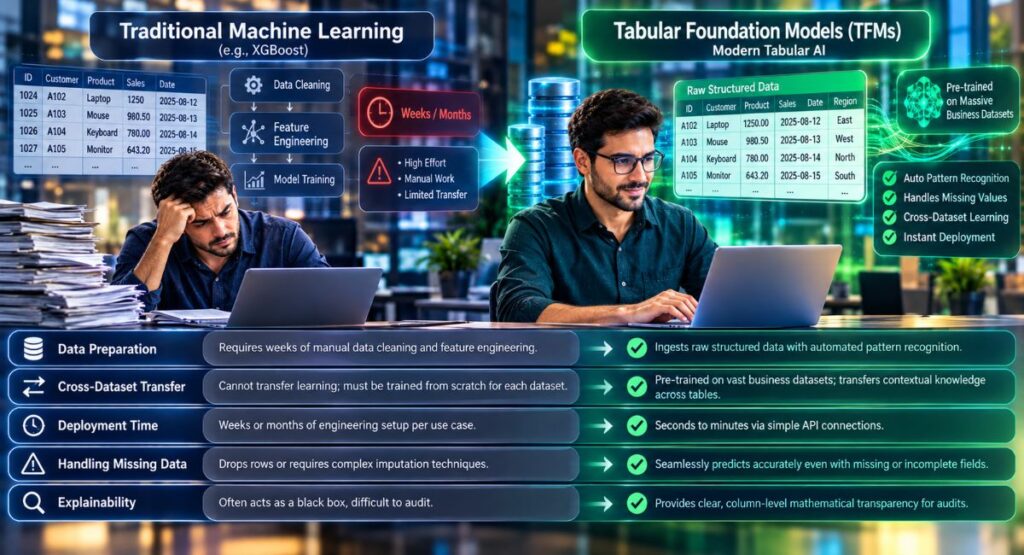
Enterprise tabular prediction is not brand new, but the way it is being executed has undergone a fundamental revolution.
| Capability | Traditional Machine Learning (e.g., XGBoost) | Modern Tabular AI (Foundation Models) |
| Data Preparation | Requires weeks of manual data cleaning and feature engineering. | Ingests raw structured data with automated pattern recognition. |
| Cross-Dataset Transfer | Cannot transfer learning; must be trained from scratch for each dataset. | Pre-trained on vast business datasets; transfers contextual knowledge across tables. |
| Deployment Time | Weeks or months of engineering setup per use case. | Seconds to minutes via simple API connections. |
| Handling Missing Data | Drops rows or requires complex imputation techniques. | Seamlessly predicts accurately even with missing or incomplete fields. |
| Explainability | Often acts as a black box, difficult to audit. | Provides clear, column-level mathematical transparency for audits. |
Key Enterprise Use Cases Driving Tabular AI Adoption
Every major industry sector stands to benefit from deploying dedicated Tabular AI solutions across their operational core.
Financial Services & Banking
- Credit Risk Assessment: Evaluating applicant background records, debt-to-income ratios, and loan histories instantly without human bias.
- Fraud Detection: Identifying anomalous spending behaviors across millions of payment processing records in milliseconds.
- Algorithmic Trading & Portfolio Management: Detecting subtle predictive signals across historical market indicators and economic metrics.
Supply Chain & Logistics
- Demand Forecasting: Predicting product inventory needs across thousands of regional retail hubs based on historical sales tables, weather patterns, and shipping logs.
- Supplier Risk Scoring: Monitoring vendor delivery lead times and price fluctuations to prevent manufacturing shutdowns before they happen.
Healthcare & Pharmaceuticals
- Patient Outcome Prediction: Analyzing historical clinical data tables, patient vitals, and treatment histories to predict hospital readmission risks.
- Drug Trial Optimization: Evaluating structured biochemical databases to identify viable medical trial candidates faster.
E-Commerce & Retail
- Customer Churn Prevention: Detecting subtle behavioral shifts in purchase frequency rows to trigger automated retention incentives before a customer leaves.
- Dynamic Pricing Models: Adjusting catalog prices in real-time based on competitor price databases, supply levels, and seasonal demand tables.
Why Tabular AI is the Next 10-Year Enterprise Mega-Trend
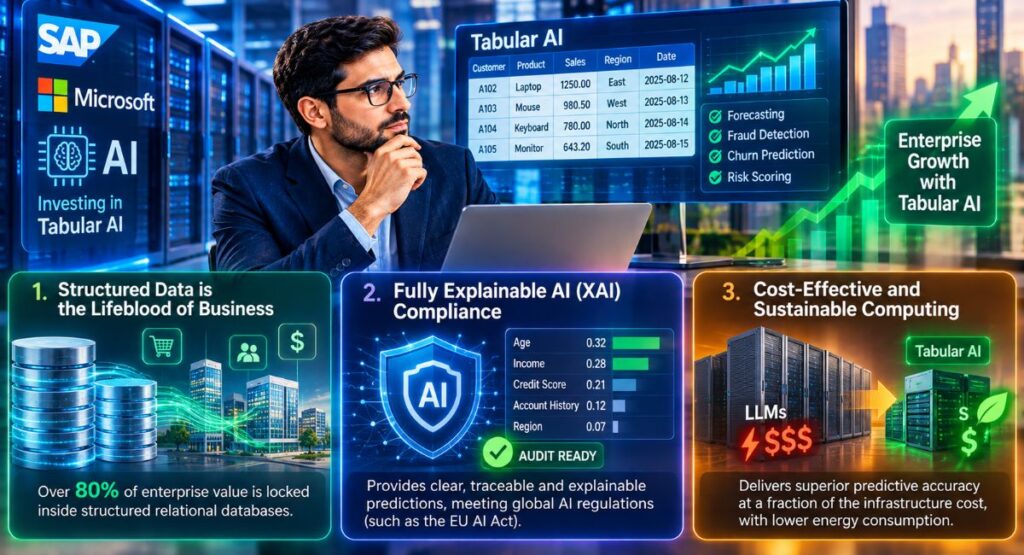
As enterprise software companies like SAP, Microsoft, and specialized frontier AI labs invest billions into Tabular AI capabilities, three major factors ensure this technology will dominate enterprise strategy for the next decade:
Structured Data is the Lifeblood of Business
While text and media generation are useful, numbers and transactions rule business decision-making. Over 80% of enterprise value is locked inside structured relational databases. Unlocking predictive intelligence from these existing data vaults delivers immediate, measurable Return on Investment (ROI) to CFOs and CEOs.
Fully Explainable AI (XAI) Compliance
Governments worldwide are enacting strict AI regulations (such as the EU AI Act). Regulators will not allow banks to deny loans or healthcare providers to deny coverage based on an opaque LLM text output. Tabular AI models offer traceable, explainable predictions, showing exactly which database columns and numeric weightings influenced a specific decision.
Cost-Effective and Sustainable Computing
Running multi-billion-parameter LLMs requires massive GPU server farms, costing enterprises millions in monthly cloud computing expenses. Tabular AI foundation models are streamlined, computationally efficient, and environmentally sustainable, delivering superior predictive accuracy at a fraction of the infrastructure cost.
Frequently Asked Questions (FAQs)
What is the main difference between an LLM and Tabular AI?
An LLM (Large Language Model) is designed to process unstructured human text and natural language. Tabular AI is specifically engineered to analyze structured data formatted in rows, columns, numbers, and database tables to make accurate numerical and predictive forecasts.
Does Tabular AI replace Large Language Models?
No. Rather than replacing each other, Tabular AI and LLMs complement one another. For example, an enterprise might use an LLM as a natural-language interface (chat interface) while using a Tabular AI backend to execute complex numeric calculations and database predictions accurately.
Can small and mid-sized businesses use Tabular AI?
Yes! Traditional machine learning required hiring expensive data science teams to code pipelines manually. Modern Tabular AI foundation models are pre-trained, meaning smaller teams can simply connect their existing spreadsheets or SQL databases to get instant enterprise-grade analytics.
Is Tabular AI secure for sensitive company data?
Yes. Unlike public LLMs that might inadvertently train on user prompts, modern enterprise Tabular AI solutions run directly inside isolated corporate cloud environments or on-premises database servers, preserving strict data privacy and regulatory compliance standards.
Conclusion
The initial wave of generative AI proved that computers can converse like humans. However, the next decade of enterprise transformation will be defined by systems that can think, calculate, and predict with mathematical precision.
Large Language Models will continue to handle communication, but Tabular AI and Tabular Foundation Models are the true backbone of enterprise data intelligence. By turning static database tables into real-time predictive engines, Tabular AI empowers businesses to make faster, smarter, and far more profitable decisions.