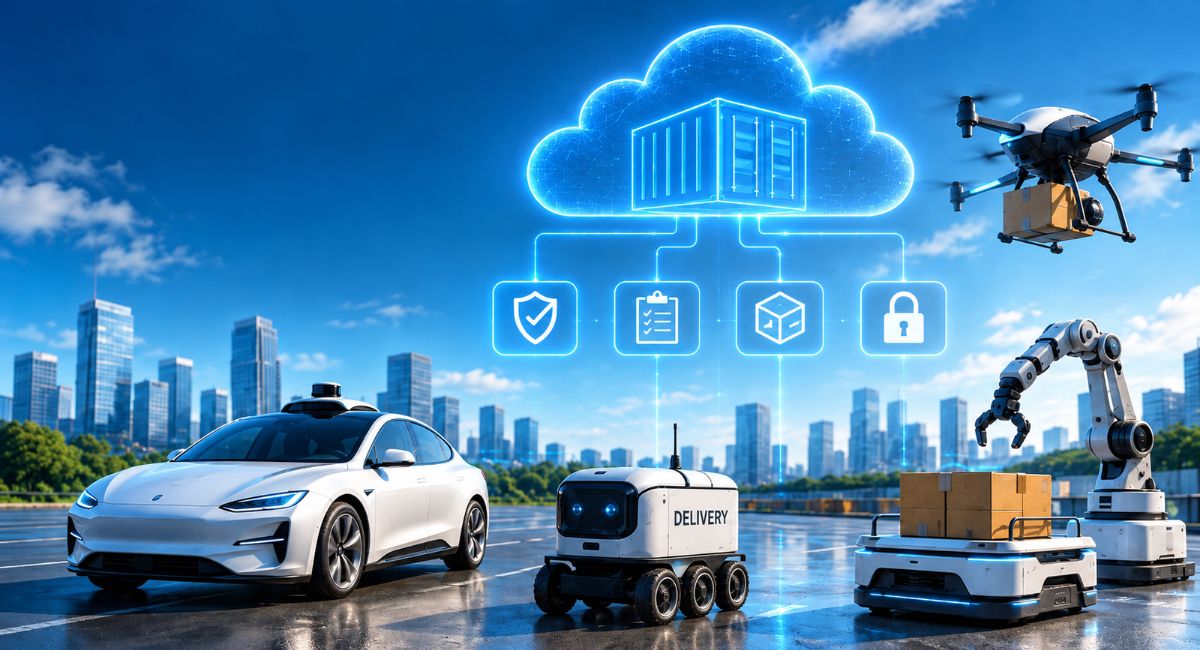
Self-driving cars navigate busy city streets, autonomous delivery drones fly through neighborhood skies, and smart warehouse robots manage inventory without human intervention. Autonomous technology is no longer science fiction; it is rapidly becoming a key part of daily life.
However, as machines take control of critical real-world tasks, a fundamental question arises: How do we ensure the software running these autonomous systems is completely safe and secure from bugs, cyberattacks, or system failures?
A single coding error in an autonomous vehicle could cause a navigation glitch, while a security vulnerability in a drone fleet could let unauthorized users access it. To reduce these risks, software developers test autonomous software in a virtual testing environment called a cloud sandbox.
To make cloud sandboxes reliable, secure, and compatible across systems, the tech industry relies on a global set of rules called the Open Container Initiative (OCI) Container Standards.
This article explains what cloud sandboxes are, how OCI container standards work, and why this technology is essential for keeping autonomous systems secure.
Understanding Cloud Sandboxes and Autonomous Tech

Before exploring open standards, it is helpful to understand what a cloud sandbox is and why autonomous technology depends on it.
What is a Cloud Sandbox?
In computing, a sandbox is an isolated, closed environment where software code can be executed without risking the rest of the system.
Think of a physical sandbox where children play with sand without making a mess on the living room floor. A cloud sandbox functions similarly in a cloud computing environment. It creates a digital safety barrier around an application. If the application crashes, behaves unexpectedly, or contains malicious code, the damage stays confined to the sandbox and doesn’t affect the main servers, databases, or physical equipment.
Why Autonomous Tech Needs Cloud Testing
Autonomous technology such as self-driving cars, industrial robotics, and automated flight systems relies heavily on artificial intelligence (AI) and machine learning (ML). These systems continuously process massive volumes of sensor data, including camera feeds, LiDAR imaging, GPS signals, and telemetry.
Before updating software on a physical vehicle or drone, engineers must test the code across millions of simulated miles. Testing directly on physical hardware can be dangerous and expensive. Cloud sandboxes enable developers to:
- Run millions of virtual driving or flight scenarios simultaneously in the cloud.
- Evaluate new updates safely before pushing them wirelessly (Over-The-Air or OTA) to real vehicles.
- Safely detonate, inspect, and analyze unverified third-party software updates for malware before live deployment.
What Are OCI Container Standards?
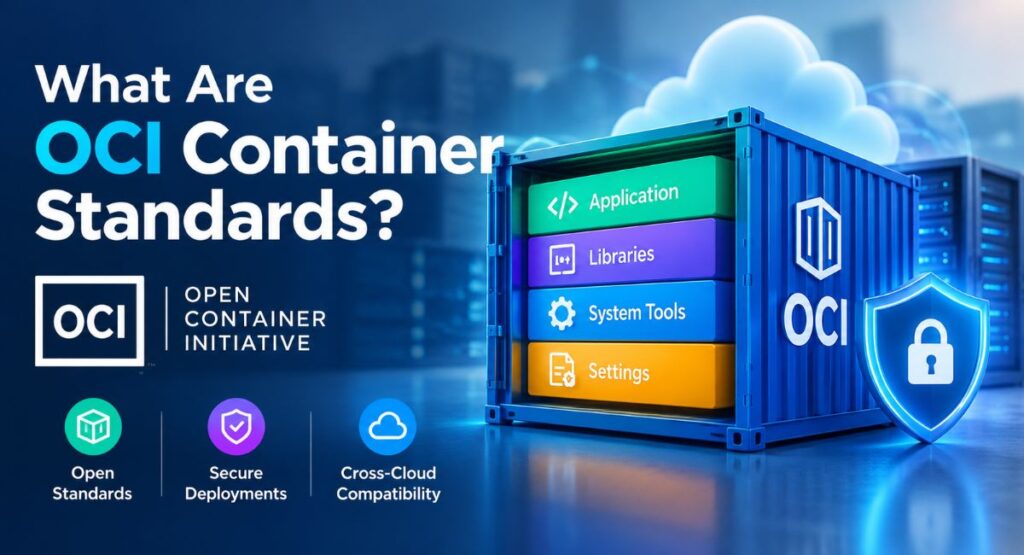
To understand how cloud sandboxes stay secure, it is necessary to examine how software is packaged using containers and standardized by the Open Container Initiative (OCI).
What is a Container?
A container is a lightweight, standalone package that includes everything needed to run a piece of software: the code, system tools, libraries, and settings.
Unlike traditional virtual machines (VMs) that emulate an entire computer hardware layer and operating system, containers share the host operating system’s kernel. This makes containers significantly faster, smaller, and more resource-efficient.
The Role of the Open Container Initiative (OCI)
In the early days of container technology, different companies created their own proprietary container formats. An application built for one platform often failed to run on another.
To solve this fragmentation, major industry leaders formed the Open Container Initiative (OCI) under the Linux Foundation. The OCI establishes open, vendor-neutral industry specifications for container formats and runtimes.
Three Core OCI Specifications Include
| OCI Specification | What It Standardizes | Security & Operational Benefit |
| Image Specification (image-spec) | How container images are built, structured, and packaged. | Enables cryptographic hashing (SHA256 digests) to verify software integrity. |
| Runtime Specification (runtime-spec) | How a container image is unpacked and executed on a host system. | Enforces resource limits and kernel isolation rules during execution. |
| Distribution Specification (distribution-spec) | How container images are shared and transferred across registries. | Ensures secure, consistent deployment pipelines across different clouds. |
Why Standardizing the Cloud Sandbox Matters for Security
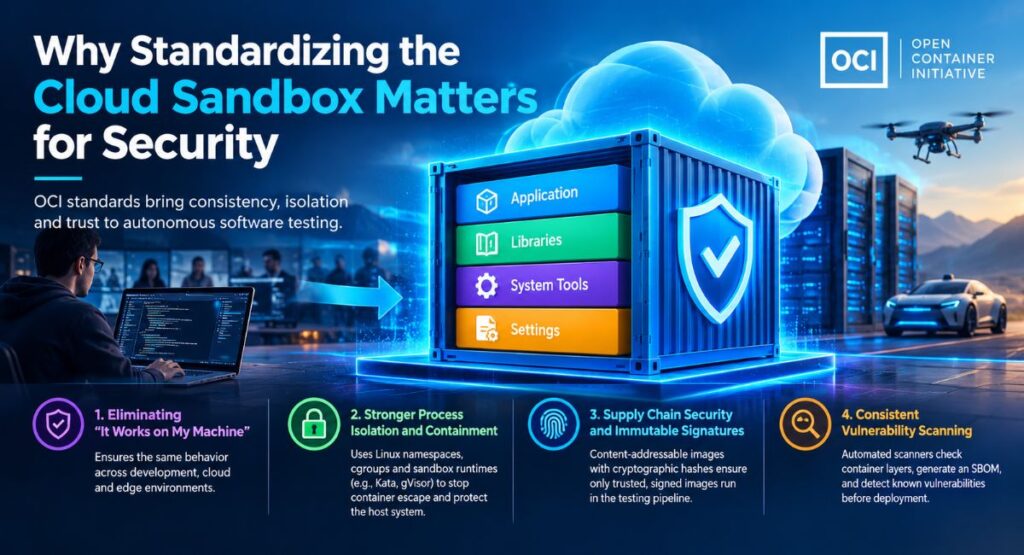
When testing autonomous software, using non-standardized or custom sandbox environments creates significant security risks. Standardizing cloud sandboxes using OCI specifications provides distinct security and operational advantages.
1. Eliminating It Works on My Machine Vulnerabilities
Autonomous software development involves multiple teams: AI researchers building vision models, embedded systems engineers writing motor controller code, and cybersecurity analysts scanning for bugs.
Without OCI standards, a container might run securely on a developer’s laptop but fail or expose security vulnerabilities when moved to a cloud testing sandbox or deployed to an edge processor on a drone. OCI compliance ensures that the software container behaves predictably across every environment.
2. Stronger Process Isolation and Containment
A sandbox is only effective if its boundaries remain secure. If a malicious actor injects code into an autonomous system’s update file, that code might attempt to escape the container in a cyberattack where malware breaks out of the container to compromise the underlying host operating system.
OCI runtime standards mandate strict isolation mechanisms, such as Linux namespaces (which restrict what a container can see) and cgroups (which restrict resource usage like CPU and RAM). Advanced sandboxed container runtimes (such as Kata Containers or gVisor) integrate with OCI standards to add lightweight virtualized boundaries. This ensures that even if an autonomous code test fails or encounters malware inside the sandbox, the host cloud infrastructure remains unaffected.
3. Supply Chain Security and Immutable Signatures
Software supply chain attacks occur when hackers tamper with code during development before it reaches the end user. In autonomous vehicles, compromised code could affect critical functions like navigation or braking systems.
OCI image specifications solve this through content-addressable storage. Every OCI container image receives a unique cryptographic hash digest based on its exact contents.
- If a single character in the code is modified, the cryptographic signature changes completely.
- Cloud sandboxes can be configured to execute only container images signed with trusted cryptographic keys.
- Unverified or altered container images are rejected automatically before entering the testing pipeline.
4. Consistent Vulnerability Scanning
Because OCI container images follow a standardized, predictable format, automated security scanners can inspect the internal layers of a container before execution.
Scanners generate a Software Bill of Materials (SBOM), which acts as an ingredient list for the application. If an open-source library inside an autonomous driving module has a known vulnerability, the security scanner detects it immediately inside the sandbox, preventing unsafe code from deploying to physical vehicles.
How OCI Cloud Sandboxes Protect Autonomous Tech: A Practical Example
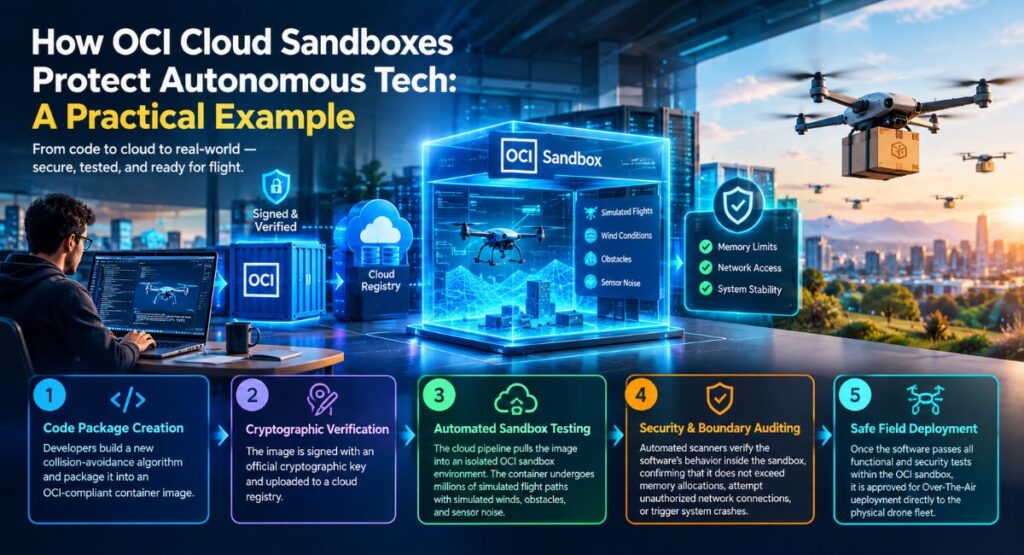
To visualize this process, consider how a real-world company deploys an Over-The-Air (OTA) update to a fleet of delivery drones:
- Code Package Creation: Developers build a new collision-avoidance algorithm and package it into an OCI-compliant container image.
- Cryptographic Verification: The image is signed with an official cryptographic key and uploaded to a cloud registry.
- Automated Sandbox Testing: The cloud pipeline pulls the image into an isolated OCI sandbox environment. The container undergoes millions of simulated flight paths with simulated winds, obstacles, and sensor noise.
- Security & Boundary Auditing: Automated scanners verify the software’s behavior inside the sandbox, confirming that it does not exceed memory allocations, attempt unauthorized network connections, or trigger system crashes.
- Safe Field Deployment: Once the software passes all functional and security tests within the OCI sandbox, it is approved for Over-The-Air deployment directly to the physical drone fleet.
The Future of Autonomous Security and Open Standards

As autonomous technology continues to evolve, standardizing cloud environments will play an increasingly vital role. Future developments include:
Edge-Cloud Integration
Autonomous systems rely on a hybrid architecture where initial AI models are trained in the cloud and then deployed to edge processors on vehicles. OCI standards bridge this gap by ensuring identical software performance on cloud servers and vehicle hardware.
Regulatory Compliance
Governments and transportation safety agencies are establishing stricter cybersecurity frameworks for autonomous transport. Standardized OCI sandbox testing provides verifiable audit logs that help organizations demonstrate compliance with safety standards.
Confidential Computing
Combining OCI container standards with hardware-level memory encryption allows autonomous software to process sensitive navigation and user data securely inside cloud sandboxes without exposing it to the cloud provider.
Conclusion
Autonomous technology holds immense promise for transforming transportation, logistics, and industry. However, achieving widespread public trust requires robust security measures at every stage of software development.
Cloud sandboxes provide a safe, isolated testing environment to evaluate autonomous AI systems, analyze edge cases, and discover software vulnerabilities before code reaches physical machines. By standardizing these environments with OCI container standards, the technology sector ensures that containerized software remains portable, secure, tamper-proof, and isolated from cyber threats.
Through open standards and cloud security protocols, developers can safely build the future of autonomous systems.