
If you have opened a tech news feed or watched a coding video recently, you have probably heard the bold claims: Programming is dead, or AI tools will replace all developers by next year. Artificial intelligence tools like ChatGPT, GitHub Copilot, and Claude can write working code in seconds. You ask for a button, a login screen, or a database query, and the code appears right before your eyes. To a beginner, it feels like magic. It makes you wonder: Is it still worth learning tech if AI can write all the code for us?
Here is the truth that the hype misses: AI can generate lines of code, but it cannot design systems. Writing code is only a small piece of building successful technology. The real magic lies in systems knowledge: understanding how different pieces of technology connect, communicate, scale, and stay secure.
In this article, we will cut through the noise. You will learn why code generation is just a tool, why systems thinking is your ultimate super-skill, and how you can position yourself to thrive in the modern tech era.
The Big Shift: From Code Writers to System Builders

For decades, getting into tech meant learning syntax. You spent hours memorizing commands, fixing missing semicolons, and figuring out how to write loops in Python, JavaScript, or C++. Writing code manually was the main bottleneck of software creation.
AI tools are fantastic at syntax. They act like hyper-fast assistants that draft boilerplate code instantly. But generating code and building a reliable software product are two entirely different things.
The Difference Between Coding and Systems Knowledge
To understand why systems knowledge wins, let us look at a simple everyday analogy.
- An AI tool can give you hundreds of high-quality bricks in seconds.
- It is knowing how to build a stable, safe, and comfortable two-story house using those bricks.
If you stack thousands of bricks without a blueprint, foundation, or plumbing layout, the house will crumble. In the digital world, a pile of AI-generated code without a solid system architecture turns into buggy, slow, and unmaintainable software.
| Feature | AI Code Generation | Systems Knowledge |
| Primary Focus | Writing individual functions & scripts | Designing end-to-end applications |
| Main Strength | Speed, automation, and instant syntax | Security, scalability, and problem-solving |
| Context Awareness | Limited to small snippets or local files | Sees the full business and user context |
| Long-Term Value | Easily automated by newer AI models | Irreplaceable human reasoning and design |
4 Reasons Why Systems Knowledge Always Beats Code Generation
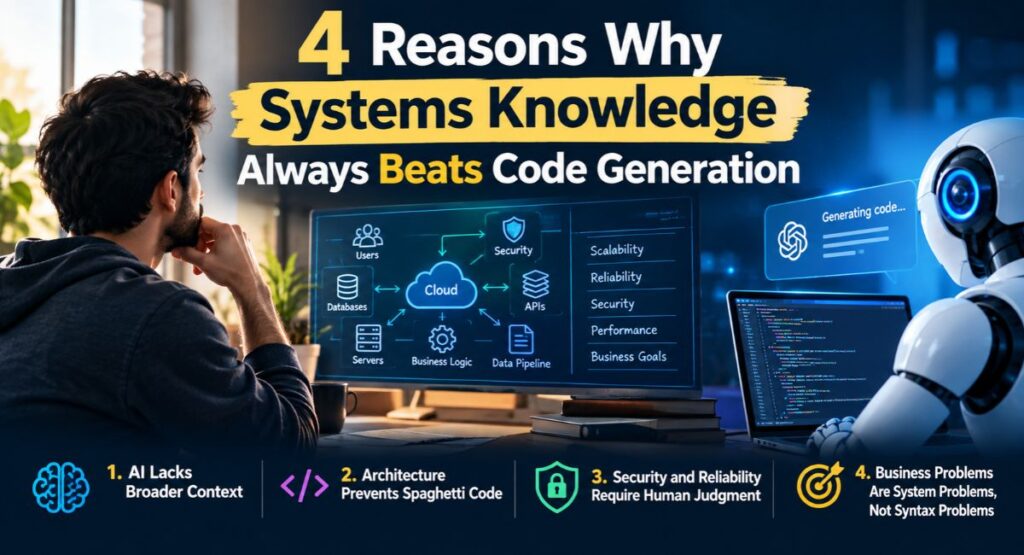
Why does understanding the big picture matter more than generating fast code? Let us explore four core reasons.
1. AI Lacks Broader Context
AI tools operate on patterns, not real-world understanding. When you prompt an AI to write a script, it generates code based on statistical probabilities. It does not know:
- How many users will visit your app at the same time.
- What security regulations your company must follow.
- How this code connects with legacy databases built ten years ago.
A developer with systems knowledge knows how to feed the right context to the AI, evaluate its suggestions, and place the code into a larger infrastructure safely.
2. Architecture Prevents Spaghetti Code
When beginners rely 100% on AI code generation, they often copy and paste snippets from multiple prompts. At first, everything seemed fine. But as the app grows, these isolated pieces start clashing.
This creates what engineers call spaghetti code: a tangled mess where fixing one small bug breaks five other features. Systems thinkers design clean boundaries, application programming interfaces (APIs), and data pipelines so that software stays organized no matter how big it gets.
3. Security and Reliability Require Human Judgment
AI models regularly generate code with hidden security flaws, outdated libraries, or inefficient queries. An AI will happily write code that works on your laptop but crashes the moment 1,000 real customers try to buy a product on your site.
Systems knowledge allows you to ask the critical questions:
- Where is customer data stored, and is it encrypted?
- What happens if our cloud server goes offline for 10 minutes?
- How do we recover lost data?
AI cannot answer these questions for your specific business; only human system designers can.
4. Business Problems Are System Problems, Not Syntax Problems
Clients and companies do not hire developers just to write loops. They hire people to solve real business challenges like reducing application load time, automating customer support, or building an online store.
Translating a messy human business goal into a structured digital system is a problem-solving skill. Once the system is designed, AI can help write the code faster, but the strategic design comes entirely from human critical thinking.
What Does Systems Knowledge Actually Mean for Beginners?

If you are new to the technology space, terms like system architecture or systems thinking might sound intimidating. But you do not need a computer science PhD to master the fundamentals.
Here is a simple breakdown of the core building blocks of systems knowledge:
- Frontend & User Interface (UI)
What the user sees and interacts with (buttons, forms, screens).
- Backend & Application Logic
The invisible brain of the app that processes data, checks passwords, and runs calculations.
- APIs (Application Programming Interfaces)
Digital bridges that let different software services talk to each other (e.g., connecting a shopping cart to PayPal).
- Databases
Where information lives permanently (user profiles, product lists, order history).
- Infrastructure & Cloud Services
The remote servers (like AWS or Google Cloud) where your application runs 24/7.
Systems knowledge means understanding how these parts interact. When you understand data flow, you can orchestrate AI tools to write code for each layer while keeping the whole map in mind.
How to Learn Systems Thinking as a Beginner (Step-by-Step)
If you are starting your tech journey today, do not waste hundreds of hours memorizing raw code syntax. Instead, combine basic coding knowledge with systems thinking.
Step 1: Learn How the Internet Works
Before touching an AI prompt, learn the web basics:
- How domain names (DNS) point to server IP addresses.
- How client-server requests work (HTTP methods like GET, POST).
- What APIs are and how JSON data travels across the web.
Step 2: Build End-to-End Micro Projects
Instead of making simple Hello World exercises, build complete, working projects from start to finish:
- Build a simple contact form.
- Send the form data to a server.
- Store that data in a database.
- Retrieve and display that data on a dashboard.
Using AI to help write the code for these steps is completely fine! Focus your learning on how the steps connect rather than typing every character yourself.
Step 3: Practice Prompting with Architecture
When using AI tools like ChatGPT or Copilot, stop asking for isolated snippets. Instead, describe the entire system context in your prompts.
Weak Prompt: Write a Python script to save user data.
Systems-Oriented Prompt: I am building a web app using Node.js and PostgreSQL. Write a secure user registration handler that hashes passwords, checks for duplicate email addresses, and returns a clean JSON error response if validation fails.
Notice the difference? The second prompt gives the AI clear system boundaries, security rules, and structural context.
The AI-Augmented Developer: Your Future Superpower

The emergence of AI does not mark the end of tech careers; it opens up a massive opportunity. In the past, a single developer spent 80% of their time writing code syntax and 20% designing solutions. Today, AI flips that ratio. You can spend 80% of your energy on problem-solving, product design, and system architecture, while letting AI handle the routine coding tasks.
These will not replace developers who master systems knowledge. Instead, they will use AI as a force multiplier to build software faster, smarter, and more securely than ever before.
Conclusion
It is easy to get caught up in the AI hype cycle. Automated code generation is impressive, fast, and undeniably useful. But code alone has never been the true engine of technological progress.
If you are a beginner entering the tech world today, do not fear AI tools. Embrace them. Treat AI as your tireless junior assistant, but step up to become the architect. Focus on understanding how software fits together, how data moves, and how systems solve human problems.